
Official website snapshot
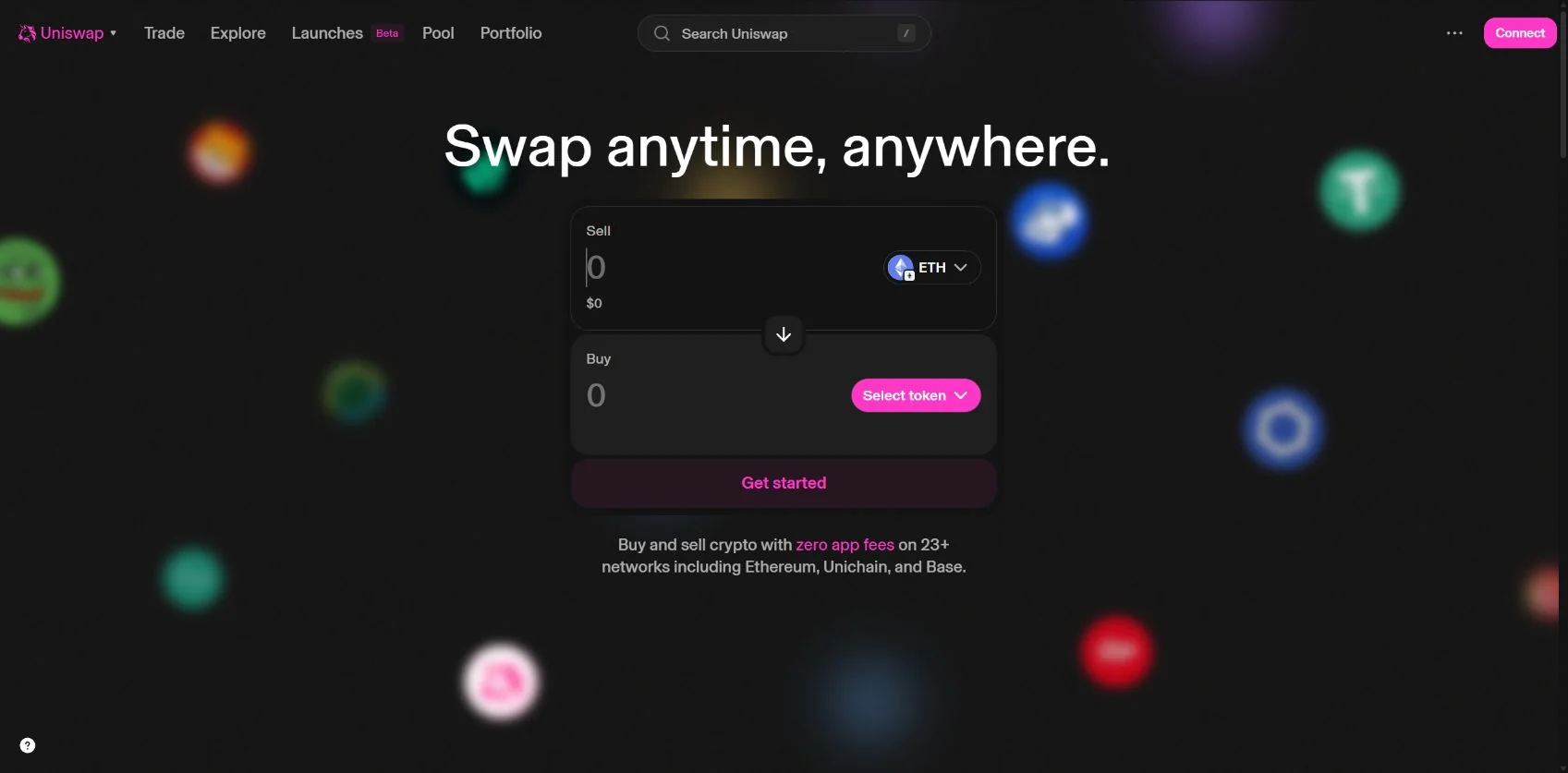
Products and key facts
The Uniswap protocol is distinct from the Uniswap Labs interface. Pools, LP positions, hooks and interface services have separate roles.
Uniswap · AMM token swaps
- Execution
- Pool-based execution. V2 uses a full-range pool; v3 and v4 support concentrated liquidity, with v4 adding custom hooks.
- Networks
- Documented settlement examples: Ethereum. Coverage is a researched subset, not a complete network inventory.
- Funds & control
- Users authorise wallet transactions and contracts. Tokens committed to an LP position have pool exposure, unlike an untouched wallet balance.
- Fees
- V2 pools charge 0.30%. V3 fees depend on the pool tier; v4 can use configurable or dynamic fees. Protocol, hook, interface and network charges need their own scope.Scope: Uniswap · AMM token swaps · checked 2026-11-24
- Access
- Interface terms and transaction screening apply. Third-party fiat purchases have separate verification and eligibility rules.
What happens when you swap
The trade interacts with pool reserves rather than placing a conventional buy order against a central exchange account. A larger trade relative to usable liquidity changes its own execution price.
The right starting point is the exact token contract and network. An asset with a familiar ticker can still be a different contract, and a visible pool is not a token endorsement.
Official reference ↗V2, v3 and v4 in practical terms
V2 supplies a simpler full-range pool model. V3 allows liquidity providers to concentrate capital within a price range; v4 adds programmable hooks and more flexible fee behaviour. A user should identify the pool and hook, not just the version badge.
A concentrated pool can have substantial aggregate deposits while little liquidity sits near the current price. That distinction matters to both swaps and LP positions.
Official reference ↗Read the quote as a complete transaction
The pool fee is not necessarily the only charge. Protocol and hook mechanics can apply, and the interface or execution route can have separate terms. Add the network cost of approvals and the swap where applicable.
For illustration, a single $1,000 v2 pool swap has a $3 pool-fee component, while $25,000 gives $75. Those calculations omit execution impact, gas and any additional charges; they are not final quotes.
Official reference ↗Official reference ↗LP positions are a separate product decision
Providing liquidity changes your asset exposure. In concentrated liquidity, a position outside its range stops earning swap fees until the market re-enters that range. Fee income alone is not a measure of profitability.
Compare the LP result with simply holding the same assets, including rebalancing and transaction costs. A swap review cannot establish an expected yield for a pool.
Official reference ↗When an aggregator may be preferable
If you are unsure which pool should handle the trade, compare a routed quote through 1inch or another relevant aggregator. Use the same amount and include every fee in both outcomes.
An aggregator using Uniswap liquidity is not a different token market by definition; it is another way to find and execute a route.
Official reference ↗Security and significant incidents
Uniswap · AMM token swaps: Core protocol, router, hook, token and interface risks differ. A verified core contract does not establish that every custom hook or token is safe.
This short review has not established a complete incident history. An audit reference or a missing incident entry is not a guarantee against loss.
Sources and check dates
A source check is not a personal trading, withdrawal or support test. Exact quotes, pool versions and market parameters can change. No score is assigned where comparable evidence is incomplete.