
Official website snapshot
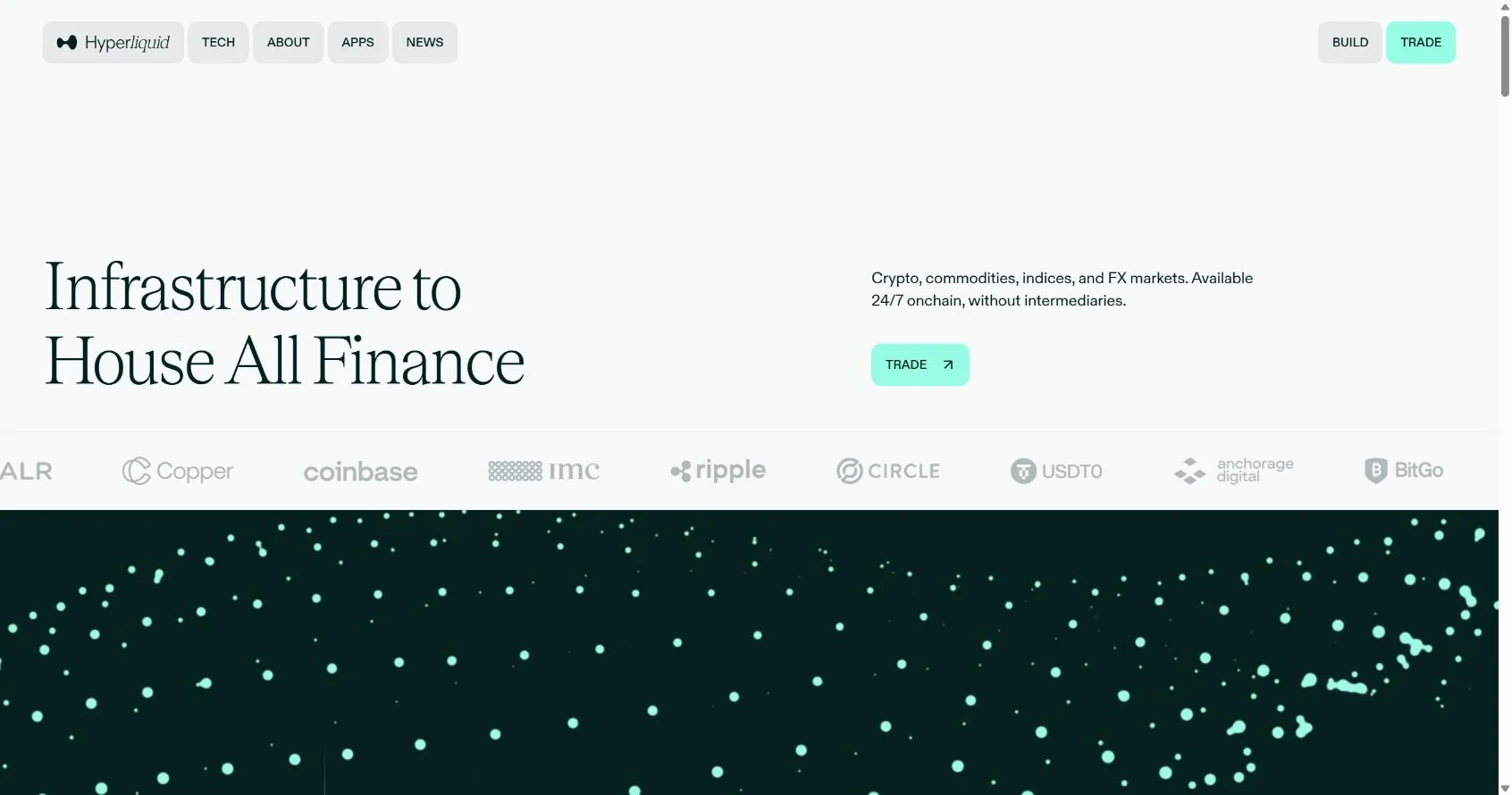
Products and key facts
Hyperliquid is an L1. HyperCore runs spot and perpetual order books; HyperEVM is its general-purpose smart-contract environment. The two are parts of one ecosystem, with different interactions.
Hyperliquid · base perpetuals
- Execution
- Orders, fills and liquidations run through HyperCore. HIP-3 markets add deployer-specific parameters.
- Networks
- Documented settlement examples: Hyperliquid. Coverage is a researched subset, not a complete network inventory.
- Funds & control
- Collateral is held in the protocol trading account; control of a connected wallet does not remove margin, bridge or validator dependencies.
- Fees
- Base tier: 0.015% maker / 0.045% taker. Funding and execution are additional; 14-day volume, HYPE staking, quote asset and HIP-3 fees can change the schedule.Scope: Hyperliquid · base perpetuals · checked 2026-11-24
- Access
- Interface terms and transaction screening apply. Third-party fiat purchases have separate verification and eligibility rules.
Hyperliquid · base spot
- Execution
- Native spot order books; a spot purchase changes the asset held rather than creating a perpetual position.
- Networks
- Documented settlement examples: Hyperliquid. Coverage is a researched subset, not a complete network inventory.
- Funds & control
- Spot balances sit on HyperCore. HyperEVM transfers and third-party deposit routes are separate operations.
- Fees
- Base tier: 0.040% maker / 0.070% taker. Quote-asset schedules, staking, volume and builder fees can modify the rate.Scope: Hyperliquid · base spot · checked 2026-11-24
- Access
- Interface terms and transaction screening apply. Third-party fiat purchases have separate verification and eligibility rules.
What the architecture changes
HyperCore handles trading state; HyperEVM supports applications. Connecting an EVM wallet is an access method, not evidence that a margin balance remains an ordinary Ethereum wallet balance. Match the asset, account and transfer destination before funding.
The useful difference from a simple swap DEX is the persistent trading account: open orders, collateral and positions continue to matter after a transaction is signed.
Official reference ↗Official reference ↗Fees: distinguish the four parts
A perpetual trade has entry and exit trading fees, execution costs, funding during the hold and any applicable transfer or builder charges. The published base maker/taker schedule is only the first part.
For an illustrative $1,000 position opened and closed as taker at an unchanged notional, the base trading fees are $0.90. At $25,000 they are $22.50. These are arithmetic scenarios, excluding funding and every other cost, not executable quotes.
Official reference ↗Margin, funding and forced exits
Funding is exchanged between position holders hourly and can be a debit or credit. Its direction and amount can change during a holding period. A displayed rate is not a fixed borrowing offer.
Liquidations first use the book; backstop arrangements through the liquidator vault can take over positions. Cross and isolated margin expose different balances. A stop order is an instruction whose actual fill still depends on execution conditions.
Official reference ↗Official reference ↗HIP-3 and vaults need their own decision
Builder-deployed perpetual markets have their own deployer responsibilities and configurable parameters. Inspect the market operator, oracle and fee additions instead of applying one base-market label to everything on the screen.
A vault is also a separate exposure from placing your own trade. A strategy can incur trading or liquidation losses. Treat a historical return as an observation, not an expected yield.
Official reference ↗Who should shortlist it
It is most relevant to users comparing on-chain perpetual execution, order types and active position management. A beginner who simply wants to own a token may find a spot route easier to evaluate.
Compare a chosen book against Lighter, Aster or an eligible CEX using the same notional, holding period and collateral assumptions. This short review does not claim a live liquidity winner.
Official reference ↗Security and significant incidents
Hyperliquid · base perpetuals: Audits and public chain state answer different questions from a corporate reserve attestation. Inspect validator, bridge, oracle and HIP-3 deployer powers.
Hyperliquid · base spot: Assess the exact contracts, authorisations and settlement path. This review does not independently certify their security or a complete incident history.
2025-03-26 · JELLY market manipulation and validator intervention
A community on-chain timeline records liquidation stress involving JELLY perpetuals and the HLP mechanism, followed by validator-led delisting and settlement. This was a market-mechanics event, rather than a demonstrated private-key theft.
The timeline records an operator commitment to reimburse unflagged users. This short review does not establish completed individual payments or reproduce the full loss calculation.
market integrity / governance · Independent community transaction analysis, explicitly distinct from an official security audit. The linked original operator post was inaccessible during this check.
Community on-chain incident analysis; not an operator audit · checked 2026-11-24Sources and check dates
- Hyperliquid architecture ·
- Hyperliquid onboarding and transfers ·
- Hyperliquid fee schedules ·
- Hyperliquid funding ·
- Hyperliquid liquidations ·
- HIP-3 markets ·
- Hyperliquid audit references ·
- Community on-chain incident analysis; not an operator audit ·
A source check is not a personal trading, withdrawal or support test. Exact quotes, pool versions and market parameters can change. No score is assigned where comparable evidence is incomplete.