
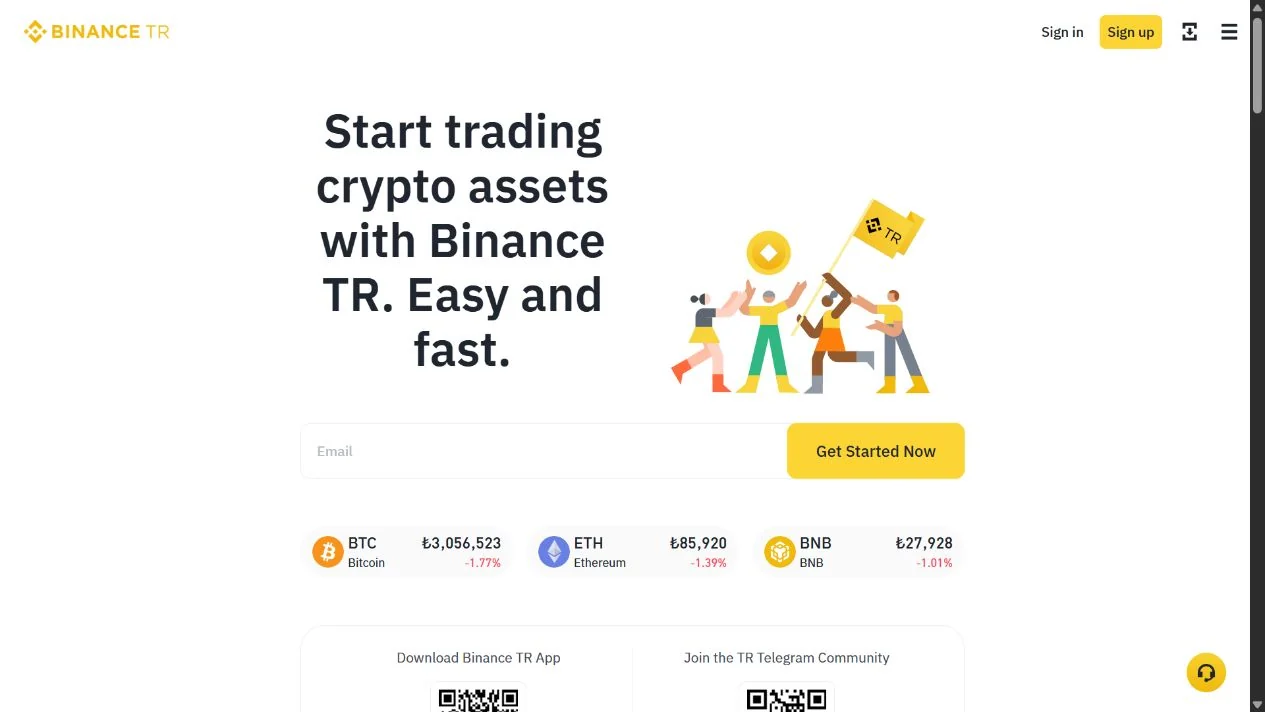
Binance TR is a Turkish-lira service with its own customer agreement. It is not the US version of Binance and should not inherit the global platform’s fees, product permissions or regulatory history without checking the local entity. The agreement names Binance Turkey Kripto Varlık Alım Satım Platformu A.Ş. Local agreement.
This is a documentation audit of the local account, TRY funding, verification and available public fee evidence. It is not a technical security audit or a personal transaction test. One limitation is central: the public fee page’s dynamic trading-rate rows did not load in the retrieved version. This article therefore does not invent an entry-level spot percentage or copy Binance.com’s tariff. Public fee page.
1. What the audit establishes
| Question | Verified public evidence | Remaining boundary |
|---|---|---|
| Local contracting provider | Named Turkish company in the customer agreement | Not Binance.US or a universal global account |
| TRY transfers | Public fee page says TRY deposits and withdrawals are free | Sending-bank, eligibility and operational conditions remain separate |
| Trading commission | Account-specific tier framework is shown | Current percentage rows did not load; obtain an account quotation |
| Identity | Original identity and supporting information required | Account approval is not guaranteed |
| Non-resident documentation | Agreement mentions foreign tax/social-security identifiers | That clause is not automatic US/EU onboarding permission |
| Historical controversy | Local advertising-board decision identified | Advertising ruling is not a wallet-loss or criminal conviction |
Sources: agreement, fees, advertising-board record.
2. Why the local entity matters
The Turkish agreement defines the platform and the services it may provide under local rules. It also addresses access to third-party services separately. Seeing a route associated with the wider Binance ecosystem does not make every global product a service of the Turkish company. Scope of services.
For a TRY-based customer, the local bank relationship can be the main reason to investigate Binance TR. For a US or EU reader without an eligible Turkish account and bank route, the same feature may have little practical value. The right first comparison is the usable regional product, not the shared logo.
This distinction also protects the incident history. A case against a global Binance entity or a global security event should not be relabelled a local Turkish customer loss without evidence connecting the event and entity.
3. TRY deposits and withdrawals
The public fee page states that Turkish-lira deposits and withdrawals are free. That is the platform’s published transfer-fee statement. It does not promise that a sending bank, intermediary or currency conversion costs nothing, or that every incoming payment will be accepted. Transfer section.
The agreement’s fiat-transfer provisions require the appropriate customer account and banking information. Use the current same-name bank instructions and supported method. A third party’s payment, a mismatched name or a transfer from an unsupported route can trigger a different process from an ordinary accepted deposit. Account and transfer provisions.
A customer starting with EUR or USD should also price the conversion into TRY. A free TRY deposit is not the same as a free EUR-to-TRY conversion. Likewise, returning to a foreign bank currency adds a separate exit conversion that does not appear in the local trading commission.
4. What can be said about trading fees?
The public fee page separates TRY-pair and crypto-pair tiers, using different volume denominations. It describes 30-day volume evaluation at 03:00 and tier/rate updates at 04:00. The retrieved tables themselves returned no records, so their current numeric rates were not verified. The page did not establish a timezone in the extracted lines used here. Fee framework.
The same incomplete rendering contained BNB discount labels with placeholder-looking zero/100 values. Those are not usable tariff evidence. It would be misleading to publish them as a 100% discount or to replace them with the familiar global Binance discount without local confirmation.
The missing input is specific and reviewable: obtain the signed-in rate for the exact local pair, tier and fee-payment setting. Until then, the calculator should leave the trading fee unknown rather than present a precise but unsupported total.
5. How to calculate the route once the rate is known
| Component | Input to obtain | Calculation |
|---|---|---|
| Foreign currency to TRY | Bank/provider executable conversion quote | Starting currency paid versus TRY received |
| TRY deposit | Published exchange charge: zero for the described route | Add any separate sending-bank charge |
| Trade | Actual local maker/taker percentage and executed notional | Notional × rate ÷ 100 |
| Price cost | Spread and depth for the exact pair and amount | Compare actual fill with the chosen benchmark |
| Crypto withdrawal | Asset, network, fee and minimum | Use the current destination-compatible route |
| Or return to cash | Sale fee, TRY withdrawal and any FX conversion | Use the later sale notional and actual bank quote |
Only the relevant branch should be included. A customer withdrawing the acquired coin should not also be charged for a hypothetical sale back to TRY. Conversely, a cash round trip needs both trading legs and any currency conversions.
No numeric example is presented as a current Binance TR quote while its local commission is unverified. That is more useful than a total whose apparent precision comes from importing another entity’s tariff.
6. KYC and customer information
The agreement requires original identity information and supporting documents and allows additional checks. It describes verification against Turkish official identity records and addresses remote customer identification under the applicable framework. The provider is not obliged to open an account before completing the necessary checks. Identity provisions.
Where a customer is resident outside Turkey, the document also mentions the tax identification or equivalent social-security number issued by the country of residence. This is a documentation provision. It does not say that any non-resident from every country will be accepted.
For a company, representative or other special account arrangement, authority and additional identity checks matter. An authorised representative’s information cannot simply be replaced with the personal details of an unrelated ordinary retail applicant.
7. US and EU readers: three separate questions
| Question | Why it matters | What this audit concludes |
|---|---|---|
| Does the local provider accept this applicant? | Residence, nationality, identity and product policy can differ | Non-resident document clauses alone do not establish acceptance |
| Can the applicant use the TRY bank route? | A working local payment path is central to the proposition | Foreign-currency support elsewhere in the group is irrelevant |
| Is the proposed service permitted for the reader’s location? | Local Turkish compliance does not create US-state or EU permission | No general US or EU retail availability is asserted |
Source: local agreement. A US version should be investigated through Binance.US as a separate product, while an EU decision requires the actual provider and current country/product permission. A Turkish company name or lira market does not answer either of those questions.
8. Crypto transfers and ecosystem links
The static fee text says transfers between Binance.com and Binance TR are free. It also says network withdrawal fees may change. That statement does not remove eligibility checks at both ends or establish that every asset/network and internal-transfer method is supported. Public transfer information.
Before moving assets, compare the exact receiving instructions. A network withdrawal and an internal ecosystem transfer are different routes. Use the live account’s available method, fee, minimum and any additional security or compliance waiting period.
The agreement allows further security steps and restrictions for address-list and account operations. This article does not invent one universal release time or promise an immediate withdrawal after every deposit. Operational provisions.
9. A local advertising controversy
The Turkish Advertising Board’s 11 December 2025 bulletin, meeting 364, case 2025/435, names Binance Turkey and examines website/X promotions using a national-pride claim, including a TRY 35 million reward-pool campaign. The board found the unsupported wording misleading and ordered the advertisements stopped. Official bulletin, page 9.
That is a concrete local regulatory record, and its scope should remain concrete. It is an advertising decision, not a criminal founder conviction, a finding that client wallets were stolen or a determination of the platform’s current licence status. The case paragraph does not impose a monetary fine, so none is invented here.
The final outcome of any later appeal or compliance process has not been independently verified in this audit. The dated board decision is the finding supported by the retrieved primary document.
10. Hacks and wider-group cases
This audit does not establish a separately verified major wallet-theft total for the local Turkish entity. That is not a “never hacked” guarantee. It also does not transfer losses or penalties from a different Binance business into the local incident table merely because the brands are related.
The practical security assessment still includes account authentication, withdrawal controls, the legal custodian and the possibility of service interruption. Those questions need actual current evidence. A logo, a large global user count or a free-transfer promotion is not an independent security certification.
11. Strengths and limitations
For an eligible TRY-based customer, the documented free local-currency transfers and local agreement are relevant advantages to investigate. The ability to distinguish local and global services is itself important for a sound comparison.
The main evidential limitation is the unverified current spot percentage. US/EU eligibility and the reader’s actual banking route are additional gates. This audit is therefore useful for understanding the service and obtaining the missing quotation, rather than declaring it the cheapest venue from an incomplete public table.
12. Frequently asked questions
Is Binance TR the US version of Binance?
No. The local agreement identifies a Turkish provider. Binance.US is a separate product and account decision. Agreement.
Are TRY deposits and withdrawals free?
That is the static statement on the checked public fee page. Bank, conversion and eligibility conditions remain separate. Fee page.
Why is there no exact trading percentage in this audit?
The current dynamic rate rows did not load in the retrieved public page. An account-specific local quotation is needed; a global Binance rate is not a substitute.
Does the non-resident documentation clause mean all EU or US applicants are accepted?
No. A rule describing documents is not a blanket onboarding or regulatory permission. Customer agreement.
13. Final documentation finding
Binance TR should be evaluated as a local TRY account, with a named Turkish counterparty and its own tariff. The public transfer-fee statement is usable; the missing trading-rate rows should remain explicitly unverified until a current local quotation is available.
That approach also gives the history its proper scope: a verified local advertising ruling belongs in the article, while unrelated global events should not be recast as Turkish customer losses. The remaining decision is country eligibility plus a complete, executable funding and exit route.
Prepared from the dated sources listed below. This is a documentary review; no account opening, trade, support-response or withdrawal test is claimed.
Sources and check dates
- Binance Turkey customer framework agreement ·
- Binance TR public fee page; dynamic rate rows unavailable ·
- Turkish Advertising Board decision, December 2025, page 9 ·
Operator, regulatory and court records support the relevant findings; third-party market data is identified in the text. Effective dates and unresolved checks remain beside the claim.