
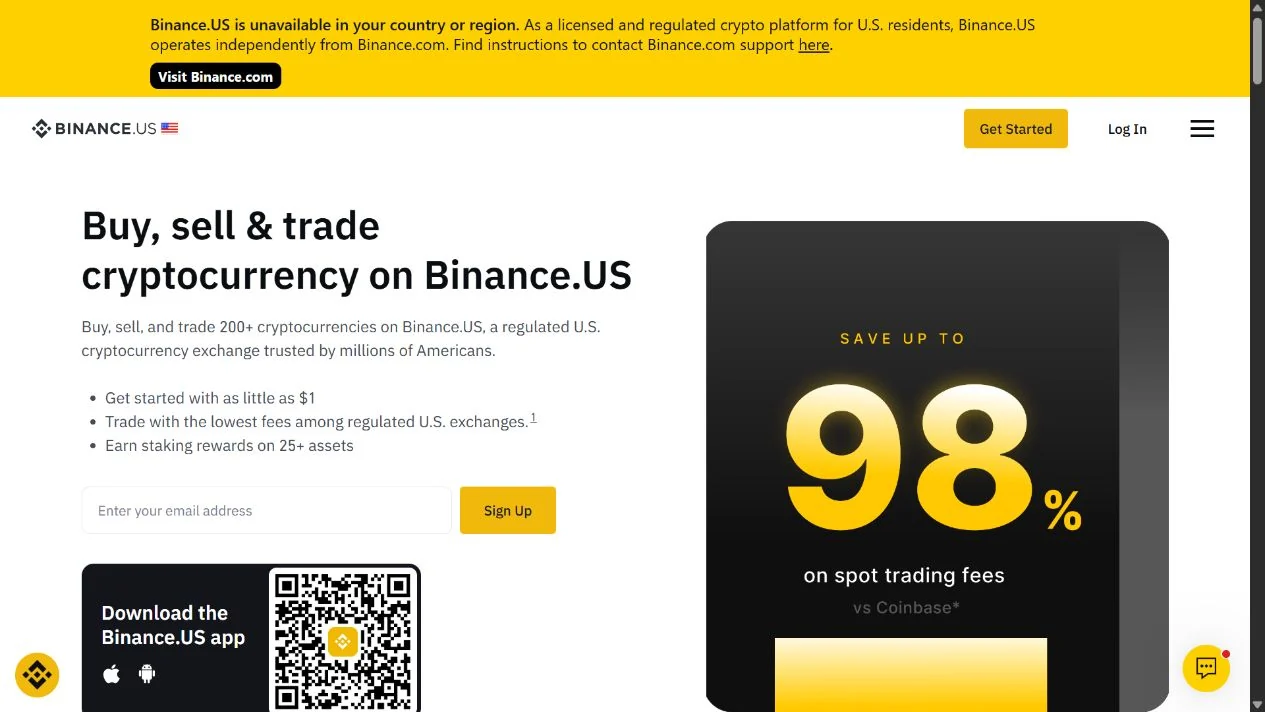
Binance.US is a US platform operated by BAM Trading Services, Inc. Its published Advanced spot commission is strikingly low: 0% maker / 0.02% taker on the ordinary row, with a separate 0% / 0.01% BNB/USD row. But a comparison becomes misleading if it stops there. State restrictions, the funding method and the withdrawal route can matter much more than a few cents of trading commission. Company identity, US fee schedule.
The brand also needs a careful legal boundary. Binance.US and Binance.com share common majority ownership according to the US company’s own description, while maintaining separate corporate or management structures. An international Binance fee discount, wallet incident or settlement is not automatically a BAM Trading account condition or a BAM loss. This overview examines the US service first and identifies group context separately.
1. Binance.US at a glance
| Topic | Published starting point | Why it matters |
|---|---|---|
| Operator | BAM Trading Services, Inc. | Separate account agreement from Binance.com |
| Launch | September 2019 | A US-specific business history |
| Regulatory identifiers | Company states FinCEN registration and NMLS 1906829 | Registration is not a government guarantee of an asset or investment |
| Advanced spot ordinary row | 0% maker / 0.02% taker | Use Advanced order-book pricing rather than a separate purchase quote |
| BNB/USD row | 0% maker / 0.01% taker | A pair-specific row, not a universal fee for every conversion |
| BNB fee-payment discount | 5% under the published US setting | Not the international 25% discount |
| USD funding | Eligible customers can use ACH following restoration of USD services | State, bank verification and settlement still matter |
| Residence | US eligibility with state/territory restrictions | An international or EEA resident cannot assume access |
| Selected order controls | Market, limit, stop-limit and linked OCO instructions | An order trigger does not guarantee a fill |
Sources: about Binance.US, fee schedule, USD service guide, access rules, order guide, OCO instructions.
2. Ownership and corporate identity
The company’s about page identifies BAM Trading Services as the US platform operator. It describes the September 2019 launch and says BAM and Binance Holdings, doing business as Binance.com, have common majority ownership with separate corporate or management structures. Both parts matter: describing the brands as completely unrelated would be inaccurate, while treating them as one account would also be inaccurate. Corporate description.
For a customer, the company named in the account agreement determines the immediate contractual relationship. A licence, fee table or security announcement from a different group company should retain that company name. The same rule applies to Binance TR and to any separate partner product offered through another service arrangement.
3. USD banking returned, but old reviews can lag
Binance.US’s guide dated 29 May 2025 states that eligible customers can deposit and withdraw USD using ACH bank transfers. That changes a common historical description of the service as exclusively crypto-to-crypto. A current assessment should use the restored service’s documentation rather than simply repeat an older banking restriction. USD restoration guide.
The word eligible is doing real work. Restoring a rail does not make it available to every state or every unverified account. The bank connection must be supported, the identity checks must be complete and the funds must be available for the intended activity. A balance that can be used to place a trade need not already be settled for external withdrawal.
For someone bringing cash into the account, this is a more important operational question than whether a small order costs ten or twenty cents. An inexpensive execution does not solve a blocked banking route. Conversely, a valid ACH route can make an otherwise small fee advantage meaningful over repeated use without requiring card funding.
4. Your state changes the available route
The official supported-state page lists California, Florida and many other states as supported. Its unsupported list includes New York, Texas, Washington, Ohio, Oregon and others. The complete list should be checked against the user’s actual residence; choosing a supported mailing address or finding the app in a store does not resolve eligibility.
Wisconsin is specifically crypto-only. The support page says residents cannot deposit USD or link bank accounts, although crypto deposits and the permitted crypto services remain available. A comparison which marks Binance.US simply “available in the US” would hide the restriction that most affects a Wisconsin bank-funded purchase.
The page also distinguishes unsupported states from states where new-user onboarding is temporarily paused. Those conditions should not be collapsed into a single status: an existing account’s access and a new applicant’s eligibility can differ. The account’s current permission controls the transaction even when a historical state list said something else.
5. What the spot commission actually covers
The published Advanced trading schedule uses the role of each execution. A resting maker fill is not charged the same way as an immediately matched taker fill. A limit order that crosses the book can still be a taker. Pair-specific exceptions and any account discount must be checked before a number is carried into a calculator. Trading fee schedule.
| Example fill | Published rate without an assumed discount | Fee on $2,000 notional |
|---|---|---|
| Ordinary Advanced spot pair, maker | 0% | $0.00 |
| Ordinary Advanced spot pair, taker | 0.02% | $0.40 |
| BNB/USD, taker | 0.01% | $0.20 |
These are arithmetic illustrations, not tested executions. They exclude spread and the cost of walking multiple price levels. They also do not price an instant Buy/Sell/Convert quote. The lowest maker rate provides no promise that a resting order will fill, or that the same number of coins can be acquired at the displayed best price.
BNB deserves particular care in comparisons. Here, BNB/USD has its own schedule. It should not inherit a global Binance BNB discount or be silently replaced with BNB/USDT. The quote asset affects both the usable balance and the market being compared.
6. A cheap trade can have an expensive deposit
The fee page lists no exchange fee for ACH deposits and withdrawals, no incoming USD wire fee, and a $25 outgoing USD wire fee. Card deposits carry 3.99%. Eligibility, limits, bank charges and holds still need a check in the account.
For an illustrative $2,000 card-funded route, applying 3.99% to the stated deposit amount produces a $79.80 funding charge. By comparison, a $2,000 ordinary-pair taker execution at 0.02% costs $0.40. Whether the card fee is added to the payment or deducted from the available balance changes the tradable amount; the confirmation screen must settle that assumption.
This is the main cost lesson of Binance.US. A low trading percentage does not make a card-funded purchase inexpensive. A bank-funded route, where supported and approved, deserves a separate calculation. For a Wisconsin resident, the USD bank route cannot be borrowed from that calculation at all.
An eventual cash exit adds the sale commission and whichever withdrawal method is used. An eventual crypto exit adds the current asset-and-network withdrawal charge. Neither route should be described as free just because the maker row is zero.
7. Basic verification already involves identity data
Binance.US’s verification guide says Basic verification asks for legal name, date of birth, SSN and a physical address; PO boxes are not accepted. It documents ACH, crypto transfers and Advanced spot among the features associated with that level, subject to the account’s actual eligibility and limits.
Advanced verification adds an identification document and facial verification. It can enable increased bank limits and OTC access. The guide accepts document categories such as a driver’s licence, state ID or passport; a user should follow the current account request rather than assume one document works in every case.
Basic therefore does not mean anonymous or “no KYC.” Nor does a successful identity check override a prohibited state. Resolve both the verification level and residence before estimating how much can move through a payment method. Personal limits are displayed in the account rather than supplied as one universal amount in this review.
8. Withdrawing the asset needs a second review
Before a crypto transfer, check the exact coin and supported network on both sides, any required memo or tag, the receiving address and the quoted withdrawal fee. A ticker alone is insufficient. A transfer on the wrong network can fail to reach the intended destination even though both platforms display an asset with the same name.
A small verification transfer can limit the amount exposed to an address or network mistake, but it does not prove that a later, larger withdrawal will have identical fees, checks or timing. This is a practical risk-control suggestion, not a test performed by Atlas or a guarantee about account review.
The withdrawal cost also changes which trading pair is useful. A low-fee BNB/USD purchase that must then be converted into another asset and transferred elsewhere is a longer transaction than the original spot fill. Model each conversion and transfer instead of treating the headline commission as the final cost.
9. Mobile use, security and product identity
The verification documentation explicitly refers to both web and mobile views for checking account limits. Those views concern the Binance.US account. Global Binance apps, Binance TR and third-party wallets do not provide interchangeable eligibility, fee schedules or customer protection. Account and limit guidance.
Use the operator’s own website to reach a download or account-support page. For API access, grant only the actions the integration needs and keep credentials out of browser code. These are operational precautions; this review has not tested the mobile interface, response times, recovery process or withdrawal execution.
For eligible US residents who can use a suitable funding route, Binance.US’s Advanced spot commissions merit a cost comparison. The conditions that can overturn that attraction are a prohibited state, crypto-only access, card funding or a costly exit. An EEA resident should compare an EEA-serving operator instead of treating a US brand suffix as a general international account option.
10. Order controls: market, limit, stop-limit and OCO
| Instruction | What it does | What can go wrong in a comparison |
|---|---|---|
| Market order | Seeks execution against available orders | The final average price can move through more than one price level |
| Limit order | Sets the acceptable price for an execution | It can remain unfilled; a crossing limit order can still take liquidity |
| Stop-limit order | Uses a trigger to activate a limit instruction | A gap can leave the activated limit unfilled |
| OCO | Links a limit order with a stop-limit order so one cancels the other | The trigger and cancellation logic do not guarantee the desired exit price |
| Cancel an open order | Removes the unfilled instruction subject to the actual state | Cancellation is not the same as reversing an execution already completed |
The OCO guide says that when one of the linked orders is fully or partially filled, the other is cancelled automatically. That makes the treatment of partial fills relevant: the linked protection should not be assumed to remain unchanged after the first execution. Read the displayed open-order state after a fill rather than rely on the original two-leg diagram. Official OCO explanation.
A stop-limit instruction is also not insurance. If a market moves through the chosen limit price quickly, the order may not execute at all. A resting maker order can lower commission, but the fee advantage must be weighed against execution timing and market movement. Market and limit guide.
11. Small commissions in dollars
| Executed notional | Maker commission | Taker commission |
|---|---|---|
| 100 USD | 0.00 USD | 0.02 USD |
| 1000 USD | 0.00 USD | 0.20 USD |
| 10000 USD | 0.00 USD | 2.00 USD |
Those ordinary Advanced examples show commission on the executed notional, with no spread, funding or withdrawal added. At the published BNB/USD 0.01% taker rate, the same $1,000 notional would incur $0.10 instead of $0.20. This is a pair-specific execution comparison, not a complete route to acquire, convert and withdraw BNB. Fee schedule.
The US fee-payment discount is 5%. Applying it to an otherwise eligible 0.02% taker rate gives 0.019%: $0.19 rather than $0.20 on $1,000. The one-cent difference illustrates why acquiring or keeping BNB solely for a very small trade needs a separate cost calculation. It does not justify importing the international 25% discount into a US estimate.
12. A funding table beside the commission
| Product and route | Currency | Deposit exchange charge | Withdrawal exchange charge | Deposit minimum | Published timing / scope | Evidence |
|---|---|---|---|---|---|---|
| Binance.US · direct BAM account / ACH | USD | No exchange fee | No exchange fee | Not established | Account/provider dependent. | Source |
| Binance.US · direct BAM account / USD wire | USD | No exchange fee | 25 USD | Not established | Account/provider dependent. | Source |
| Binance.US · direct BAM account / Debit/credit card deposit | USD | 3.99% | Not documented | Not established | Account/provider dependent. | Source |
The schedule’s card percentage is 3.99%. On a stated $1,000 amount, that percentage alone is $39.90—far larger than a $0.20 ordinary Advanced taker commission. This does not mean a card purchase should automatically be charged both rows: the purchase interface and its quote determine which charges actually apply. The comparison is between routes, not an invitation to stack unrelated fee lines. Current US tariff.
Likewise, a $25 outgoing USD wire can dominate the total cost of a small cash withdrawal. A free ACH exchange charge can be attractive where the rail is available, but unknown settlement conditions, intermediary charges or an unsuitable state should not be converted into a zero-cost guarantee.
13. State eligibility and identity verification
The documented BAM service restrictions include states such as New York, Texas, Washington, Oregon, Ohio and Maine, among other listed states and territories. Wisconsin has a different condition: crypto-only availability rather than the full documented banking route. The precise current list belongs beside the account and should not be inferred from the general phrase “US exchange.” Availability restrictions.
The identity guide describes legal-name, date-of-birth, Social Security and physical-address information for the basic route, with additional photo identification and a selfie for advanced verification. A physical address is different from a PO box. Verification levels affect supported account activity and limits; submitting documents is not the same as receiving approval. Verification guide.
For an EEA resident, a US suffix does not create international eligibility. Compare a service that actually accepts the relevant European residence and product. For a US resident, choose the state in the country tool before interpreting the trading fee or available funding route.
14. Litigation, banking history and the global Binance distinction
| Matter | Relevant company or product | Documented status / boundary |
|---|---|---|
| 2019 US launch | BAM Trading / Binance.US | Company history identifies a separate US platform |
| 2025 USD-service restoration | Eligible Binance.US accounts | US operator guide documents ACH deposits and withdrawals |
| 2023–2025 SEC litigation | Binance, BAM entities and Changpeng Zhao | SEC announced dismissal with prejudice on 29 May 2025; separate from a criminal resolution |
| 2023 US criminal resolution | Binance.com corporate case | Not a BAM Trading guilty plea merely because the brand is shared |
| October 2026 global wallet incident | International Binance service | The global notice does not, on its own, establish the same loss in a Binance.US account |
Sources: US corporate description, USD guide, SEC dismissal, DOJ corporate resolution, global incident notice.
The SEC dismissal is a real procedural outcome, but it should not be treated as a merits ruling approving every asset or business practice. The same discipline applies in the other direction: the international group’s criminal or wallet history can be relevant to evaluating a shared brand, while still requiring the correct defendant, legal entity and customer scope.
This review does not reconstruct a complete litigation docket for every affiliated company. Nor does the absence of a separately verified BAM wallet loss in the records used here establish an incident-free history. The aim is to identify the major documented matters without moving losses or findings from one company to another.
15. Custody and security statements
The US company’s about page states that customer assets are held 1:1 in US-based custody and describes SOC 2 Type II assurance. These are operator disclosures. This review did not inspect a complete SOC report or perform an independent custody reconciliation. A control report and a customer-asset reserve calculation answer different questions. Company security and custody description.
Personal account protection still matters. Use the official site to reach support or software downloads, keep authentication and recovery information secure, and check an outgoing transfer’s asset, network and destination. A low trading commission does not reduce the consequences of an irreversible transfer error.
For API use, restrict the key to the required actions. A market-data or portfolio tool should not receive withdrawal authority merely because the exchange offers that option. No trading, withdrawal or recovery test is claimed in this review.
16. Advantages, limitations and suitable users
| Potential advantage | Material condition |
|---|---|
| Very low published Advanced spot commission | The account, pair and trading interface must match the tariff |
| US-specific platform and documentation | State and territory restrictions are substantive |
| Restored USD ACH service | Not all states or unverified accounts have the same rail |
| Linked OCO and conditional order tools | Triggered instructions and partial fills require monitoring |
| Separate corporate identity from Binance.com | Common ownership means group context should still be identified accurately |
| Potentially inexpensive bank-funded small trades | Cards or an outgoing wire can dominate the commission saving |
An eligible US customer with a supported ACH route and a straightforward spot-trading need has a concrete reason to compare Binance.US. A prohibited-state resident, an international applicant or someone relying on global Binance’s broader product catalogue faces a different answer.
Compare the final outcome: dollars deposited, asset bought, asset or cash withdrawn. If a cheap pair requires another conversion to reach the desired asset, that extra step belongs in the comparison. If the intended withdrawal method is unavailable, a low maker/taker row does not complete the route.
17. Frequently asked questions
Is Binance.US the same company as Binance.com?
The US operator identifies BAM Trading Services, Inc. and describes common majority ownership with Binance.com, alongside separate corporate or management structures. The accounts and terms are not interchangeable. Company description.
Are the ordinary Advanced fees really 0% maker and 0.02% taker?
Those are the documented ordinary row in the checked US fee schedule. BNB/USD has its own row, and a separate purchase quote should not be priced from the Advanced table automatically. US fee schedule.
Is the BNB discount 25%?
The checked US fee-payment discount is 5%. The international figure belongs to another service. On a $1,000 ordinary 0.02% taker example, 5% off the commission saves one cent.
Can I deposit and withdraw USD?
The restored service guide supports ACH for eligible accounts. Residence, state, verification, bank connection and fund availability still control the actual route. USD guide.
Is Binance.US available throughout the United States?
No. The BAM availability list excludes several states and territories, and Wisconsin has a crypto-only condition. A separate partner offer must be assessed under its own current agreement and tariff. Access rules.
18. Final overview
Binance.US’s main attraction is a specific combination: low Advanced spot commissions and a usable US funding route for eligible customers. Its main constraints are equally specific: state access, account verification, the selected interface and the cost of leaving.
The corporate and incident history should be read with the same precision. Recognising the shared Binance brand is reasonable; treating every global event or product as a BAM account condition is not a sound comparison. Start with the US account, then price the complete transaction it can actually carry out.
Research checked on 23 November 2026. This is a review of official documentation; no account opening, trade, support-response or withdrawal test is claimed.
Sources and check dates
- Binance us about ·
- Binance us fees ·
- Binance us usd return ·
- Binance us access ·
- Binance us order guide ·
- Binance us oco ·
- Binance us kyc ·
- Binance sec dismissal ·
- Binance doj resolution ·
- Binance incident 2026 ·
Operator, regulatory and court records support the relevant findings; third-party market data is identified in the text. Effective dates and unresolved checks remain beside the claim.