
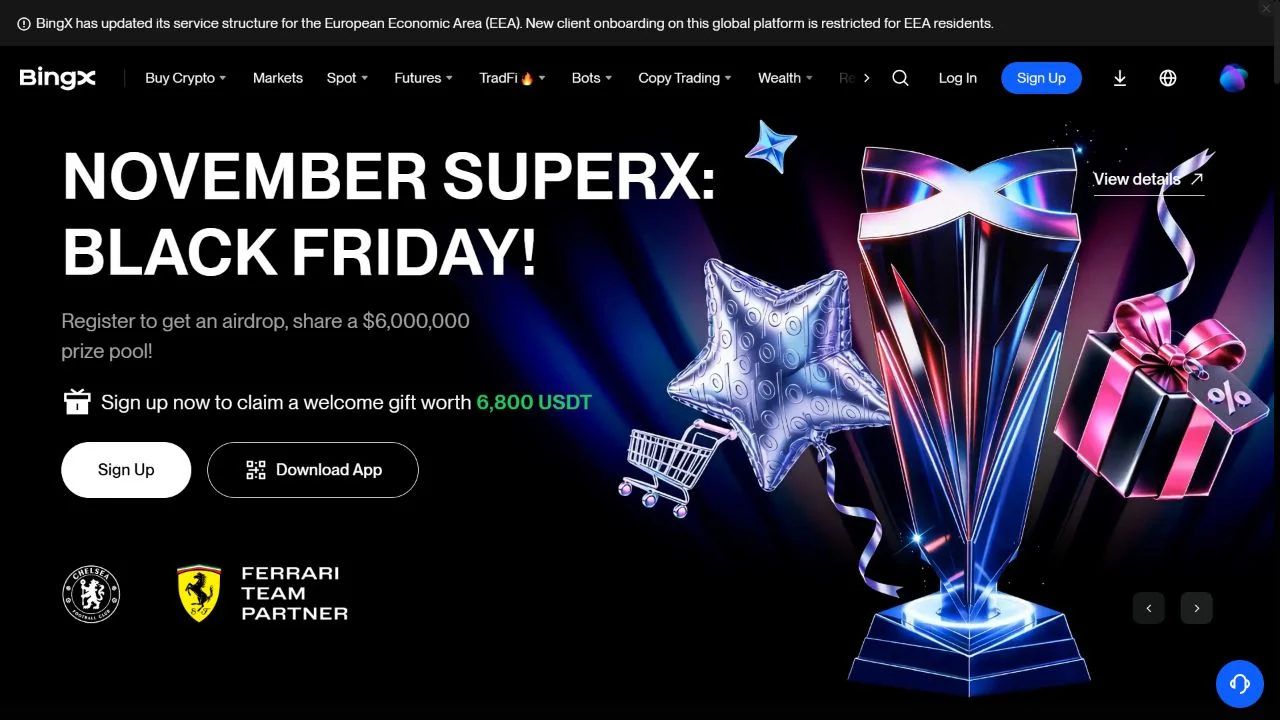
BingX is best assessed by separating an ordinary spot trade from a copied strategy. The checked VIP0 spot table shows 0.10% maker / 0.10% taker. Copy trading adds a different set of costs and operational decisions: the copied product, profit-sharing arrangement, funding, execution differences and what happens to open positions when copying stops. Spot fees, copy-trading agreement.
For US and European readers, start with access. The checked disclaimer excludes the United States, United Kingdom and Netherlands, among other jurisdictions. Its EEA-issued-card fee is not proof that every EEA resident may open or use every BingX product. Restricted jurisdictions, card FAQ.
1. At a glance: three products, three cost questions
| Activity | What the checked documentation shows | Cost or eligibility question |
|---|---|---|
| Ordinary spot | VIP0 maker and taker both 0.10% | Actual pair, VIP status and execution role |
| Perpetual copy trading | Mode-specific profit sharing and contract rules | Profit share, trading fees, funding and liquidation exposure |
| Card purchase | Visa/Mastercard; first-purchase KYC | Card issuing region, displayed quote and issuer charges |
| US / UK / Netherlands | Listed as restricted | Website visibility does not override access rules |
| Security record | September 2024 hot-wallet intrusion acknowledged | Operator compensation statements and historical restoration dates need their original scope |
Sources: fees, copy parameters, card requirements, disclaimer, incident FAQ.
2. What the platform offers
The public platform presents spot and futures categories alongside copy trading and other services. A copied strategy can involve a spot asset, a leveraged futures position or another supported product. The copy agreement explicitly sends eligibility, margin, fees, settlement and custody questions back to the applicable product terms. Public platform, copy agreement.
That is a useful way to organise the platform. “Copy trading” describes a way of generating orders; it does not identify the underlying instrument or erase its risks. A futures strategy remains a futures exposure when another trader supplies the signal.
The agreement also says the relevant provider is identified in the product terms or interface. A group brand, a card processor and a CFD provider should not be treated as one interchangeable counterparty.
3. Ordinary spot trading fees
| Executed notional | Maker commission | Taker commission |
|---|---|---|
| 100 USDT | 0.10 USDT | 0.10 USDT |
| 1000 USDT | 1.00 USDT | 1.00 USDT |
| 10000 USDT | 10.00 USDT | 10.00 USDT |
These single-execution examples use the captured VIP0 0.10% / 0.10% spot rate. A 1,000 USDT trade therefore has 1 USDT of commission before spread, market impact, payment and withdrawal costs. The current fee page directs users to account-specific rates; higher tiers and particular arrangements can differ. Official fee page.
A resting limit order can be maker, while a limit order priced to execute immediately can be taker. At VIP0 the displayed percentages are equal, but execution behaviour still matters: waiting for a resting order to fill and crossing the spread are different choices.
The ordinary spot tariff should not be applied to futures copy trading. A comparison that uses 0.10% as the complete cost of a leveraged copied position would omit both product-specific fees and the profit-sharing arrangement.
4. Profit sharing depends on the copy mode
| Public trader level | Standard Futures mode | Perpetual Futures: Per Order | Perpetual Futures: Position Ratio |
|---|---|---|---|
| Bronze | 8% | 10% | 10% |
| Silver | 9% | 16% | 16% |
| Gold | 10% | 20% | 20% |
| Diamond | 13% | 32% | 32% |
The official parameter guide displays these different public-trader rates and a 0–50% range for private arrangements in the corresponding tables. The actual parameters in use prevail if the announcement and live configuration differ. These are shares of the applicable copy profit, not annual yields or commission percentages on every trade’s notional.
The differences are large enough to matter. An article that quotes only the Standard Futures 8–13% range would understate the displayed public rates for some perpetual modes. Conversely, the top perpetual figure is not the default charge for every BingX customer.
5. A copy-trading cost example
Suppose the relevant settlement calculation produces 100 USDT of shareable profit before the trader’s profit share. A 10% arrangement allocates 10 USDT to that share; a 32% arrangement allocates 32 USDT. The remaining amounts are 90 and 68 USDT respectively, before any other costs not already included in the assumed profit measure.
This example explains the denominator. It does not predict a profitable strategy or establish how every realised/unrealised balance enters the account’s settlement formula. The actual mode’s accounting rules control. A losing copied strategy can still incur execution and financing costs even when there is no positive profit to share.
The parameter guide describes no separate copy-service fee while still requiring profit sharing. “No copy fee” therefore should not be expanded into “cost-free execution.” Mode parameters, applicable product terms.
6. Settlement timing and open positions
The parameter guide describes daily settlement for its Standard Futures table. For Perpetual Futures Per Order, it describes Monday 00:00–00:15 UTC+8, with only fully closed orders included and orders closed in a later week carried to that week’s settlement. Position Ratio also has a weekly schedule in the guide. Detailed parameters.
The practical lesson is to read the actual mode rather than assume one universal “BingX settlement day.” A position can remain open across a settlement boundary. Its unrealised value, eventual close price and profit-share timing are different pieces of information.
Stopping the copying relationship also does not necessarily close every existing copied position. The agreement places responsibility on the customer to understand and manage outstanding exposure. Before stopping, inspect open orders, positions and the product’s closing controls. Copy agreement.
7. Why a follower’s result can differ
The agreement explains that copied orders need not match the lead trader’s price, timing, size or execution. Account balance, minimum order size, leverage settings and market movement can all matter. The parameter guide also warns about copying failures where leverage permissions differ. Agreement, parameters.
A lead trader’s displayed return is therefore not a personalised forecast. Two accounts following the same strategy can enter at different times, receive different fills or carry different remaining positions. A leaderboard needs its measurement period, drawdown, leverage and selection effects to be understood before it is used as a decision aid.
Atlas does not manufacture an expert portfolio or a tested return series for this review. Any later performance comparison would need reproducible data and a clear treatment of funding, fees, closed accounts and strategies that disappeared from the ranking.
8. Card purchases: 1.5% and 3.3% describe issuing regions
| Card issuing region | Published transaction fee | Illustrative charge on a 1,000-unit fee base |
|---|---|---|
| EEA countries | 1.50% | 15 units |
| Non-EEA countries | 3.30% | 33 units |
The card FAQ supports Visa and Mastercard with 3D Secure and says KYC is required on the first purchase. It lists several fiat payment currencies and USDT as the supported crypto in that guide. The issuing region determines the displayed percentage; it is not a regulatory permission for the cardholder’s country.
The arithmetic above isolates the percentage charge. The actual amount debited and crypto received depend on the checkout quote, conversion and any card-issuer charges. A purchase paid by card is also different from first depositing cash into an exchange balance and then placing an order-book trade.
9. KYC and regional availability
The disclaimer describes customer due diligence and risk-based additional checks, including screening of beneficial owners. The card guide makes first-purchase identity verification explicit. Neither document supports presenting BingX as a universal anonymous service. Due diligence, card KYC.
| Location / context | Checked position | Interpretation |
|---|---|---|
| United States, including territories | Restricted | Do not recommend the global platform as a US account |
| United Kingdom | Restricted | English content does not create UK availability |
| Netherlands | Restricted | Do not infer availability from an EEA card tariff |
| Singapore / Canada | Also named in the list | Use the full current list |
| Other EEA country | Country and product permission require separate verification | No blanket EU licence is established by this article |
Source: current disclaimer. The document says restrictions may change and differ by service. A genuine licence or registration must be matched to the actual provider and authorised activity; a generic “regulated” badge would not resolve that.
10. Deposits and withdrawals
For an eligible customer, the usable route is the combination of accepted payment method, acquired asset and eventual withdrawal network. The public menu cannot supply one universal withdrawal fee or arrival time. Check the current account quotation, any minimum, network availability and destination requirements. Platform.
There is also a difference between funds available for trading and funds immediately available to withdraw. Identity or risk checks, an outstanding leveraged position and network maintenance can affect the exit. This review does not claim to have completed a personal deposit or withdrawal test.
11. September 2024 hot-wallet intrusion
BingX’s incident FAQ acknowledges unauthorised intrusion into a hot wallet at approximately 04:00 on 20 September 2024, UTC+8. It describes a temporary suspension of deposits and withdrawals, followed by staged restoration. Official incident FAQ.
The company said its reserves would cover the losses and customer assets would not be impaired. That is an important operator statement, but it is not the same as an independently audited loss calculation. The retrieved primary FAQ does not supply a final total that would justify copying a dollar estimate from another site’s headline.
The FAQ records restoration of selected withdrawals, including BTC and ETH, before 21 September 08:30 UTC+8, and deposit restoration on 22 September 08:30, with remaining services addressed in stages. These are historical restoration milestones. They do not confirm that every coin and network is withdrawable today.
12. What the incident does and does not show
| Issue | Supported conclusion | Unsupported shortcut |
|---|---|---|
| Hot-wallet compromise | A material security event was acknowledged | “Never hacked” |
| Company coverage statement | Operator said reserves would cover losses | Every balance independently reconciled by Atlas |
| Staged restoration | Some services returned before others | All current networks always available |
| Trading continuity claims | Company described trading as operating normally | A transfer suspension has no customer impact |
Source: company FAQ. An active trader can be affected by inability to move collateral even if the trading screen remains usable. Security history therefore belongs beside funding and withdrawal conditions, not only in an isolated badge.
No separate founder-conviction claim is manufactured from this wallet incident. A security breach, an accusation and a judicial outcome require different evidence.
13. Strengths, limitations and alternatives
BingX provides unusually detailed mode-specific copy parameters, which makes a more precise assessment possible than a single profit-share headline. Its ordinary spot fee is also easy to model at VIP0. The trade-off is complexity: underlying contracts, lead-trader economics, settlement rules and follower execution all need separate attention.
For US readers and users in explicitly restricted European locations, eligibility ends the shortlist discussion first. Elsewhere, compare an ordinary spot venue with BingX spot, and a legally available derivatives product with the corresponding BingX contract. Comparing an unrelated retail instant-buy quote with a copied perpetual position would answer neither question well.
14. Frequently asked questions
Does BingX charge only 8–13% for copy trading?
That range appears in one Standard Futures table. The guide displays 10–32% public rates for the specified perpetual modes, with private arrangements separately configured. Parameters.
Does stopping copy trading automatically remove my exposure?
Do not assume it. The agreement warns that existing positions can require separate management. Agreement.
Is an EEA-issued card proof that I can use BingX in the Netherlands?
No. The card tariff describes a payment charge; the disclaimer lists the Netherlands as restricted. Card guide, country restrictions.
Has BingX experienced a major security incident?
Yes. Its official FAQ acknowledges the September 2024 hot-wallet intrusion and staged transfer restoration. Incident record.
15. Final assessment
The useful BingX comparison is specific: ordinary spot costs are one calculation, while copying a leveraged strategy is a separate product decision. Profit sharing, follower execution and open-position management deserve as much attention as the lead trader’s displayed return.
Country eligibility and the 2024 security history also belong in the decision. The platform’s own documents support a detailed assessment, but they do not support guaranteed performance, blanket EU access or a claim that every trading activity costs only the spot commission.
Prepared from the dated sources listed below. This is a documentary review; no account opening, trade, support-response or withdrawal test is claimed.
Sources and check dates
- BingX current ordinary spot fee schedule ·
- BingX copy-trading agreement and disclaimer ·
- BingX customer due diligence and restricted jurisdictions ·
- BingX bank-card fees and identity requirements ·
- BingX mode-specific copy-trading parameters ·
- BingX September 2024 incident and restoration FAQ ·
- Bingx home current ·
Operator, regulatory and court records support the relevant findings; third-party market data is identified in the text. Effective dates and unresolved checks remain beside the claim.