
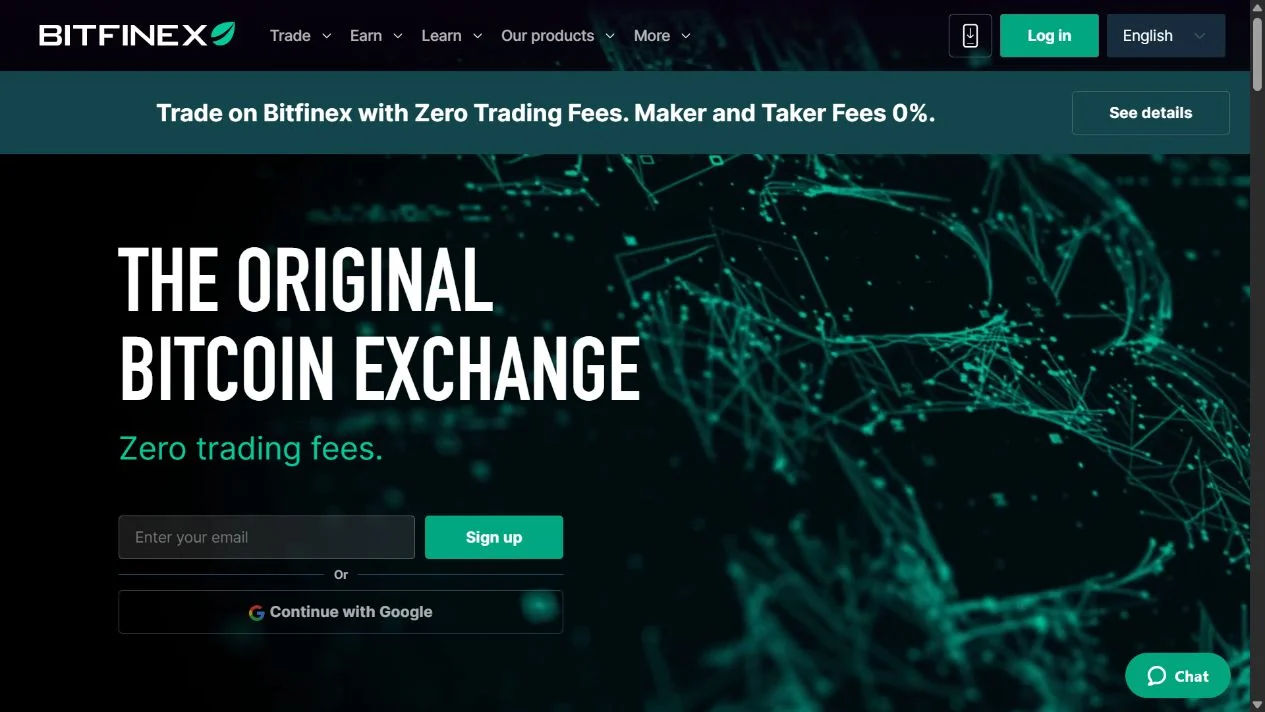
Bitfinex’s current fee schedule changes the starting point of many older comparisons: it displays zero maker and taker fees for spot and margin order execution, and also zero derivatives execution fees. That does not make every transaction free. Bank minimum charges, crypto withdrawal fees and financing can dominate the cost of an otherwise commission-free trade. Current schedule.
This evaluation follows the money into and out of the account, then examines the 2016 theft and the separate New York settlement. US retail access is excluded under the checked terms. European readers still need to verify their exact provider, country and product; a supported euro transfer does not establish a blanket EU authorisation. Exchange terms.
1. The short version
| Topic | Documented finding | What to check next |
|---|---|---|
| Spot execution | Zero maker / zero taker on the checked public schedule | Pair, account and current tariff |
| Margin and derivatives | Execution fees shown as zero | Financing, collateral, liquidation and product eligibility remain separate |
| Manual international bank transfer | Minimum amount 10,000 USD/EUR/GBP | Full verification and bank/provider conditions |
| OpenPayd EUR/GBP | Different tariff and minimums from manual wires | Route availability for the actual account |
| Basic Access | View-only mode with narrowly described withdrawal exceptions | Do not equate it with an active anonymous trading account |
| US retail users | Excluded by US-person provisions | USD support is not US eligibility |
| Security and disputes | 2016 theft and 2021 NYAG settlement are material | The two events have different facts and loss scopes |
Sources: fees, verification comparison, terms, DOJ case, NYAG agreement.
2. The platform: exchange trading, financing and OTC
Bitfinex presents exchange trading, margin-related services and OTC functions. These are different transactions even when accessed through the same interface. Spot execution exchanges assets. Margin funding or borrowing adds an interest-bearing relationship, while an OTC quote uses a different execution route from hitting a public order book. Public platform, fee categories.
That distinction matters particularly under a zero-execution-fee schedule. A customer can pay no maker/taker commission while still owing loan interest, a funding-related charge or a withdrawal fee. “Free trading” is too broad a description of the whole account lifecycle.
The contracting entity and product terms also matter more than the group name. The New York agreement names several Bitfinex and Tether entities, but it does not turn every service offered by those businesses into the same legal product. Named respondents.
3. Current execution tariff versus older reviews
| Activity on current public schedule | Displayed execution fee | Costs not removed by that line |
|---|---|---|
| Spot and margin maker | Zero | Spread, price impact, borrowing and transfers |
| Spot and margin taker | Zero | Spread and market depth still determine fill price |
| Derivatives maker / taker | Zero / zero | Funding, margin and liquidation mechanics |
| OTC trades | Zero stated fee | Quote and counterparty terms still determine economics |
| Margin funding provider | 15% of fees generated; 18% for a hidden offer | This is a share of generated funding fees, not 15% of the loan principal |
Source: schedule checked 24 November 2026. Older percentage-based spot tables should not be copied over this current publication without a date and explanation.
The funding-provider percentages have a different denominator from trading commission. If an applicable funding arrangement generates 10 units of interest, a 15% provider charge would be 1.5 units of that interest. It is not a 15% levy on the entire amount lent. Individual loan terms and any eligible LEO benefit need separate confirmation.
4. Manual wires and OpenPayd: a meaningful difference
| Route | Deposit exchange charge | Withdrawal exchange charge | Relevant minimum / boundary |
|---|---|---|---|
| Manual bank wire USD/EUR | 0.10%; minimum 60 | 0.10%; minimum 100 | Verification guide gives 10,000 minimum manual transfer amount |
| Express manual withdrawal | Not a deposit option | 1%; minimum 125 | Described as within 24 hours on business days; not an unconditional arrival guarantee |
| OpenPayd EUR/GBP, ≤10,000 | 5 EUR/GBP per transaction | 5 EUR/GBP per transaction | Guide states no deposit minimum; withdrawal minimum 25 EUR/GBP |
| OpenPayd EUR/GBP, >10,000 | 0.10% | 0.10% | Current fee schedule distinguishes this band |
| OpenPayd USD | 0.10%; minimum $30 | 0.10%; minimum $30 | Account and provider eligibility must be established |
Sources: current tariff, verification and transfer minimums. The verification guide’s simplified €5/£5 description should be read alongside the current schedule’s explicit above-10,000 band. Bank, intermediary and conversion charges can be additional.
There is a discontinuity around that OpenPayd threshold. At 10,000 EUR the published fee is €5; at 10,001 EUR the 0.10% band calculates to €10.001 before applicable rounding. Do not smooth that into a fictitious flat €5 tariff for every transfer size.
5. A bank-to-bank cost example
Consider an eligible customer sending 10,000 EUR by manual wire, trading at an unchanged price and later withdrawing the remaining euro balance by ordinary manual wire. The published deposit minimum fee is €60, so €9,940 remains before trading. Zero execution commission does not reduce that initial charge. The withdrawal minimum fee is €100, leaving €9,840, before any other charges or market effects.
The €160 exchange transfer cost is 1.6% of the original €10,000. This example deliberately assumes no gain, loss or spread so the bank charges are visible. It does not predict a tradable round trip at an unchanged price. Wire tariff.
For comparison, the fee components for one eligible OpenPayd EUR deposit and one withdrawal within the ≤10,000 band would total €10. That is a different route, not a promise that every bank customer can select it. Account permissions, provider availability, minimum withdrawal and actual receiving instructions still need checking.
6. Crypto deposits and withdrawals
The public schedule labels crypto and stablecoin deposits free of exchange deposit charges. Sending-network fees remain a separate cost at the originating wallet. Withdrawals have asset/network-specific charges. Selected captured rows show 0.00006 BTC for Bitcoin, 0.001 ETH for Ethereum and 0.000001 LN-BTC for Bitcoin over Lightning. Transfer schedule.
These are dated amounts, not a permanent quotation. Bitcoin on-chain and Lightning are different transfer routes, so the receiving wallet must support the chosen one. Likewise, an Ethereum asset on a rollup cannot be assumed compatible with an Ethereum-mainnet-only receiving instruction.
The schedule also describes a $150 recovery charge for certain missing/wrong memo or tag cases and discretionary recovery procedures for other deposit mistakes. A listed recovery service is not a promise that every wrong-chain or wrong-address transfer can be recovered, or that it will be quick.
7. Verification levels without the “no-KYC” shortcut
| Level / feature | Official comparison | Boundary |
|---|---|---|
| Basic Access | View-only; limited exceptions for some sub-$1,000 crypto withdrawals | Not general permission to trade without verification |
| Basic Plus | Exchange and OTC trading; crypto/stablecoin transfers subject to restrictions | Not ordinary manual international bank-wire access |
| Intermediate | Additional margin/funding/borrowing features; OpenPayd SEPA shown | Account creation date and product restrictions can affect legacy permissions |
| Full | Manual international bank deposits and withdrawals shown | Financial and identity checks still apply |
| Individuals / companies | Separate verification processes linked | KYB is not the same documentation package as individual KYC |
Source: current verification comparison. The guide distinguishes newer accounts from some pre-March-2022 accounts for margin-related access. A legacy exception should not be sold as the standard new-account experience.
One correction to a common oversimplification is important: the table allows OpenPayd SEPA at Intermediate, while manual international wires require Full. Saying “all fiat requires Full” would erase that documented distinction.
8. US and EU access
The exchange terms’ US-person restriction makes Bitfinex unsuitable as a general US retail recommendation. Narrow discretionary provisions for eligible contract participants are not an ordinary retail signup pathway. Supporting USD deposits or displaying a US-dollar order book does not change that conclusion. Terms.
For an EEA reader, this evaluation does not invent a group-wide MiCAR licence from euro-transfer support. Check the precise country, provider, customer type and product. Derivatives can have a different contracting arrangement and restriction list from exchange trading.
A useful comparison with Coinbase Exchange, Kraken or Bitstamp begins only after this access test. The next step is the same amount, pair and funding route. Zero spot commission on Bitfinex and a percentage commission elsewhere do not by themselves settle the total-cost question.
9. The 2016 theft: what the criminal record establishes
The DOJ’s November 2024 account states that Ilya Lichtenstein hacked Bitfinex in 2016 and fraudulently authorised more than 2,000 transactions moving 119,754 BTC to a wallet he controlled. It says he subsequently enlisted Heather Morgan’s assistance in laundering the funds. DOJ sentencing announcement.
Both pleaded guilty to conspiracy to commit money laundering in August 2023. The announcement records Lichtenstein’s sentence of five years’ imprisonment and three years’ supervised release. Its reference to Morgan’s forthcoming sentencing was written before that later event; it should not be read as a statement that her case is still awaiting sentencing today.
The BTC amount is kept in its original denomination. Repricing it at today’s BTC price would produce a different historical dollar figure, and a larger dollar headline would not mean more coins were stolen. The attack record also does not establish a founder’s criminal conviction: the named hacker and the platform’s management are different actors.
10. Recovery, forfeiture and customer reimbursement
The DOJ describes a formal third-party claim process for seized and forfeited property. Recovery by law enforcement, a court’s distribution order and payment to an individual customer are separate stages. Forfeiture-process description.
This evaluation has not verified the final entitlement or payment of every original account holder. It therefore avoids using a recovered-asset headline to assert that every affected person has received the same number of BTC back. A platform reimbursement arrangement and the eventual distribution of criminally seized assets can also use different legal and valuation rules.
For a current customer, the history remains material even when an attacker is identified years later. It demonstrates both the consequences of platform-key compromise and the length of a recovery process. It is not a current technical-security test of Bitfinex.
11. The 2021 New York settlement is a separate event
The February 2021 NYAG settlement concerned Bitfinex/Tether conduct, statements and financial arrangements, including the period when approximately $850 million held through Crypto Capital was inaccessible. The agreement imposed $18.5 million in penalties and restrictions on New York business, along with reporting obligations. Original settlement.
The document expressly says the respondents neither admit nor deny the OAG’s findings. The OAG’s findings and the negotiated relief should be described accurately; neither should be relabelled a criminal conviction of all group executives.
The inaccessible Crypto Capital funds are not the same event or asset pool as the 119,754 BTC stolen in 2016. Adding them together into one “Bitfinex hack loss” would be misleading. The case also concerns specific dated representations; it is not a substitute for a current review of any stablecoin issuer’s reserves.
12. History and current decision points
| Record | Established scope | Question for a current customer |
|---|---|---|
| 2016 theft / later DOJ prosecution | Exchange assets stolen; named attacker and laundering conduct | How are account and withdrawal risks managed now? |
| Criminal forfeiture process | Seized property subject to formal third-party claims | What final order and entitlement apply to the individual claim? |
| 2021 NYAG settlement | Regulatory findings and negotiated penalties/restrictions | Which entity and jurisdiction govern the proposed service? |
| Current zero-fee schedule | Published execution tariff | What do funding, borrowing and withdrawal cost? |
Sources: DOJ, NYAG, current fees. These are different records with different evidential weight; the table is not a numeric safety score.
13. Advantages and limitations
The current zero-execution-fee tariff can be attractive to an eligible trader who already has an efficient funding and exit route. The distinction between manual wires and OpenPayd is particularly valuable for a euro or sterling comparison. The platform also documents its verification tiers in more detail than a simple “KYC required” label.
The limits are substantial: US retail exclusion, product-specific eligibility, relatively high minimum manual-wire fees and a serious security/regulatory history. Financing adds costs even where execution is free. No measured liquidity advantage is claimed in this article.
14. Frequently asked questions
Are Bitfinex spot maker and taker fees really zero?
That is what the public schedule captured on 24 November 2026 displays. Verify the current account tariff; transfer and financing costs remain separate. Schedule.
Does Basic Access let a new user trade anonymously?
The current guide describes Basic Access as view-only with narrow withdrawal exceptions, not a general trading account. Verification.
Does every bank route require Full verification?
Manual international wires are shown at Full. The comparison separately shows OpenPayd SEPA at Intermediate and Full. Feature comparison.
Was the $850 million issue the 2016 hack?
No. The NYAG’s Crypto Capital-related findings concern a different matter from the 2016 BTC theft. Settlement, DOJ theft account.
15. Final evaluation
Bitfinex deserves a fresh cost calculation under its current execution tariff. For an eligible account, the largest avoidable mistake may be choosing an expensive transfer route while focusing on a zero trading fee. Its incident history deserves the same precision: theft, reimbursement, forfeiture and regulatory settlement should remain separate.
The sensible shortlist decision combines legal access, verification level and an executable deposit-to-withdrawal route. Those details are more useful than either an outdated commission table or a blanket assertion that zero fees make the platform cheapest.
Prepared from the dated sources listed below. This is a documentary review; no account opening, trade, support-response or withdrawal test is claimed.
Sources and check dates
- Bitfinex execution, funding and transfer fee schedule ·
- Bitfinex exchange terms ·
- Bitfinex verification levels and transfer minimums ·
- US DOJ Bitfinex hacker sentencing announcement ·
- New York Attorney General Bitfinex/Tether settlement ·
- Bitfinex home current ·
Operator, regulatory and court records support the relevant findings; third-party market data is identified in the text. Effective dates and unresolved checks remain beside the claim.