
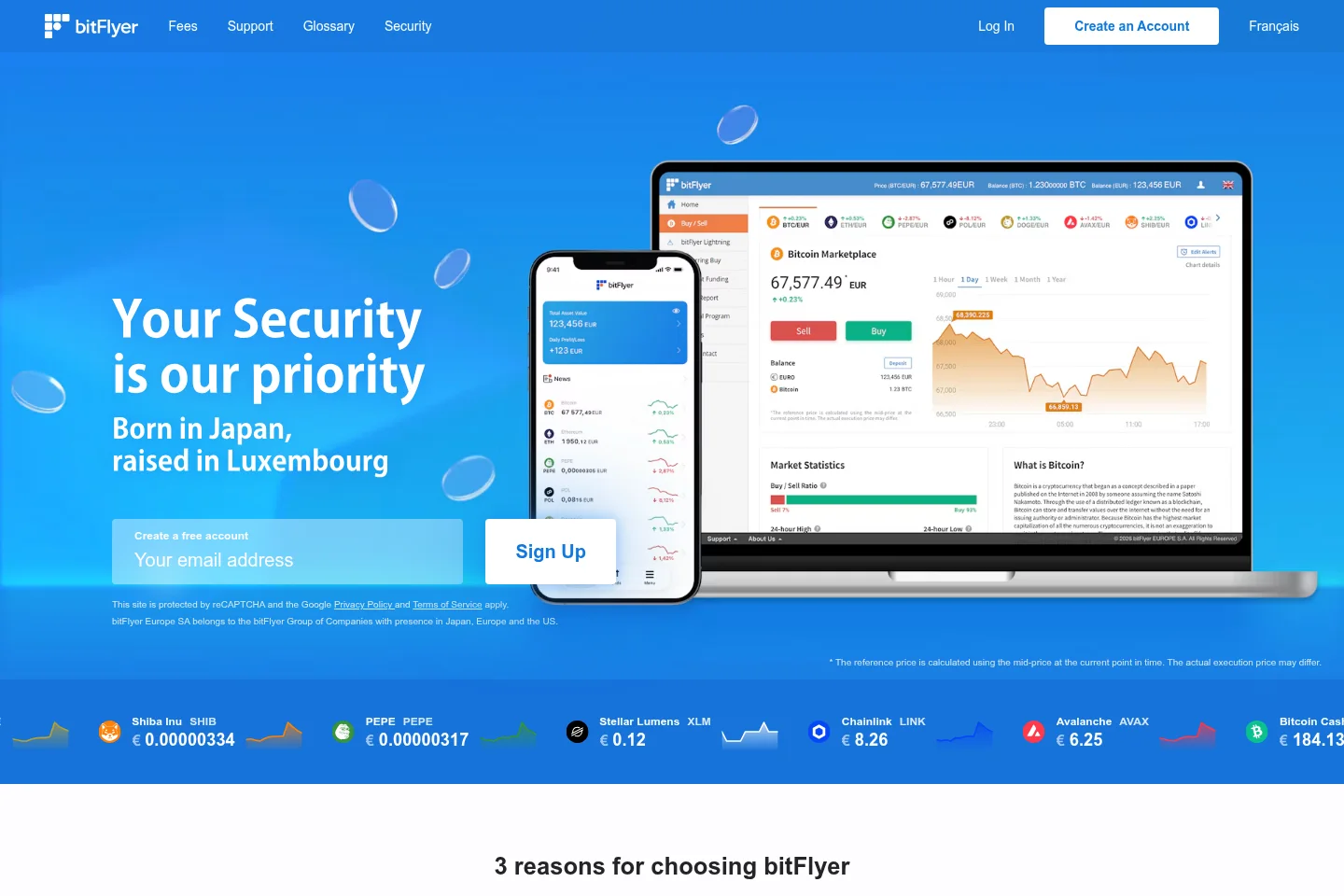
bitFlyer is a case where the same brand needs several separate comparisons. bitFlyer USA Inc., bitFlyer Europe S.A. and the Japanese service have different agreements, currencies and product rules. The US and European public schedules both show a 0.10% entry Lightning Spot rate below 50,000 units of regional 30-day volume, while their cash-withdrawal charges differ materially. US schedule, EU schedule.
The EU regulatory question also needs a fresh check. The European terms describe a Luxembourg payment-institution licence and VASP registration. Those descriptions should not be automatically upgraded into a current MiCAR CASP authorisation: the CSSF states that the VASP transition ended on 1 July 2026. This evaluation has not independently confirmed bitFlyer’s current CASP status or complete EU onboarding coverage. EU terms, CSSF transition notice.
1. Regional products at a glance
| Topic | United States | Europe | Japan |
|---|---|---|---|
| Provider / document | bitFlyer USA Inc. terms | bitFlyer Europe S.A. terms | Separate local product and documentation |
| Published fee-volume currency | USD | EUR | Do not import USD/EUR tiers into JPY |
| Entry Lightning rate checked here | 0.10% below $50,000 | 0.10% below €50,000 | No current Japanese rate inferred from these tables |
| Cash route in checked schedule | Fedwire | SEPA | Separate local JPY rules |
| Cash withdrawal exchange charge | $20, subject to change | €0.30 at ≤€250,000; €10 above | Not established by the US/EU schedules |
| Eligibility | US citizen/resident criteria plus state restrictions | Country and product conditions; current CASP permission needs verification | Not established by a US or European account |
Sources: US terms, EU terms, US fees, EU fees. A supported BTC/JPY trading board outside Japan is not the same as a local Japanese bank account.
2. Lightning versus Buy/Sell
The regional fee schedules distinguish Lightning Spot from Buy/Sell. A separate execution fee of zero on a quoted buy/sell service does not establish a zero spread or the same executable price as the order book. The amount paid versus the asset actually received remains the useful comparison.
The US fee page’s indexed Buy/Sell footnote describes a 0.1%–6.0% price component, with quotes outside the range possible in sudden-price-change or liquidity conditions. It is not a guaranteed maximum or the Lightning commission. The footnote was available in the primary page’s indexed text but omitted by a later page parser; it should be checked again against the actual checkout quote. Official price-component footnote.
That distinction is particularly important for a small occasional buyer who never opens Lightning. Quoting only the 0.10% order-book tariff would describe a different execution route from the one being used.
3. US and EU Lightning tiers
| Past 30-day volume in the regional currency | Lightning Spot published rate |
|---|---|
| 0 to less than 50,000 | 0.10% |
| 50,000 to less than 500,000 | 0.09% |
| 500,000 to less than 1 million | 0.08% |
| 1 million to less than 5 million | 0.07% |
| 5 million to less than 10 million | 0.06% |
| 10 million to less than 50 million | 0.05% |
| 50 million to less than 500 million | 0.04% |
| Over 500 million, as worded on the page | 0.03% |
The bands are denominated in USD for the US schedule and EUR for Europe. They are not a common dollar-equivalent threshold. The pages describe daily recalculation around 00:00–00:10 JST and possible negotiated arrangements. US tariff, EU tariff.
The public wording around the very top boundary should be confirmed for an account exactly at that amount rather than silently rewritten. For most ordinary users, the more relevant questions are the current account tier and the execution route.
4. What the entry commission costs
| Single executed notional | US Lightning at 0.10% | EU Lightning at 0.10% |
|---|---|---|
| 100 regional currency units | $0.10 on $100 | €0.10 on €100 |
| 1,000 regional currency units | $1 on $1,000 | €1 on €1,000 |
| 10,000 regional currency units | $10 on $10,000 | €10 on €10,000 |
These examples isolate commission and use different currencies. They do not compare the fiat value of a dollar with a euro, or include spread, price impact and withdrawals. At 1,000 units, the transfer route can cost more than the one-unit commission.
For example, two equal-notional 1,000-unit executions have two units of entry-tier commission. Add the checked ordinary cash withdrawal and the exchange charge components are $22 for the US Fedwire route or €2.30 for the qualifying EU SEPA route. These are component examples, not a promise of an unchanged-price cash round trip or an exact post-fee account balance.
5. Cash deposits and withdrawals
| Region / method | Deposit exchange charge | Withdrawal exchange charge | Boundary |
|---|---|---|---|
| US Fedwire | Free | $20, subject to change | Bank and intermediary charges may be additional |
| EU SEPA | Free | €0.30 at ≤€250,000 | Eligible registered bank route required |
| EU SEPA above €250,000 | Free | €10 | Different withdrawal band |
| JPY cash on the checked US/EU schedules | Not available | Not available | Do not confuse a JPY-priced board with JPY bank funding |
Sources: US schedule, EU schedule. A free exchange deposit charge does not eliminate sending-bank or FX conversion costs. The actual account must also support the proposed route and currency.
The EU terms distinguish payment and reserve functionalities within the account and describe circumstances in which access to funds can be limited. The headline balance should not be treated as an unconditional instant-payment promise. European account provisions.
6. Crypto withdrawals: fixed units matter
The checked US/EU schedules list 0.0004 BTC for a Bitcoin withdrawal and 0.005 ETH for Ethereum. They also list asset-specific fees and some zero-fee rows. Those are dated asset amounts, not a guarantee that every network or every coin is free. US fees, European fees.
A fixed BTC charge has a different percentage impact on a small and a large withdrawal. It should not be converted into a timeless dollar amount using an unstated BTC price. Check the current network, minimum, receiving support and fee before comparing an external-wallet route with a cash-withdrawal route.
An asset’s availability on the Japanese platform also does not establish that a US or EU account can acquire and withdraw it. The provider, pair and regional listing have to match.
7. US KYC and state restrictions
The US terms require an individual to be at least 18, meet US citizen/resident criteria, accurately identify the state of residence and comply with sanctions and other eligibility conditions. They allow services to be restricted by state, territory or jurisdiction and require the customer to report a change of state. US terms.
The document says moving to a state where bitFlyer is not licensed can lead to account termination. That is a real operational condition, not simply a label for the initial signup screen. A historical “48 states plus DC” statement in a 2023 regulatory record is not a verified current state list.
The terms describe identity verification and screening, with the programme subject to updates. This evaluation does not infer no-KYC access, a guaranteed approval time or universal national coverage from the existence of a US company.
8. European KYC and the authorisation gap
The EU terms require accurate identity and location information and allow further information about the individual or business before permitting payments or withdrawals. They require residence/location information to be kept current and allow standby, suspension or closure where required information is missing. EU customer terms.
The same terms describe payment licence Z00000016 and VASP registration 00000001 under Luxembourg supervision. Those are the operator’s published regulatory descriptions. A payment licence and a VASP registration are distinct from a CASP authorisation under MiCAR.
The CSSF’s July 2026 notice says the transition has ended and directs customers to verify CASP status and the ability to continue providing crypto services. This review has not completed a current bitFlyer-specific CASP-register confirmation, so it leaves EU onboarding permission unverified, rather than asserting either a verified current licence or a verified refusal. CSSF guidance.
9. Security enforcement: the 2023 New York consent order
The original NYDFS-hosted consent order records cybersecurity-program deficiencies at bitFlyer USA, including an inadequate risk-assessment approach. It imposes a $1.2 million civil monetary penalty and remediation/reporting obligations. Original consent order.
The distinction at the centre of the document is useful: an IT audit was not an adequate substitute for the comprehensive cybersecurity risk assessment required by the regulator. This was a controls/compliance action, not a finding in the order that $1.2 million of customer crypto had been stolen.
The order called for a remediation plan aimed at compliance by the end of 2023, with reporting. A deadline in a historical order is not independent confirmation that every item was completed on time. This evaluation does not certify the present technical implementation or extend the US order automatically to all regional entities.
10. Hacks, founder controversies and evidence
The verified material here supports a concrete cybersecurity-enforcement section. It does not support an unqualified “never hacked” guarantee or a fabricated founder conviction. Absence of a separately verified wallet-loss total in this review is not proof that the entire group has never had an operational or security issue.
The same principle applies to ownership and management disputes: name the actual person, entity, allegation and outcome when a reliable record is available. A regulator’s control finding should not be sensationalised into theft, and the existence of a licence should not erase that finding.
For a current customer, the practical checks remain account authentication, withdrawal controls, supported routes and country/product permissions. This article is a documentary evaluation, not a penetration test or a personal account trial.
11. How to compare bitFlyer fairly
| Comparison question | Match these inputs | Common mismatch to avoid |
|---|---|---|
| Execution cost | Region, pair, Lightning/Buy-Sell route, tier and size | Lightning commission versus a retail quoted price |
| Cash exit | USD Fedwire or EUR SEPA and withdrawal size | Treating $20 and €0.30 as the same route |
| Crypto exit | Asset, network and amount | A fixed BTC charge expressed at an unstated dollar price |
| US availability | Current state and product | A state count from an old consent order |
| EU availability | Current CASP permission, country and service | Payment/VASP wording treated as automatic MiCAR authorisation |
| Japanese market | Actual regional provider and local funding | Assuming a JPY board provides Japanese bank access |
The relatively low entry Lightning tariff can be useful to an eligible customer. Its advantage is meaningful only when the cash or crypto exit is also suitable. A small US withdrawal, for example, has a different fee profile from an eligible EU SEPA withdrawal even when the trading percentage matches.
12. Frequently asked questions
Is bitFlyer trading free?
The schedules distinguish Buy/Sell from Lightning. The checked entry Lightning rate is 0.10%; a zero separate Buy/Sell fee does not establish a zero price spread. US fees, price footnote.
Does bitFlyer Europe’s payment licence prove current MiCAR authorisation?
No. Those are different permissions. Current CASP status and onboarding coverage remain unverified in this evaluation. EU terms, CSSF.
Was the $1.2 million penalty a customer-wallet loss?
The retrieved consent order imposes a civil penalty for cybersecurity compliance deficiencies. It does not describe that penalty as stolen customer assets. Order.
Can I use a US account after moving to any other state?
The terms require residency updates and allow termination if the new state is not licensed. Check the actual state before moving funds. US terms.
13. Final evaluation
bitFlyer’s useful comparison starts with the regional operator and the execution route. Its published entry Lightning rate can be modelled clearly, but a quoted Buy/Sell spread, a fixed crypto charge or a bank withdrawal can change the total substantially.
The regulatory and security record also needs exact scope. Keep the US consent order, European payment/VASP descriptions and unresolved current CASP verification separate. Those distinctions give the reader a more reliable decision than a single worldwide fee or safety label.
Prepared from the dated sources listed below. This is a documentary review; no account opening, trade, support-response or withdrawal test is claimed.
Sources and check dates
- bitFlyer USA published fee and transfer schedule ·
- bitFlyer Europe published fee and SEPA schedule ·
- bitFlyer Europe customer and regulatory terms ·
- CSSF notice ending the VASP transition, July 2026 ·
- bitFlyer USA customer and state-residency terms ·
- bitFlyer USA indexed Buy/Sell price-component footnote ·
- NYDFS original bitFlyer USA cybersecurity consent order ·
Operator, regulatory and court records support the relevant findings; third-party market data is identified in the text. Effective dates and unresolved checks remain beside the claim.