
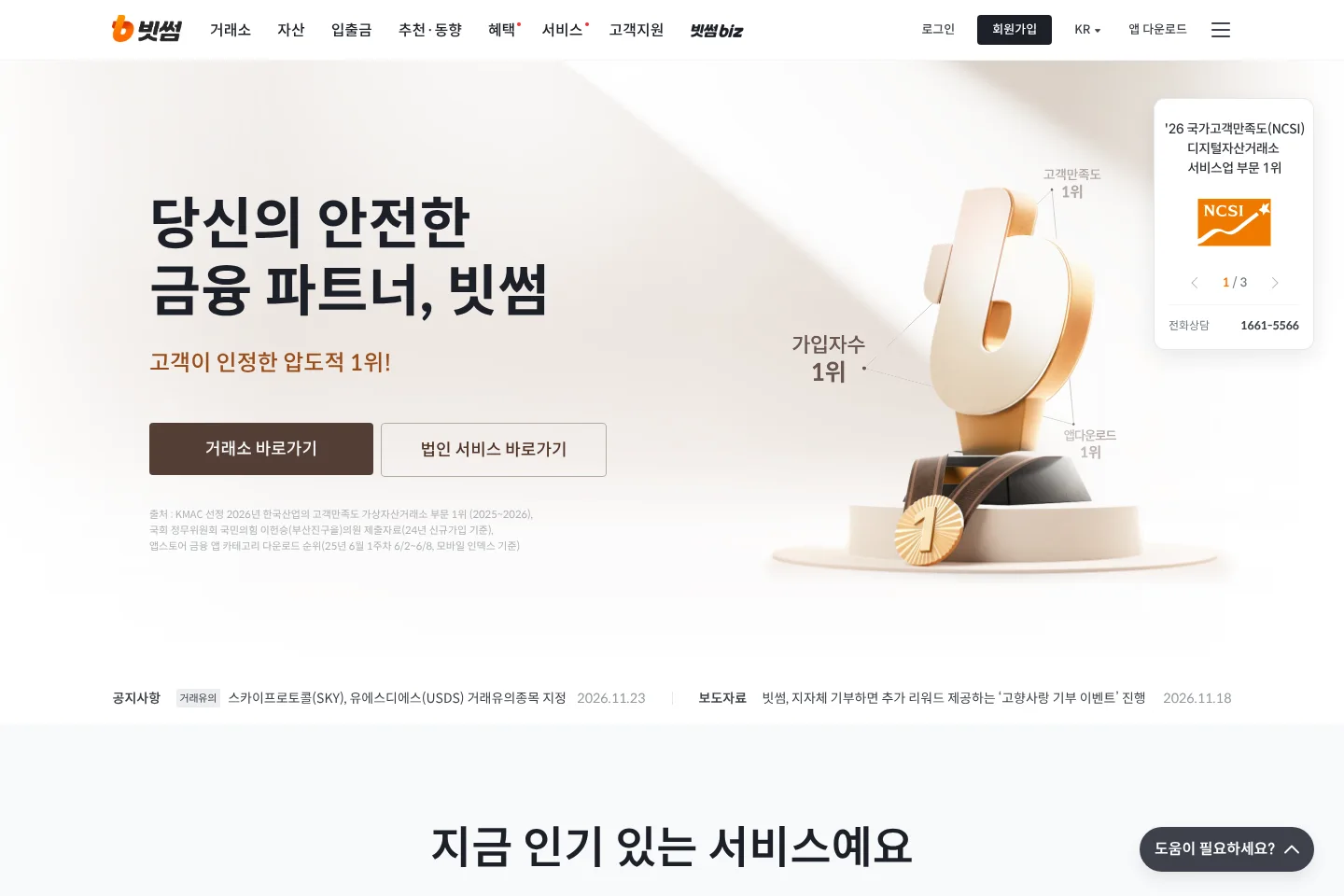
Bithumb’s two most useful entry checks are eligibility and the active fee application. Its current FAQ says foreign nationals cannot register, including foreign residents of Korea. Its KRW fee page advertises 0.04% only for customers who apply for the benefit, valid for 30 days; otherwise the normal rate is 0.25%. Foreign-applicant FAQ, current fee terms.
The 2026 history is also unusually important. A February erroneous-BTC-payout incident prompted a regulator response, company compensation arrangements and a temporary fee waiver. That internal-control event should not be confused with Bitcoin’s on-chain supply or with the platform’s earlier hacking history. FSC response, company recovery notice.
1. Who can realistically use the Korean service?
| Reader / prerequisite | Official finding | Implication |
|---|---|---|
| Foreign national outside Korea | Foreign-applicant FAQ excludes registration | Not an ordinary international account route |
| Foreign national resident in Korea | FAQ explicitly includes these residents in the exclusion | Local residence alone is insufficient |
| Eligible domestic individual | Identity-capable phone, accepted ID and same-name financial account | Document and verification requirements apply |
| KRW-market user | Linked Kookmin Bank account required under the current preparation guide | KYC and bank linkage are distinct |
| US/EU reader without an eligible local account | No general US/EU version established by these documents | Use a separately eligible venue |
Sources: foreign applicants, current identity checklist. Bithumb’s rule should not be replaced with a different Korean exchange’s foreign-resident policy.
2. The trading proposition
Bithumb’s public Korean site and fee schedule describe KRW and BTC markets. A domestic customer can assess the actual pair and order book, while an overseas reader can study the market without assuming that seeing its prices creates an account entitlement. Public site, market tariff.
This review focuses on the Korean service. It does not import a former “global” branded platform’s products, permissions or incidents into the same account. The legal provider, current terms and specific market need to be kept attached to any comparison.
For a local trader, the decision also depends on bank linkage, active fee settings and the intended asset’s receiving/withdrawal network. A large reported volume figure alone cannot establish that a particular order size will execute near the displayed price.
3. KRW trading fees: application versus default
| Fee state | Published treatment | Condition |
|---|---|---|
| Normal KRW rate | 0.25% | Applies without the active 0.04% application benefit |
| Applied KRW benefit | 0.04% | Valid for 30 days from the application date |
| Point-shop zero-fee coupon | Separate conditional benefit | Cannot apply simultaneously with the 0.04% benefit |
| After the point coupon expires | 0.04% only if that benefit remains valid or is applied again | Do not assume all discounts stack |
| BTC market | Public table currently labels trading free | Dated market-specific statement, subject to policy changes |
Source: current fee page, checked 24 November 2026. The page reserves the possibility of fee changes and separate events. A “from 0.04%” headline without the 30-day application condition is incomplete.
The point-shop coupon and the percentage application are separate mechanisms. A membership reward or points benefit is also not automatically a cash rebate that can be subtracted from every trading fee. Its eligibility and redemption rules must be assessed independently.
4. The cost of forgetting to renew
| Single KRW execution | At 0.04% | At 0.25% | Difference |
|---|---|---|---|
| KRW 100,000 | KRW 40 | KRW 250 | KRW 210 |
| KRW 1,000,000 | KRW 400 | KRW 2,500 | KRW 2,100 |
| KRW 10,000,000 | KRW 4,000 | KRW 25,000 | KRW 21,000 |
These examples isolate commission and assume the stated fee state applies. They exclude spread, price movement and withdrawals. On KRW 1 million of executed notional, the difference is KRW 2,100 for a single leg. A buy-and-sell sequence has two separately calculated notionals, so the difference can accumulate with activity.
This is one reason the account’s active fee setting is more useful than a permanent scorecard entry saying “Bithumb fee: 0.04%.” The date of application can change the cost without any change to the coin or trading interface. Application conditions.
5. Current KYC preparation
The official checklist asks domestic customers for a phone capable of identity confirmation, an accepted resident-registration or driving-licence document, and a same-name bank or securities account. It supports specified mobile-ID forms, with the relevant mobile-ID app installed. Passports, copies and temporary IDs are excluded in the checklist. Identity preparation.
The same guide separately requires a linked Kookmin Bank account for KRW trading. Completing an identity screen and possessing a bank account somewhere are therefore not interchangeable with enabling the actual local-currency route.
These are applicant prerequisites, not a promise of approval or a fixed review time. The foreign-national restriction remains a separate gate; an overseas applicant should not use the domestic checklist as evidence of eligibility.
6. Funding and withdrawals
For an eligible domestic customer, check the current linked-bank instructions and the exact crypto network at both ends. A supported ticker does not mean every chain is supported, and a tradable balance is not always immediately withdrawable when verification or operational checks remain outstanding.
This review does not invent one universal withdrawal fee. The actual asset/network quotation, minimum, bank condition and any current service notice belong in the cost calculation. Nor does it claim a personal deposit, trade or timed withdrawal test.
Historical fee promotions must retain their dates. The seven-day waiver announced after the February 2026 incident was 9 February 00:00 through 15 February 23:59, with specified caution-designated assets excluded. It is not the ordinary November fee schedule. Historical waiver.
7. February 2026 erroneous BTC payouts
The FSC says the erroneous payouts occurred around 19:00 on 6 February 2026 and were followed by a sharp BTC price fall on the platform. Its response focused on user compensation, ledger accuracy and internal controls. Regulator statement.
This is an internal-accounting/control incident. Crediting an exchange ledger does not mint on-chain BTC or establish that the platform held an equivalent quantity of actual bitcoins. A very large promotional or ledger number should therefore not be presented as Bitcoin supply newly created by the exchange.
The incident also illustrates why a correct headline balance is not the entire risk assessment. An erroneous credit can affect market orders, prices and other customers before it is corrected, even if the operator later says the asset backing has been restored.
8. Recovery and compensation: what the company reported
In its 8 February publication, Bithumb said it had restored asset reconciliation as of 7 February at 22:45. It reported immediate recovery of 99.7% of the erroneous BTC credits and said the already-sold 0.3%, described as 1,788 BTC, was covered using company assets. Company notice.
The percentages are rounded. Dividing 1,788 by 0.3% to reverse-engineer a precise total would create a number the retrieved notice does not establish. The correct treatment is to preserve the company’s stated quantities and their scope.
The announced compensation included KRW 20,000 for customers logged in at the incident time and the full sale-price difference plus an additional 10% for specified low-price sellers during 19:30–19:45 on 6 February. These are the operator’s announced arrangements. This review has not independently reconciled payment to every eligible customer.
9. Regulator response and later-message risk
The FSC described inspections of Bithumb and broader industry internal controls, including ledger cross-checking, multiple verification and prevention of human error. Its publication also discussed planned legislative measures. A plan in that response should not be described as a law already enacted by the date of that publication. FSC response.
Bithumb later warned about fake compensation messages. Its 12 February notice gives a dated warning about impersonation and credential requests. That is useful context for affected users, but its statement about messages not yet sent at that time should not be rewritten as a permanent claim that Bithumb will never contact a customer. Impersonation warning.
10. Earlier hacking history
A contemporaneous CNBC report from June 2018 reproduced Bithumb’s official tweets acknowledging stolen cryptocurrency initially valued at about $30 million, suspension of deposits/withdrawals and an intention to cover the stolen assets from company reserves. Contemporary report reproducing the statements.
The original post could not be retrieved successfully in this research session, so this passage is explicitly attributed to the contemporary reproduction. The initial dollar estimate is not presented as a final forensic reconciliation, and the compensation promise is not independently verified here as every customer’s completed payout.
This record and the 2026 control incident have different mechanisms. The former concerns stolen assets; the latter concerns erroneous credits and their market effects. They should not be added into a single theft total. A “never hacked” or “no significant operational incidents” claim would be inconsistent with this history.
11. Incident chronology
| Record | Nature | Evidence and limit |
|---|---|---|
| June 2018 | Acknowledged cryptocurrency theft and transfer suspension | Contemporary reproduction of operator tweets; initial estimate, not final audit |
| 6 February 2026 | Erroneous BTC payouts and market disruption | FSC describes the event and control response |
| 8 February 2026 company update | Recovery/reconciliation and compensation arrangements | Operator statement, not individual payout verification |
| 9–15 February 2026 | Temporary fee waiver | Historical promotion with exclusions |
| 12 February 2026 | Fake compensation-message warning | Dated impersonation warning |
Sources: 2018 account, FSC, recovery, waiver, warning. No founder conviction is inferred from these records; any separate ownership or court dispute needs its own verified case and outcome.
12. Advantages, limitations and alternatives
For an eligible domestic customer, the local KRW market and documented conditional fee benefit can be useful. The fee rules are specific enough to calculate the effect of an expired application rather than quote an unexplained range.
For US/EU readers, the foreign-applicant exclusion is the more consequential fact. Even for a local customer, the 2026 incident makes ledger controls and service continuity relevant alongside spread and commission. A competing venue should be compared using its actual local bank and identity requirements, not simply its brand’s international tariff.
13. Frequently asked questions
Is the 0.04% fee permanent?
The checked benefit lasts 30 days from application. Without it, the normal KRW rate is 0.25%, subject to other applicable programmes. Fee conditions.
Can a foreigner living in Korea register?
The current FAQ explicitly says foreign nationals, including those resident in Korea, cannot register. FAQ.
Did the February error create new bitcoins on the blockchain?
No such conclusion follows from an erroneous exchange-ledger credit. The regulator described a payout/internal-control incident. FSC.
Is the February zero-fee event still the current tariff?
No. The notice specified a seven-day February window. Use the current fee/application page for the ordinary tariff. Waiver dates, current fees.
14. Final assessment
Bithumb’s fee benefit is meaningful only for an eligible customer with the correct active application and bank linkage. For an international reader, the current foreign-national exclusion is a much stronger filter than a low advertised percentage.
The incident history is also central to the assessment. Keep the 2018 theft and 2026 ledger error separate, identify company statements as such and do not turn temporary compensation measures into permanent account terms. That gives the reader a clearer picture than a volume ranking or an unsupported safety score.
Prepared from the dated sources listed below. This is a documentary review; no account opening, trade, support-response or withdrawal test is claimed.
Sources and check dates
- Bithumb foreign-applicant eligibility FAQ ·
- Bithumb current market fees and 30-day application conditions ·
- Korean FSC response to erroneous BTC payouts ·
- Bithumb recovery and compensation update, February 2026 ·
- Bithumb domestic identity and bank checklist ·
- Bithumb home current ·
- Bithumb historical 9–15 February fee waiver ·
- Bithumb fake compensation-message warning ·
- CNBC contemporary reproduction of Bithumb’s 2018 statements ·
Operator, regulatory and court records support the relevant findings; third-party market data is identified in the text. Effective dates and unresolved checks remain beside the claim.