
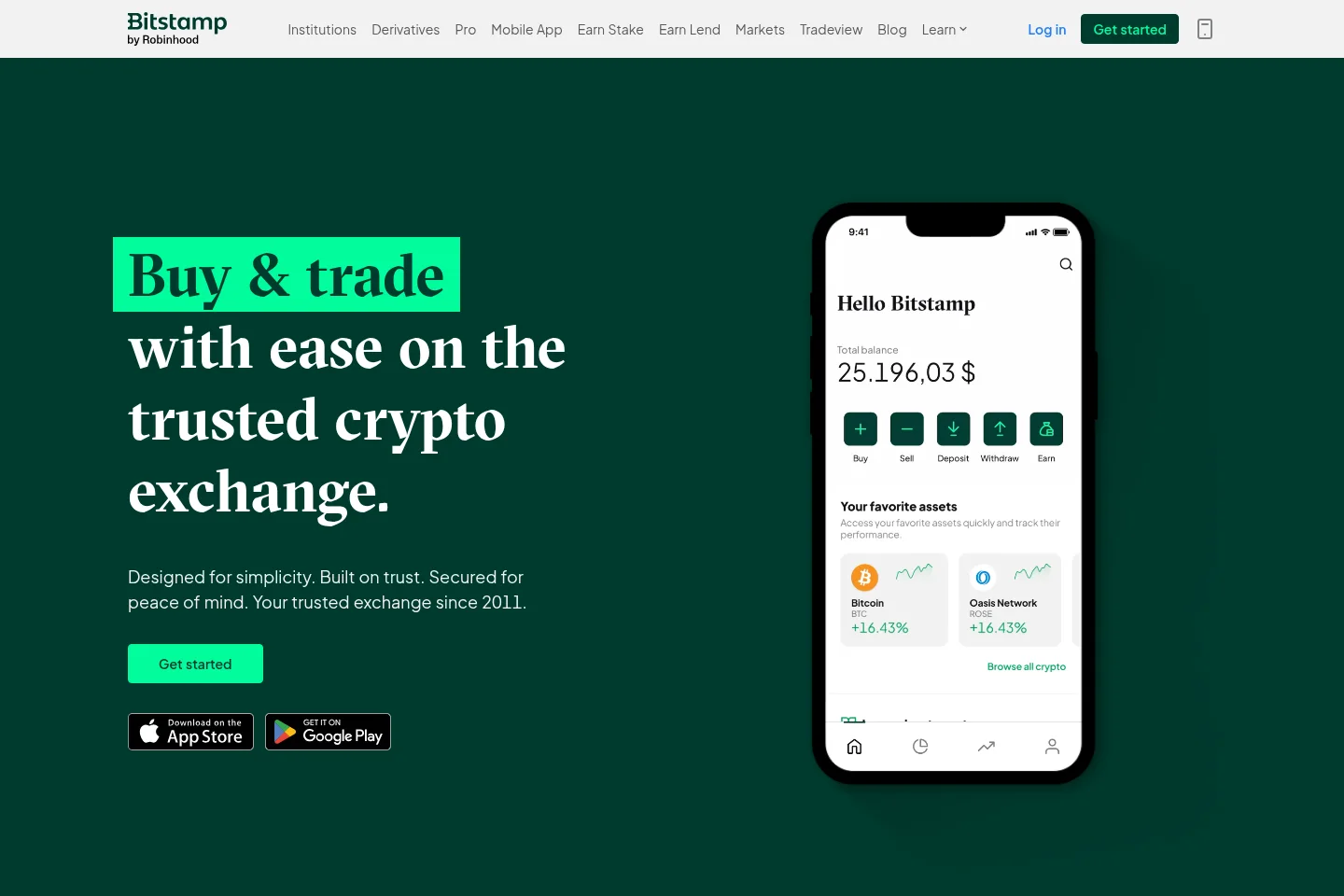
Bitstamp is one of the longest-operating cryptocurrency exchanges, having served traders since 2011. Today, the platform combines traditional spot trading, fiat payment infrastructure, institutional liquidity services and regulated cryptocurrency derivatives. Its acquisition by Robinhood Markets in June 2025 marked a major change in the exchange’s ownership and long-term strategy.
Bitstamp’s main advantages are its established regulatory structure, support for EUR and USD transactions, institutional trading infrastructure and comparatively conservative approach to cryptocurrency listings.
Its limitations are equally important. Standard trading fees are not particularly low, the selection of smaller cryptocurrencies is narrower than at some competitors, and European retail customers are experiencing significant changes as Bitstamp integrates with Robinhood.
This review examines what Bitstamp offers in 2026, how much it costs to trade, how customer assets are protected and which types of traders may benefit from using the exchange.
1. Bitstamp at a Glance
| Category | Details |
|---|---|
| Exchange | Bitstamp by Robinhood |
| Founded | 2011 |
| Parent company | Robinhood Markets, Inc. (NASDAQ: HOOD) |
| Primary EU entity | Bitstamp Europe S.A., Luxembourg |
| Regulation | EU MiCA, MiFID II for derivatives, US state licensing, UK FCA AML registration, Singapore MAS |
| Cryptocurrencies | Catalogue varies by entity, region and connected-app status |
| Spot trading fees | From 0.30% maker / 0.40% taker |
| EU trading via Robinhood | Generally 0.95% per executed trade |
| Fiat currencies | EUR, USD, GBP and selected regional currencies |
| Bank transfers | SEPA, ACH, Faster Payments, international wire where supported |
| Derivatives | Crypto and multi-asset perpetual futures for eligible clients |
| Maximum advertised derivatives leverage | Up to 10x on selected contracts |
| Staking | ETH and ADA for eligible accounts |
| Trading platforms | Bitstamp Basic, Bitstamp Pro, institutional interfaces, Robinhood app for transitioning EU retail users |
| Mobile access | iOS and Android |
| KYC | Mandatory |
| API | HTTP, WebSocket and FIX |
| Public self-verifiable PoR | No comprehensive customer-level Merkle-tree verification established |
The main distinction is that Bitstamp is no longer a single, uniform retail trading experience. Services, fees and access depend on the customer’s jurisdiction, contracting entity and whether an account has transitioned to Robinhood.
Sources: bitstamp fees, bitstamp home, bitstamp robinhood migration, bitstamp eu entity, bitstamp us entity, bitstamp asia entity.
2. Background, History and Ownership
Bitstamp was founded in Slovenia in 2011 by Nejc Kodrič and Damijan Merlak. At a time when cryptocurrency trading was dominated by a small number of exchanges, the company positioned itself as a European alternative with a strong focus on banking relationships, security and regulatory compliance.
Over the following years, Bitstamp expanded into Luxembourg, the United Kingdom, the United States and Singapore. It established relationships with financial institutions, professional trading firms and custodians while maintaining services for ordinary cryptocurrency investors.
Robinhood’s acquisition
On June 2, 2025, US financial services company Robinhood Markets completed its acquisition of Bitstamp.
The transaction was announced at approximately $200 million in cash before closing adjustments. Robinhood subsequently reported an acquisition-date consideration of approximately $224 million in its financial disclosures.
Robinhood reported more than 500,000 funded retail customers and approximately 5,000 funded institutional customers as of April 30, 2025. These are dated acquisition-disclosure figures, not current customer counts.
The acquisition gave Robinhood an established international cryptocurrency exchange, an institutional trading business and a portfolio of more than 50 regulatory licenses and registrations.
Source: Robinhood acquisition announcement
Bitstamp’s role within Robinhood
Bitstamp now serves several functions within the wider Robinhood ecosystem.
First, it continues to provide cryptocurrency exchange and custody services to eligible retail and institutional customers.
Second, its trading infrastructure supports Robinhood’s international cryptocurrency expansion. This includes access to liquidity, execution technology and regulated infrastructure.
Third, Bitstamp is increasingly positioned as an institutional platform connecting cryptocurrency markets with traditional financial instruments, including derivatives and tokenized securities.
The acquisition has therefore changed Bitstamp from a predominantly standalone cryptocurrency exchange into an important infrastructure component of a broader financial services group.
Sources: robinhood bitstamp deal, robinhood close investor, robinhood bitstamp sec q2.
3. Regulation and Legal Structure
Regulatory coverage is one of Bitstamp’s most distinctive characteristics. However, its licenses apply to different legal entities and products, rather than giving every customer access to every service.
European Union: MiCA authorization
In May 2025, Bitstamp Europe S.A. received authorization as a Crypto-Asset Service Provider under the European Union’s Markets in Crypto-Assets Regulation (MiCA).
The authorization was granted by Luxembourg’s Commission de Surveillance du Secteur Financier (CSSF).
It covers regulated crypto-asset services, including operating a trading platform, executing customer orders and providing custody.
Bitstamp Europe also holds authorization as a payment institution.
Through the applicable European passporting framework, these services can be offered across the European Economic Area.
Source: Bitstamp MiCA authorization
MiFID II authorization for derivatives
Cryptocurrency spot trading and financial derivatives are treated differently under European regulation.
Bitstamp’s perpetual futures business operates through Bitstamp Financial Services Ltd., an investment firm authorized and supervised by Slovenia’s Securities Market Agency.
This entity operates a Multilateral Trading Facility under the MiFID II framework.
Customers who wish to trade derivatives must satisfy the relevant eligibility and onboarding requirements. Holding a standard Bitstamp spot account does not automatically grant access.
United States
Bitstamp has maintained a regulatory presence in the United States for several years, including obtaining a New York BitLicense in 2019.
Its US business operates within applicable federal and state requirements, including anti-money-laundering obligations and money transmission regulations.
Available cryptocurrencies, funding methods and services can differ by state.
United Kingdom and Singapore
In the United Kingdom, Bitstamp UK Ltd. is registered with the Financial Conduct Authority for certain crypto-asset activities under anti-money-laundering regulations.
This registration should not be confused with full FCA authorization of every crypto product or with protection under the UK’s Financial Services Compensation Scheme.
In Singapore, Bitstamp Asia Pte Ltd. is licensed by the Monetary Authority of Singapore as a Major Payment Institution.
What regulation means for customers
Regulatory authorization provides an established framework for operational controls, safeguarding, compliance, reporting and supervision.
It does not eliminate the possibility of exchange failure, cyberattacks, market losses or delayed withdrawals. Cryptocurrency holdings should not be assumed to receive the same deposit protection as money held in an insured bank account.
Sources: bitstamp mica license, bitstamp eu entity, bitstamp bfs entity, bitstamp us entity, bitstamp asia entity, bitstamp security learn.
4. Trading Platforms and User Experience
Bitstamp has historically offered two primary trading experiences: Basic and Pro. In 2026, a third interface — Robinhood — is becoming increasingly important for European retail users.
Bitstamp Basic
The Basic interface is designed for straightforward cryptocurrency purchases and sales.
Instead of presenting a complete order book, the platform provides a simplified transaction flow. Users select an asset, enter the amount and review a quoted purchase or sale price.
This approach reduces complexity for beginners. However, the convenience comes with higher embedded trading costs.
Basic Trading uses a quoted-price model that incorporates a fixed spread and potentially an additional volatility component.
Bitstamp Pro and Tradeview
Bitstamp Pro is intended for users who want greater control over trade execution.
Its trading environment includes order-book information, price charts, market depth and professional trading tools.
Depending on the interface and account, supported order types include market, limit and conditional orders.
The principal advantage is direct access to an order-book fee structure. This makes trading costs easier to calculate and can be substantially cheaper than using the simplified purchase interface.
A limit order lets traders specify the maximum price they are prepared to pay or the minimum price they are prepared to accept. However, a limit order is not guaranteed to execute, and one that immediately matches an existing order may incur taker fees.
Robinhood interface
For certain European customers, the future retail trading experience is being delivered through the Robinhood application rather than the traditional Bitstamp interface.
This is not merely a visual redesign. It affects supported order types, trading fees, asset availability and payment functionality.
The implications are examined in the next section.
Sources: bitstamp home, bitstamp tradeview, bitstamp fees.
5. Bitstamp and Robinhood Integration in 2026
One of the most important developments in Bitstamp’s recent history is the phased connection of affected European retail accounts to the Robinhood app.
Bitstamp started inviting eligible retail customers in the European Economic Area and Switzerland to access their existing Bitstamp Europe accounts through the Robinhood app.
The transition is being implemented in phases.
Importantly, this does not mean that a customer’s Bitstamp Europe account or crypto assets are automatically transferred to a different custodian. Bitstamp Europe remains the regulated crypto-asset service provider and contractual counterparty.
Robinhood supplies the customer-facing application.
The connection date is communicated through the customer’s notice and in-app prompt. The guide retrieved on November 23 does not establish one universal November 14 deadline. Affected accounts can become sell-and-withdraw-only, then view-only, in the original Bitstamp app.
What changes for migrated customers?
According to Robinhood’s migration documentation, several functions differ from the traditional Bitstamp experience.
| Feature | Traditional Bitstamp | Migrated Bitstamp account in Robinhood |
|---|---|---|
| Market orders | Available | Available |
| Limit orders | Available | Initially unavailable |
| Stop orders | Available where supported | Initially unavailable |
| Staking | Available to eligible customers | Not initially available |
| SEPA deposits | Supported | Supported |
| Card deposits | Supported where eligible | Not initially supported |
| International wires | Supported where eligible | Not initially supported |
| Cryptocurrency selection | Bitstamp asset catalogue | Restricted to Robinhood-supported assets |
| Stablecoin trading pairs | Available where supported | Not initially available |
| Order-book pricing | Maker/taker model | Different fee schedule |
The guide says open limit, stop and stop-limit orders will be canceled during the transition, and unsupported assets can remain accessible through the original Bitstamp interface for sale or withdrawal.
Some account settings, including recurring investments and previously linked payment methods, will need to be configured again.
Robinhood also states that customers whose countries are unsupported may not be able to complete the migration and can instead be restricted to closing positions and withdrawing balances.
These changes are particularly relevant to active European retail traders who previously relied on Bitstamp Pro.
Source: Robinhood’s official Bitstamp migration guide
Sources: bitstamp robinhood migration.
6. Supported Cryptocurrencies and Trading Pairs
Bitstamp offers a changing catalogue of cryptocurrencies across its trading infrastructure. A global listing count does not establish which assets a particular regional or connected Robinhood account can trade.
The platform’s catalogue is considerably more selective than the enormous inventories offered by some high-volume offshore exchanges.
Major cryptocurrencies
Its established asset selection includes Bitcoin (BTC), Ethereum (ETH), Solana (SOL), XRP, Cardano (ADA), Litecoin (LTC), Chainlink (LINK) and other major networks.
Bitstamp also lists selected smaller cryptocurrencies and newer projects. Consequently, describing the platform as exclusively focused on blue-chip assets would be inaccurate.
Stablecoins
Stablecoin support has included USD Coin (USDC), Tether (USDT), Ripple USD (RLUSD) and euro-denominated stablecoins such as EURC.
However, access to individual stablecoins and trading pairs depends on local regulatory requirements.
European stablecoin availability is particularly sensitive to MiCA-related restrictions. Customers should distinguish between an asset being listed globally and being available to their own account.
Fiat trading pairs
Bitstamp has historically emphasized direct trading between cryptocurrency and traditional currencies.
BTC/EUR, BTC/USD, ETH/EUR and ETH/USD are examples of the markets for which the platform is known.
Direct fiat pairs can simplify trading for customers who do not want to convert their funds into stablecoins before placing an order.
Sources: bitstamp fees, bitstamp robinhood migration.
7. Spot Trading and Order Execution
Spot trading involves exchanging fiat money or one cryptocurrency for another at the current market price or at a specified limit price.
Unlike derivative trading, a normal spot purchase provides exposure to the purchased cryptocurrency without requiring leverage or margin borrowing.
Maker and taker orders
An order that immediately matches available liquidity is normally treated as a taker order.
An eligible order that remains on the order book and adds liquidity is treated as a maker order when it executes against a later incoming order.
Bitstamp applies different fee rates to these executions.
This distinction is important because selecting a limit order does not automatically guarantee maker pricing.
Liquidity and slippage
Trading fees are only one component of execution costs.
A market order may fill at several prices if the quantity available at the best quoted price is insufficient.
This difference between the expected and executed price is called slippage.
For large trades, liquidity and order-book depth can have a greater effect on the final result than a small difference in the advertised fee.
Bitstamp has an established institutional liquidity business, but liquidity varies substantially by cryptocurrency and trading pair. Major BTC and ETH markets should be assessed separately from thinly traded altcoins.
Sources: bitstamp tradeview, bitstamp fees.
8. Perpetual Futures and Leveraged Trading
Bitstamp expanded its derivatives business significantly in 2026.
There are two important categories of perpetual futures on the platform.
Cryptocurrency perpetual futures
In April 2026, Bitstamp announced the general launch of cryptocurrency perpetual futures for eligible institutional and retail traders in the European Union.
Initial supported cryptocurrencies included BTC, ETH, SOL, DOGE, XRP, SUI, ADA, AVAX, LINK and HYPE.
The contracts allow traders to obtain long or short exposure without purchasing the underlying cryptocurrency directly.
They do not have a fixed expiry date. Positions can remain open as long as margin requirements are satisfied.
Leverage is available up to 10x on selected contracts.
Source: April 2026 derivatives launch
Multi-asset perpetual futures
In July 2026, Bitstamp introduced a broader institutional derivatives offering covering cryptocurrencies and traditional financial markets.
Its advertised markets include:
| Asset class | Examples |
|---|---|
| Cryptocurrencies | BTC, ETH, SOL, XRP, ADA, DOGE |
| Precious metals | Gold, silver |
| Energy commodities | WTI and Brent oil |
| Equity and ETF-linked markets | QQQ, EWY |
| Foreign exchange | EUR/USD |
The system uses USD settlement and a unified collateral structure, allowing eligible institutional traders to manage exposure across multiple asset classes.
The venue also offers API and FIX connectivity, benchmark-based pricing and scheduled funding calculations.
Unlike the April cryptocurrency perpetual futures launch, the July multi-asset offering is principally marketed toward institutions.
Source: Bitstamp multi-asset perpetual futures
Risks of perpetual futures
Leverage magnifies price movements in both directions.
For example, with 10x leverage, a position with €1,000 of initial margin can represent approximately €10,000 of market exposure. A 5% adverse move in the underlying price would produce approximately €500 in trading losses before fees and funding costs.
Liquidation can occur if the position no longer satisfies margin requirements. Actual liquidation thresholds depend on contract specifications, maintenance margin, collateral and other factors.
Perpetual contracts also involve funding payments that may accumulate while positions remain open.
These products are fundamentally different from ordinary cryptocurrency purchases and are unsuitable for users who do not understand leveraged trading.
Sources: bitstamp april perpetuals, bitstamp multiasset, bitstamp perpetuals.
9. Robinhood Stock Tokens and Tokenized Assets
Bitstamp’s role in tokenization has grown under Robinhood’s ownership.
Robinhood offers products designed to provide economic exposure to traditional securities using token-based infrastructure.
However, there are important differences between the products.
Classic Stock Tokens
Robinhood introduced its first generation of stock-linked products to eligible European customers in 2025.
These instruments, now called Classic Stock Tokens, provide economic exposure to selected US stocks and exchange-traded products.
They support extended 24/5 trading access, but they do not confer the same shareholder rights as directly owning the underlying shares.
Robinhood Stock Tokens on blockchain
In July 2026, Robinhood introduced a separate generation of Stock Tokens on Robinhood Chain.
These are tokenized debt securities issued by Robinhood Assets (Jersey) Limited.
They provide economic exposure to underlying stocks or ETFs but do not grant direct ownership or shareholder rights in those underlying securities.
Eligible holders can access blockchain-based functionality, including token transfers and interactions with supported decentralized finance protocols.
Bitstamp’s institutional role
Bitstamp’s institutional enquiry form includes tokenized assets and Stock Tokens among the subjects a business can discuss. That establishes an enquiry route, rather than proving that every Robinhood token trades on Bitstamp or is available to retail exchange accounts.
This does not mean that every cryptocurrency trading account on Bitstamp automatically offers stock token trading.
The specific product, issuer, custody arrangement, trading venue and jurisdiction must be identified before assessing access or investor protections.
Source: Robinhood Stock Tokens announcement
Sources: robinhood stocktokens, robinhood chain stocktokens, bitstamp perpetuals.
10. Bitstamp Earn: Staking and Yield Products
Bitstamp Earn has provided opportunities for eligible users to receive rewards from certain cryptocurrency holdings.
Its established staking assets include Ethereum and Cardano.
Ethereum staking
Ethereum staking contributes to the operation and security of the Ethereum proof-of-stake network.
Bitstamp manages the technical staking process on behalf of participating customers and retains a portion of the resulting rewards.
The referenced commission has been 15% of ETH staking rewards.
Rewards are variable rather than fixed interest payments. The effective return depends on blockchain conditions, validator performance, platform fees and the duration of participation.
Cardano staking
Cardano staking allows ADA holders to participate in the network’s delegation mechanism.
Bitstamp has offered automatic staking for eligible ADA balances, with an option to opt out.
The referenced platform commission has been 25% of ADA staking rewards.
Geographic restrictions
Staking availability has changed over time.
Historical staking availability in one country does not establish today’s eligibility in another. Follow the current terms of the company serving the account.
Availability must therefore be checked against the current terms of the relevant legal entity rather than inferred from older global restrictions.
Migrated Bitstamp Europe users should also note that staking was not initially supported through the Robinhood interface.
Staking versus lending
Staking and lending are not interchangeable.
Staking rewards generally arise from participation in blockchain validation. Crypto lending involves extending assets to another party or lending arrangement, introducing additional counterparty and credit risks.
Any available Earn Lend product should be evaluated separately, using its current contractual terms.
Sources: bitstamp fees, bitstamp robinhood migration.
11. Bitstamp Trading Fees
Bitstamp uses different pricing models for different transaction types, user categories and jurisdictions.
The following table summarises selected charges checked on November 23, 2026, under the schedule valid from October 21. Bitstamp has published an update effective November 24, 2026; readers trading after that date must use the updated schedule for their exact product and route.
| Transaction type | Indicative fee | Important conditions |
|---|---|---|
| Pro spot maker, first tier | 0.30% | Under $10,000 in qualifying 30-day volume |
| Pro spot taker, first tier | 0.40% | Under $10,000 in qualifying 30-day volume |
| Pro spot, higher volume | Progressively lower | Depends on qualifying volume |
| Certain stablecoin/FX pairs | Reduced schedule | Depends on asset and pair |
| Basic Trading, ordinary crypto | 1.8% fixed spread | Additional variable spread may apply |
| Basic Trading, stablecoins | 0.5% fixed spread | Additional conditions may apply |
| Instant card purchases | Around 4% | Payment-provider and issuer costs may apply |
| Bitstamp Europe trading through Robinhood | 0.95% of executed EUR value | Minimum €0.01; EURC buy/sell exception; account availability is separate |
| SEPA deposit | Free | Where supported |
| SEPA withdrawal | €3 | Traditional Bitstamp schedule |
| US ACH | Generally free | Eligible US accounts |
| International wire deposit | 0.05% | Minimum and maximum conditions apply |
| International wire withdrawal | 0.10% | Minimum charge applies |
| Crypto withdrawal | Variable | Network and processing costs |
| ETH staking commission | 15% of rewards | Eligible staking accounts |
| ADA staking commission | 25% of rewards | Eligible staking accounts |
Clients using Bitstamp through Robinhood have a dedicated section that excludes other Bitstamp charges as specified there; third-party and affiliate charges can still apply. A tariff exception for EURC does not establish current tradability where the connection guide says stablecoin trading is not yet available.
These charges should not be combined indiscriminately. A trade made through the traditional Bitstamp Pro order book and a trade executed through the Robinhood application may follow entirely separate fee schedules.
Trading volume discounts
Bitstamp’s traditional maker/taker fees decline as qualifying trading volume increases.
For example, the standard schedule has included:
| Qualifying 30-day volume | Maker | Taker |
|---|---|---|
| Below $10,000 | 0.30% | 0.40% |
| Above $10,000 | 0.20% | 0.30% |
| Above $100,000 | 0.10% | 0.20% |
| Above $500,000 | 0.08% | 0.18% |
Higher tiers offer further reductions.
Some stablecoin and currency pairs receive discounted fees but contribute less qualifying volume toward the standard trading tiers.
The precise schedule should always be checked before trading.
Official Bitstamp fee schedule
Sources: bitstamp fees, bitstamp upcoming.
12. How Much Does a €1,000 Trade Cost?
The difference between Bitstamp’s interfaces becomes clearer with a simple example.
Assume a customer buys €1,000 worth of cryptocurrency, with no special discounts and no change in the market price.
| Execution method | Illustrative cost |
|---|---|
| Traditional Pro maker order at 0.30% | €3.00 |
| Traditional Pro taker order at 0.40% | €4.00 |
| Basic Trading at 1.8% fixed spread | €18.00 |
| Basic Trading with an additional 0.5% volatility spread | €23.00 |
| Robinhood interface at 0.95% | €9.50 |
| Instant card purchase at 4% | €40.00 |
These figures isolate the specified fees or spread components. They do not include every possible cost, such as third-party charges or additional execution slippage.
For a traditional Pro market purchase followed by a sale of the same notional value, two 0.40% taker fees would total €8.00. With a €3 SEPA withdrawal charge, the combined cost would be €11.00, assuming no price change and excluding other costs.
Through a Robinhood interface charging 0.95% per transaction, the same hypothetical purchase and sale would incur €19.00 in trading fees alone.
This distinction matters for active traders. A platform may remain convenient for occasional purchases but become noticeably more expensive when used for frequent transactions.
Sources: bitstamp fees.
13. Deposits, Withdrawals and Banking
Bitstamp’s support for traditional currencies is a significant part of its appeal.
Many cryptocurrency platforms are primarily designed around stablecoins. Bitstamp has maintained banking infrastructure that allows eligible users to deposit and withdraw ordinary fiat currencies.
EUR deposits and SEPA transfers
European customers can use SEPA transfers to fund eligible accounts in euros.
Under the traditional Bitstamp schedule, standard SEPA deposits are free and withdrawals cost €3.
This makes bank transfers an economical funding method compared with payment cards, although receiving banks and intermediary services may have their own conditions.
US dollar payments
Eligible US users can access ACH transfers. Domestic and international banking options depend on account type and location.
International wire transfers can incur percentage-based fees and minimum charges, while correspondent banks may impose additional costs.
UK and Singapore payments
The fee schedule includes GBP/Faster Payments references and SGD-denominated transfer charges. The supported bank route still needs the relevant regional account instructions. A fee currency alone does not establish that every customer can use a local funding network.
Cryptocurrency deposits and withdrawals
Bitstamp supports transfers to and from external wallets.
Customers must select the correct asset and blockchain network. Some assets require additional information, such as a destination tag or memo.
A transfer sent over an unsupported network or without required destination information may be delayed or permanently lost.
For direct Bitstamp accounts, crypto withdrawal charges are not necessarily fixed. They can depend on blockchain network fees and platform processing charges.
Withdrawal processing times
Bank processing times depend on the transfer method, bank operating hours and compliance checks.
Use the processing estimate displayed for the exact bank route. The sources checked here do not establish one universal one-to-two-day SEPA delivery promise; international wires, cut-off times and intermediary banks require their own instructions.
Additional verification can delay withdrawals independently of the banking system.
Sources: bitstamp fees, bitstamp robinhood migration.
14. Account Registration and KYC
Bitstamp requires identity verification as part of its compliance obligations.
The exact onboarding process varies by jurisdiction and account type, but it generally follows the same structure.
- Create an account. Register through the official Bitstamp or applicable Robinhood onboarding interface using an email address and secure credentials.
- Verify identity. Provide the requested identity documentation, which may include a passport or national identity card.
- Provide residential information. Depending on the account, proof of address and tax information may be required.
- Complete additional checks. Some customers must explain their occupation, expected transaction activity or source of funds.
- Activate trading and funding. Access becomes available after the relevant verification checks are completed.
Source-of-funds verification
Bitstamp may request additional documentation when customer activity requires enhanced due diligence.
Such requests can include bank statements, employment or business income documents, transaction records or information establishing the origin of cryptocurrency funds.
These requirements can apply after an account has already been opened, particularly when transaction patterns change.
An account may be temporarily restricted while checks are completed.
This is an important practical consideration for customers who regularly move large sums, receive payments from third parties or transfer cryptocurrency from external services.
Sources: bitstamp kyc, bitstamp source funds.
15. Security, Custody and Proof of Reserves
Bitstamp has a long operating history and established security controls. Nevertheless, its history includes a significant security incident.
Cold storage and wallet security
Bitstamp states that approximately 95% of cryptocurrency private keys are kept in offline storage.
Its security framework has also included multisignature technology, account authentication controls and specialist custody providers.
Other safeguards include withdrawal-address controls and transaction monitoring.
The current company page lists ISO/IEC 27001 certification and periodic SOC 2 Type 2 attestations. These have defined scopes; this review has not obtained the complete current reports. Historical financial-audit statements are discussed separately below.
Source: Bitstamp security and custody explanation
Customer asset segregation
In a statement dated November 11, 2022, Bitstamp described customer assets as separate from corporate assets and held 1:1 in custody. The current contractual arrangement and legal entity remain the relevant checks for an individual account.
The exchange also describes reconciliation processes involving independent custodians.
Segregation reduces certain operational and insolvency risks, but the precise legal treatment of assets depends on the contract, custodian, jurisdiction and circumstances of any insolvency.
Financial audits versus Proof of Reserves
A November 18, 2022 statement says Bitstamp’s legal entities had been audited annually by a Big Four accounting firm since 2016. This review has not obtained a current audit opinion or established that every entity and product has identical coverage today.
Those historical disclosures describe a traditional assurance framework; the scope and date of a current report remain separate checks.
However, financial audits and publicly self-verifiable Proof of Reserves are different mechanisms.
A comprehensive cryptographic PoR system should allow users to verify the inclusion of their balances while providing evidence relevant to total customer liabilities.
Bitstamp has discussed Proof of Reserves initiatives, but a continuously available, customer-level Merkle-tree verification system has not been established in the material reviewed here.
Third-party on-chain reserve trackers can provide visibility into identified wallet assets. They cannot independently demonstrate all customer liabilities or establish that an exchange is fully solvent.
Source: Bitstamp on Proof of Reserves
Sources: bitstamp about, bitstamp security learn, bitstamp custody policy, bitstamp reserve transparency.
16. Major Hacks, Controversies and Ownership Disputes
Bitstamp’s history includes a major wallet breach, a founder shareholding dispute and a reversed fee proposal. They concern different risks and should not be collapsed into one allegation about the present company.
| Date | Event | Customer or ownership impact | Documented response or outcome |
|---|---|---|---|
| January 2015 | Operational Bitcoin wallets compromised | Bitstamp reported fewer than 19,000 BTC stolen; operations were suspended | The exchange rebuilt its systems and said pre-suspension customer balances would be honoured in full |
| 3 February 2022 | Founder Nejc Kodrič’s share-option dispute | Civil litigation about the sale of shares held through White Whale | The High Court rejected the claimants’ claims and upheld the defendant’s counterclaim, requiring the share sale |
| 6 July 2022 | Proposed inactivity fee reversed | A proposed charge concerned some inactive accounts with balances below €200 | Bitstamp cancelled the plan after the community response; it said the fee would not be implemented |
The 2015 wallet breach
In January 2015, Bitstamp suffered a security breach involving its operational Bitcoin wallets.
The company reported that fewer than 19,000 BTC had been stolen.
It temporarily suspended operations, rebuilt its systems and introduced additional security measures.
Bitstamp publicly stated that customer balances held before the suspension would be honored in full.
The incident is a relevant part of its security history. It also demonstrates why an exchange’s longevity should not be presented as evidence that it has never experienced a major hack.
Source: Bitstamp’s official 2015 incident announcement
The operator’s statement establishes the reported loss and its promise to honour balances. It is not an independently performed Atlas reimbursement audit. The event predates Robinhood’s acquisition by a decade and remains relevant when assessing the exchange’s security history. Original incident announcement.
The founder’s ownership dispute
In Kodrič and another v Bitstamp Holdings NV [2022] EWHC 210 (Ch), Nejc Kodrič and White Whale challenged arrangements surrounding the exercise of share call options. The court’s conclusion rejected the claimants’ claims and upheld the counterclaim, with orders requiring Kodrič to procure the share sale. High Court judgment, conclusion.
This was a civil ownership and contract dispute, not a criminal judgment establishing theft of customer assets. It predates the Robinhood acquisition. Its relevance is the documented disagreement between a founder and the then majority owner; it should not be presented as an unresolved criminal charge against the current operator.
The cancelled inactivity-fee plan
On 6 July 2022, Bitstamp said it would not implement its proposed inactivity fee following the community response. Its announcement described the affected proposal as applying to some inactive customers with balances below €200. This was a pricing-policy controversy and reversal, rather than an exchange hack or a regulatory fine. Cancellation announcement.
For any future enforcement entry, the relevant record is the regulator’s order or court decision, including its outcome and any appeal. This review does not infer the absence of other proceedings from a limited search.
17. Liquidity, Trading Volume and Market Quality
Bitstamp’s institutional business is a major distinguishing feature.
Rather than competing only on cryptocurrency selection, the exchange emphasizes liquidity, execution and integration with professional trading systems.
Its infrastructure supports retail order flow, institutional counterparties and automated trading systems.
The DefiLlama page retrieved on November 23, 2026 displayed approximately $321.57 million in 24-hour spot volume and $183.75 million in perpetual-futures volume. These are attributed third-party observations at the research check, not independently measured Atlas results.
The two market categories remain separate. Neither number establishes order-book depth at the time of a later trade or guarantees execution capacity. Dated market-data page.
Source: DefiLlama Bitstamp exchange data
Why order-book depth matters
Published trading volume indicates market activity, but it does not tell traders how much they can buy or sell at a particular price.
A more meaningful execution assessment considers available order-book depth, bid-ask spreads and slippage for a specific order size.
A €500 BTC order and a €500,000 order may experience entirely different execution costs.
For institutional customers, execution quality and operational reliability can justify using an exchange even when its advertised retail fee schedule is not the lowest in the market.
Sources: defillama bitstamp, bitstamp tradeview.
18. Institutional Services and API Infrastructure
Bitstamp operates a broader institutional business than its retail interface alone suggests.
Its services include institutional execution, market connectivity, OTC trading arrangements, custody integrations and crypto-as-a-service infrastructure.
Trading APIs
Bitstamp provides several integration methods.
| API | Primary use |
|---|---|
| HTTP / REST | Account operations, order submission and market data |
| WebSocket | Streaming market information and trading-related updates |
| FIX | Professional execution connectivity and institutional workflows |
These interfaces support automated market-making strategies, algorithmic execution, portfolio monitoring and integrations with third-party platforms.
OTC and large transactions
Institutional customers may require execution methods outside the ordinary retail order-book workflow.
OTC arrangements and institutional execution services can help clients manage transaction size, market impact and operational settlement requirements.
Pricing, minimum trade sizes and availability are generally established through institutional onboarding rather than a universal retail schedule.
Trading platform integrations
During 2026, Bitstamp expanded integrations with institutional trading and order management systems, including platforms such as Talos, CoinRoutes and Wyden.
This direction reinforces its positioning as financial market infrastructure rather than solely a consumer cryptocurrency application.
Sources: bitstamp api, bitstamp oems.
19. Mobile Applications
Bitstamp has offered mobile trading applications for iOS and Android, historically supporting both simple buying and more advanced trading functionality.
The apps provide access to balances, transactions, markets and account management features, subject to the user’s jurisdiction and account status.
However, the integration with Robinhood means that app functionality must be assessed in two separate contexts.
Traditional Bitstamp application
Customers who have not been migrated may continue to use the traditional Bitstamp application according to the services available to their account.
This can include trading, portfolio monitoring, deposits and withdrawals.
Robinhood application for migrated users
Eligible European retail customers may instead be required to access their Bitstamp accounts through Robinhood.
The interface offers portfolio management, trading and funding functionality, but the initial migration does not preserve every feature of the original Bitstamp trading environment.
Users should particularly check advanced orders, staking, supported assets and available funding methods.
A feature advertised for a standard Robinhood Europe customer is not necessarily available to a recently migrated Bitstamp account.
Sources: bitstamp home, bitstamp robinhood migration.
20. Customer Support and Account Restrictions
Bitstamp provides customer assistance through its support infrastructure, including email and published telephone contact channels.
Support requests can involve failed deposits, withdrawals, identity verification, technical access and account security.
Common sources of friction
A consequential support problem is an inability to complete a transaction or access expected account functions. This review has not measured the frequency of different complaint types or a representative support-resolution time.
Potential causes include enhanced KYC checks, transaction monitoring, banking delays, unsupported assets or restrictions arising from changes to the account’s jurisdiction or service provider.
These issues should be distinguished from an exchange’s refusal to honor valid withdrawals. A compliance review is not, by itself, evidence of insolvency or misconduct.
At the same time, a platform can satisfy its compliance requirements while still creating a frustrating customer experience.
What to check before a large deposit
Before transferring substantial funds, users should understand which legal entity serves their account, what documentation may be requested and which withdrawal methods are supported.
Maintaining transaction records and ensuring account information is current can reduce avoidable verification problems.
Bitstamp does not publish a universally reliable resolution time for every type of support or compliance case, and individual customer reviews are not a substitute for measured support performance.
Sources: bitstamp about, bitstamp source funds.
21. Supported Countries and Regional Restrictions
Bitstamp serves customers across Europe, the United States and selected international markets, but availability is not universal.
Access depends on the customer’s residence, applicable legal entity and the product concerned.
The most important regional distinctions are summarized below.
| Market | Main considerations |
|---|---|
| European Economic Area | MiCA-regulated spot services; phased Robinhood retail migration |
| Latvia and other euro-area countries | SEPA access where eligible; Robinhood transition and revised fees may apply |
| United Kingdom | Separate UK regulatory framework and product restrictions |
| United States | State-dependent cryptocurrency and payment availability |
| Singapore | MAS-regulated institutional and eligible services |
| Other international markets | Availability depends on local rules and the relevant Bitstamp entity |
Not all regions offer staking, derivatives, the same cryptocurrencies or identical banking facilities.
For European customers, the identity of the service provider is especially important because Bitstamp Europe and Bitstamp Financial Services operate under different regulatory authorizations.
A standard MiCA-regulated spot account does not automatically provide eligibility to trade leveraged financial derivatives.
Sources: bitstamp eu entity, bitstamp us entity, bitstamp asia entity, bitstamp robinhood migration.
22. Bitstamp Compared With Other Crypto Exchanges
Bitstamp competes with platforms such as Kraken, Coinbase, Binance and other centralized exchanges.
The most meaningful differences relate to trading costs, product selection, jurisdiction and the type of trader each platform is designed to serve.
| Exchange | Main strengths | Potential limitations |
|---|---|---|
| Bitstamp | Established banking infrastructure, EU regulation, institutional connectivity | Higher basic trading fees; changing EU retail experience |
| Kraken | Advanced trading tools, fiat funding, broad professional trading features | Product and fee availability varies by region |
| Coinbase | Retail accessibility, broad ecosystem, institutional services | Simple purchase flows can be more expensive than advanced trading |
| Binance | Large market selection, broad trading ecosystem, competitive spot fee structures | Significant jurisdiction-specific service restrictions |
| Bybit | Active trading tools and derivatives ecosystem | Regulation and product availability vary significantly by market |
This is a comparison of product positioning rather than a current ranking of execution quality or a live fee benchmark.
Where Bitstamp competes well
Bitstamp is particularly relevant when a customer values a regulated European service provider, direct fiat transfers and established custody and trading infrastructure.
Its institutional connections and derivatives venue also provide capabilities beyond a simple retail exchange.
Where competitors may be preferable
For users whose main priority is low-cost frequent spot trading, Bitstamp’s standard fees and Robinhood transition pricing can be disadvantages.
For traders searching for a very large range of small-cap assets, exchanges with broader catalogues may offer more opportunities.
However, those alternatives should be assessed against local regulatory access, custody risks, payment methods and actual execution costs rather than headline trading fees alone.
Sources: kraken fees, binance spot schedule, bybit eu fees, bitstamp fees.
23. Advantages and Disadvantages
| Advantages | Disadvantages |
|---|---|
| Operating since 2011 | Standard spot fees are not among the lowest |
| Backed by publicly traded Robinhood Markets | Major retail interface changes during 2026 |
| MiCA authorization in the EU | Robinhood trading can cost more than traditional Pro |
| Established EUR and USD banking infrastructure | Limited selection of smaller crypto assets |
| Institutional liquidity and API connectivity | Strict KYC and enhanced verification requirements |
| Regulated European derivatives infrastructure | Derivatives access restricted by eligibility and jurisdiction |
| Historical external-audit disclosures; current scope needs checking | No established comprehensive self-verifiable customer-level PoR |
| Spot and institutional trading services | Staking and other functionality vary by account and region |
Sources: bitstamp fees, bitstamp about, bitstamp robinhood migration.
24. Who Is Bitstamp Best For?
European fiat-based investors
Bitstamp remains relevant for European customers who want regulated cryptocurrency access with traditional banking infrastructure.
However, they should examine their current application and fee schedule carefully, particularly if they have been included in the Robinhood transition.
Institutional clients
Institutions represent one of Bitstamp’s strongest target audiences.
The exchange offers professional connectivity, regulatory infrastructure, market access and services designed for systematic trading and large-scale execution.
Its integration into Robinhood may further strengthen this segment.
Experienced cryptocurrency traders
For traders with continued access to the traditional Pro order book, Bitstamp provides a familiar centralized exchange environment.
Its fees may be reasonable for some strategies, but they should be compared with competing platforms based on actual order sizes and executed prices.
Beginners
The simplified purchase process can make Bitstamp accessible to beginners.
That convenience needs to be weighed against potentially substantial pricing differences between Basic Trading, Pro and Robinhood access.
Traders for whom Bitstamp may be less suitable
Bitstamp is a weaker fit for users whose primary goals are accessing numerous speculative tokens, minimizing transaction costs on every small trade or using a broad selection of leveraged instruments without jurisdiction-specific eligibility checks.
Customers who depend on advanced order types may also find the initial Robinhood migration limitations inconvenient.
Sources: bitstamp home, bitstamp fees, bitstamp robinhood migration.
25. Frequently Asked Questions
Is Bitstamp a legitimate cryptocurrency exchange?
Yes. Bitstamp is an established cryptocurrency exchange founded in 2011, with regulated entities operating in several major financial jurisdictions. Its EU entity holds MiCA authorization, while other services operate under separate local regulatory frameworks.
Legitimacy and regulation do not remove the risks of cryptocurrency investing or holding assets with a centralized custodian.
Who owns Bitstamp?
Bitstamp is owned by Robinhood Markets, Inc., which completed its acquisition in June 2025.
Is Bitstamp available in Europe?
Yes. Bitstamp Europe S.A. provides authorized cryptocurrency services across the EEA. Specific products and onboarding options depend on local conditions and the ongoing Robinhood integration.
Does Bitstamp support bank transfers?
Yes. Eligible customers can use services such as SEPA, ACH, Faster Payments and international bank transfers, depending on their jurisdiction.
Does Bitstamp offer futures trading?
Yes. Bitstamp offers perpetual futures through a separately regulated MiFID II entity. Eligible EU retail and institutional users may access cryptocurrency perpetuals, while the wider multi-asset offering is principally institutional.
Does Bitstamp support staking?
Yes. ETH and ADA staking have been offered to eligible customers. Availability, reward rates and fees depend on current product terms and account eligibility. Migrated Bitstamp accounts may not have the same staking functionality in the Robinhood app.
Does Bitstamp provide Proof of Reserves?
Bitstamp has published historical external-audit and custody-reconciliation statements. This review has not obtained a current audit opinion. A comprehensive, continuously available customer-level cryptographic Proof of Reserves system has not been established in the sources reviewed.
Can I withdraw cryptocurrency to my own wallet?
Yes, where withdrawals are supported for the relevant asset, network and account. Network fees, security checks and withdrawal restrictions may apply.
Is Bitstamp cheaper than Coinbase or Kraken?
Not necessarily. Bitstamp’s standard Pro fees begin at 0.30% maker and 0.40% taker, while its Basic and Robinhood routes can be more expensive.
A fair comparison must use the same transaction size, product type, execution method and applicable regional fee schedule.
Does Robinhood own the cryptocurrency held in my Bitstamp account?
For the EU retail migration announced in 2026, Bitstamp states that Bitstamp Europe remains the crypto-asset service provider and contractual counterparty. Connecting the account to Robinhood changes how eligible customers access their services; it does not automatically transfer their assets to a new custodian.
Sources: bitstamp eu entity, bitstamp fees, bitstamp robinhood migration, bitstamp perpetuals.
26. Final Verdict: Is Bitstamp Worth Using in 2026?
Bitstamp remains a significant participant in the global cryptocurrency market, particularly because of its regulatory infrastructure, banking relationships and institutional trading business.
Its acquisition by Robinhood has increased its strategic importance and expanded its involvement in derivatives, liquidity services and tokenized financial assets.
For institutional clients, these developments make Bitstamp more than a traditional crypto spot exchange. It is becoming part of a broader financial infrastructure connecting digital assets and conventional markets.
For European retail customers, the conclusion is more complicated.
Bitstamp’s MiCA authorization and established custody arrangements remain meaningful strengths. However, the transition to Robinhood introduces pricing and functionality changes that can materially affect the user experience.
A trader previously paying 0.30%–0.40% through Bitstamp Pro may face a different fee structure, including a standard 0.95% charge when accessing crypto trading through Robinhood. Some advanced order types and other features may also be unavailable during the transition.
Overall assessment: Bitstamp is worth considering for users who value established regulation, fiat banking and institutional-quality infrastructure. It is less compelling as a universally low-cost retail trading platform, especially for active European traders affected by the Robinhood migration.
The deciding factor is no longer simply whether Bitstamp is a reputable exchange. It is which Bitstamp entity, platform and fee schedule a particular customer will actually use.
Sources: bitstamp fees, bitstamp robinhood migration.
Research Methodology
This review was prepared using publicly available information checked through November 23, 2026, including Bitstamp’s official announcements, Robinhood’s product and migration documentation, regulatory disclosures, fee information and third-party market data.
The assessment distinguishes historical exchange features from the Robinhood integration and separates retail spot services from institutionally oriented financial products.
No personal trading activity, deposits, withdrawals or customer-support interactions were conducted for this review. Quoted transaction examples are illustrative calculations rather than live executable offers.
Fees, product eligibility, staking rewards and supported jurisdictions can change. Readers should verify the current contractual terms and applicable fee schedule before using a financial service.
Cryptocurrency investments and leveraged trading involve substantial risk, including the potential loss of the entire invested amount.
Sources and check dates
- Bitstamp fees ·
- Bitstamp home ·
- Bitstamp robinhood migration ·
- Bitstamp eu entity ·
- Bitstamp us entity ·
- Bitstamp asia entity ·
- Robinhood bitstamp deal ·
- Robinhood close investor ·
- Robinhood bitstamp sec q2 ·
- Bitstamp mica license ·
- Bitstamp bfs entity ·
- Bitstamp security learn ·
- Bitstamp tradeview ·
- Bitstamp april perpetuals ·
- Bitstamp multiasset ·
- Bitstamp perpetuals ·
- Robinhood stocktokens ·
- Robinhood chain stocktokens ·
- Bitstamp upcoming ·
- Bitstamp kyc ·
- Bitstamp source funds ·
- Bitstamp about ·
- Bitstamp custody policy ·
- Bitstamp reserve transparency ·
- Bitstamp 2015 incident ·
- Kodric judgment primary ·
- Bitstamp inactivity cancel ·
- Defillama bitstamp ·
- Bitstamp api ·
- Bitstamp oems ·
- Kraken fees ·
- Binance spot schedule ·
- Bybit eu fees ·
Operator, regulatory and court records support the relevant findings; third-party market data is identified in the text. Effective dates and unresolved checks remain beside the claim.