
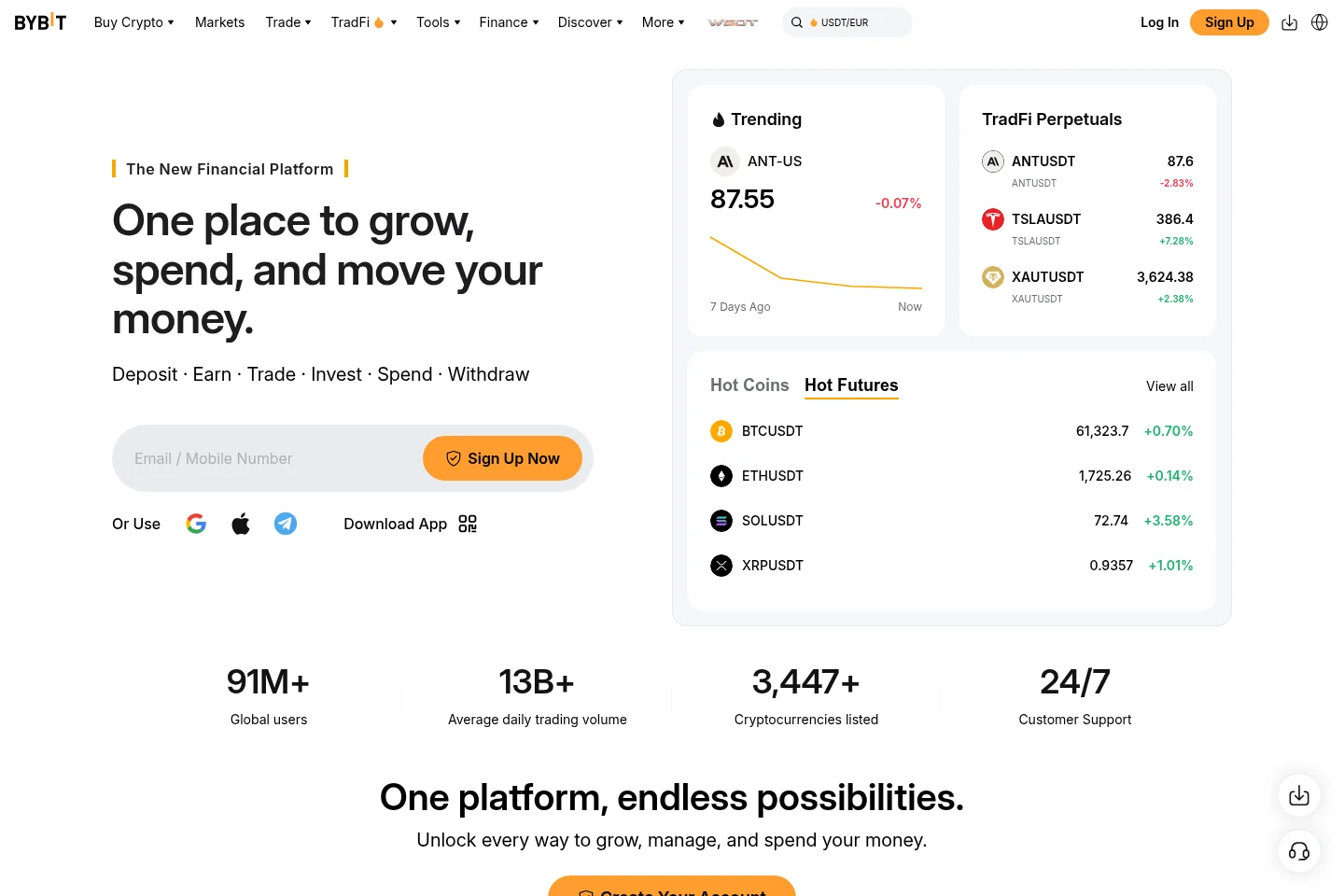
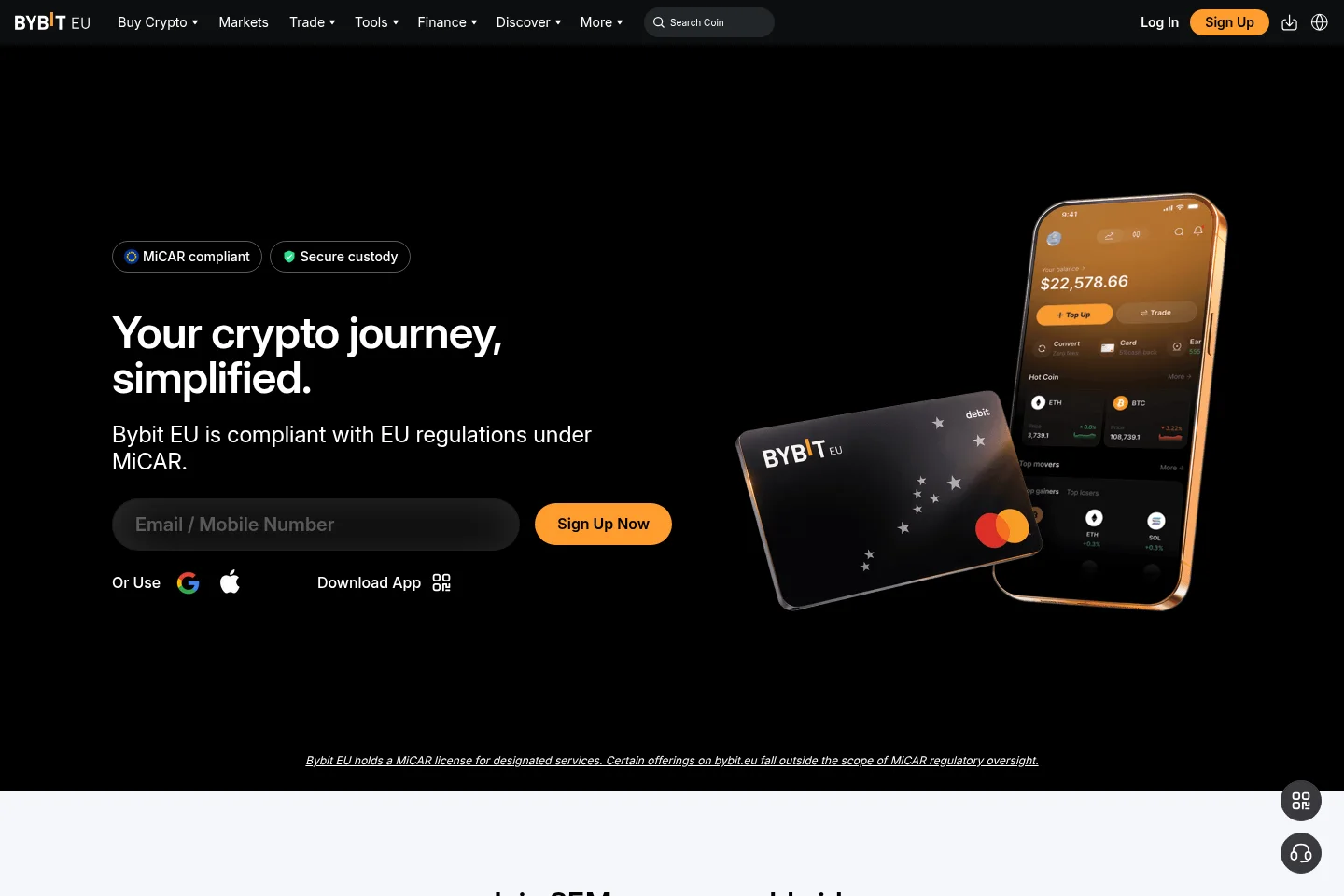
Bybit’s global service and Bybit EU present two different decisions. An eligible international customer can encounter an ordinary crypto-to-crypto spot fee of 0.10% maker / 0.10% taker. The European service introduced a unified base rate of 0.25% from 5 October 2026, with lower rates at qualifying volume or asset tiers. The cheaper global row is irrelevant to an account excluded from that service. Global fees, EU schedule.
Security history is equally central to the assessment. The FBI attributed the theft of approximately $1.5 billion from Bybit on or about 21 February 2025 to North Korean actors. That is a documented exchange-level event, not merely a complaint about an individual withdrawal. The current reserve-verification programme therefore deserves examination alongside the trading tools. FBI notice.
1. Bybit at a glance
| Topic | International service | Bybit EU |
|---|---|---|
| Account scope | Global service with its own jurisdiction restrictions | Separate European company and account conditions |
| Ordinary entry spot pricing | 0.10% maker / 0.10% taker for the documented crypto-pair row | Unified 0.25% base; volume/asset qualification changes the rate |
| US access | US excluded by the international restricted-jurisdiction notice | US nationality is among the EU service exclusions |
| Regulatory record | Do not transfer a foreign group permission to a global account | FMA authorised Bybit EU GmbH under MiCAR on 28 May 2025 |
| Trading architecture | Unified Trading Account guide includes spot and derivatives categories | Use the EU product guide and account permissions |
| Security history | February 2025 theft documented by FBI | A separate entity does not make group history irrelevant, but liabilities and protections must retain entity scope |
| Reserve evidence | Public verification page, audit tools and dated snapshot | Check whether the evidence covers the actual EU account and assets |
Sources: international restrictions, EU nationality rules, FMA authorisation, UTA guide, reserve verification.
2. Start with the company and permitted service
The Austrian FMA’s notice identifies Bybit EU GmbH, commercial-register number FN 636180i, and an authorisation decision dated 28 May 2025. The notice was released on 30 May. Its listed crypto-asset services include custody and administration, exchange of crypto-assets for funds or other crypto-assets, placing and transfer services. Those are concrete permissions attached to a named company. FMA record.
This does not mean every instrument on the global Bybit homepage is an EU product. Financial derivatives, borrowing and other account features require their own applicable terms and permissions. A MiCAR authorisation should not be used as a shortcut to approve the international derivatives catalogue for a European retail account.
Bybit’s global restriction notice and the EU service’s nationality notice also have different functions. The former identifies jurisdictions excluded from the international service; the latter imposes additional person-level conditions. The correct sequence is to establish eligibility, select the account and then compare its prices. It is not to start with the cheapest tariff and find a domain that displays it.
3. The February 2025 theft: what is established
On 26 February 2025, the FBI issued a public notice stating that North Korea was responsible for the theft of approximately $1.5 billion in virtual assets from Bybit on or about 21 February. It associated the activity with TraderTraitor and described subsequent conversion and dispersal of assets across multiple blockchains. FBI public service announcement.
The notice establishes the agency’s attribution, approximate scale and timing. It does not establish that every customer lost that proportion of their balance, publish a complete reimbursement register or certify the safety of a later Bybit deposit. It should also not be expanded into a detailed reconstruction of signing software or device compromise without the corresponding technical evidence.
For a prospective customer, the event highlights a custody question that is separate from personal login security. A customer can protect a password and still depend on the exchange’s institutional transfer controls. Conversely, an exchange’s recovery or reserve statement does not eliminate the customer’s exposure to phishing and account takeover.
| Question | What the cited evidence supports | What it does not establish |
|---|---|---|
| Was there a major exchange theft? | FBI describes approximately $1.5bn taken in February 2025 | That every later withdrawal is impaired |
| Who was responsible? | FBI attributed the activity to North Korean TraderTraitor actors | An independently reconstructed technical chain in this review |
| Does a reserve snapshot matter? | It can support examination of a defined balance/liability snapshot | Continuous solvency, complete corporate liabilities or future access |
| Are customer repayments verified here? | No personal repayment or withdrawal test was conducted | A customer-by-customer compensation outcome |
| Does EU authorisation answer the incident? | It identifies a separate company and specified permissions | A universal insurance policy for all Bybit-branded assets |
4. The international Unified Trading Account
Bybit’s UTA guide describes a unified account covering spot, spot margin, perpetuals, futures and options. It presents an account-level collateral and margin framework rather than treating each instrument as a completely isolated cash purchase. The guide’s dollar-denominated margin balance, collateral values and borrowing fields deserve attention before a trader combines positions. Official UTA explanation.
Collateral value and market value need not be identical. An asset used as collateral can be subject to a valuation adjustment, and liabilities or losses elsewhere in the account can change available margin. That is different from an unleveraged spot order funded entirely with a cash or crypto balance.
The practical distinction is control over the risk boundary. Buying an asset outright, borrowing to buy it and posting it as collateral for another position create different obligations. A unified screen can make those activities convenient to manage, while also making their combined effects harder for a new user to understand. This is a description of the international architecture, not a statement that all of it is available through Bybit EU.
| Activity | Economic exposure | Cost or account field to inspect |
|---|---|---|
| Unleveraged spot purchase | Ownership of the purchased asset in custodial form | Spot execution fee, fill price and withdrawal charge |
| Spot margin | Asset purchase plus borrowing liability | Borrowed amount, interest and collateral requirements |
| Perpetual position | Contract exposure without a fixed expiry | Commission, funding and liquidation parameters |
| Dated futures or options | Contract-specific expiry and payoff obligations | Settlement rules, premium where relevant and margin treatment |
| Multiple collateral positions | Combined account risk under the selected margin mode | Haircuts, liabilities and available margin rather than headline account value |
5. A European address is only one eligibility check
Bybit EU’s restricted-country notice is framed around nationality, not simply the address entered during registration. It also excludes stateless individuals. A US national resident in an EEA country therefore cannot infer eligibility from an EEA residence alone.
The EU KYC guide describes the standard identity and address process for its EEA users. Its verification requirement should be read alongside the nationality notice; the two documents answer different questions. A successful document upload does not grant an exception to an excluded nationality.
For the international service, the global restriction page, updated 16 October 2026, names excluded jurisdictions including the US, Canada and others. It also addresses false representations of location or residence. This review does not treat a VPN, a different app-store country or an alternative nationality field as a route around those conditions.
6. The EU pricing change is already in force
The EU fee article states that trades executed from 5 October 2026 at 11:00 UTC use a single unified fee structure. For the base published band, that rate is 0.25%. Lower-volume sub-bands in the article and VIP qualifications affect which row a particular account reaches, so “0.25% base” should not be taken as a complete tier table.
For an illustrative €3,000 spot execution at 0.25%, the commission is €7.50. A hypothetical unchanged-price round trip with fees deducted from the traded value would leave €2,992.50 after the first trade and €2,985.01875 after the second. The modeled trading charge is €14.98, rounded at the end, before spread, funding, withdrawal and tax.
Do not copy an old EU maker/taker screenshot into a current estimate simply because the account still offers limit and market orders. The documented unified rate changed the fee question. Orders still have different execution behaviour even where their applicable commission row is the same.
7. Global spot is not a substitute tariff
The international schedule gives a VIP 0 crypto/crypto spot rate of 0.10% for each role. Fiat/crypto and other market categories have separate provisions. At 0.10%, an illustrative 3,000 USDT crypto/crypto fill has a 3 USDT-equivalent commission; that arithmetic is not a quote for a euro transaction on Bybit EU.
Comparing €7.50 and 3 USDT as though both purchased exactly the same eligible route would be misleading. The currencies, entities, access rules and possibly market execution differ. The useful comparison holds those conditions constant rather than presenting the international fee as an option for every European or US reader.
Derivatives add still more costs and eligibility conditions. A spot fee does not include perpetual funding, borrowing, liquidation or a separate product’s risk. This review’s fee examples remain unleveraged spot examples and do not recommend moving to a derivatives market to reduce a commission.
8. What EU verification involves
Bybit EU says Standard Verification is compulsory to access its products and services. Its guide, updated 12 November 2026, describes quick, bank and video identity-verification paths, with identity documentation and the relevant liveness or interview steps. Advanced Verification is optional and can support higher fiat deposit limits.
The bank-verification route is unusually concrete: after the identity stage, it asks for an IBAN and a €1 SEPA transfer from a bank account in the user’s own name. A third-party payer is not accepted for that verification process. The €1 step should not be advertised as a universal minimum trading deposit or as a complete bank-fee schedule; its purpose is verifying the account.
The guide also includes a profile survey, residence information and potential enhanced due diligence. Have current documents ready and use the route offered to the actual account. No fixed approval time is promised here, and choosing the quickest-looking route does not guarantee acceptance.
9. Funding, execution and the exit remain separate
A same-name bank account is part of the documented EU verification route. The cost of an ordinary fiat deposit or withdrawal still needs the current method and account quote. This review does not infer zero-cost SEPA transfers from the existence of the €1 verification step.
For crypto-funded spot trading, verify the receiving network and confirmation requirements before sending. When exiting, compare withdrawing the purchased asset with selling into a balance that can actually reach the desired bank account. A chain withdrawal, a fiat transfer and an internal account movement are different operations with different potential costs.
A marketable order can walk several price levels. A limit price can constrain the execution price but leave an order partly filled. Neither the international fee schedule nor the EU unified rate guarantees enough depth for a particular amount. Atlas has not performed a live, matched-size Bybit execution comparison for this review.
10. The correct app follows the correct account
Bybit EU publishes app and web verification instructions in its KYC guide. Those instructions do not establish that an international account and an EU account share every feature, fee or funding method. Use the account’s regional documentation when choosing a download, support route or verification workflow.
Review sign-in, recovery and withdrawal controls in that account before relying on it as part of a longer transfer route. Keep any API key narrowly permissioned. These are operating considerations; no hands-on app test or security audit is represented by the review.
Bybit’s useful comparison is conditional: an eligible international crypto/crypto trader may evaluate the global spot product, while an eligible EEA customer needs the EU contract, current unified fee and nationality checks. A US customer cannot resolve the global exclusion by selecting the EU version. Those access facts outweigh the attraction of the lowest visible fee.
11. A more useful European fee table
The EU rate is unified across the stated spot and spot-margin fee scope. It is not the old global maker/taker pair. The following selected rows retain the account qualification rather than implying that one large order instantly earns a lower fee:
| EU qualification shown in the schedule | Published trading rate | Important assumption |
|---|---|---|
| VIP 0, volume below €100,000 across the listed lower sub-bands | 0.2500% | No separate balance or other qualification placing the account at a higher VIP tier |
| VIP 0, volume at least €100,000 | 0.2200% | Use the account’s actual qualifying row at order placement |
| VIP 0, volume at least €250,000 | 0.2000% | Higher qualifying rows may supersede this one |
| VIP 0, volume at least €500,000 | 0.1500% | Not an invitation to manufacture volume |
| VIP 1: €100,000 assets OR €1m spot volume | 0.1200% | Only one of the stated main criteria is required |
| VIP 2: €250,000 assets OR €5m spot volume | 0.0775% | The full VIP requirements also describe borrowing-related criteria |
| VIP 3: €500,000 assets OR €10m spot volume | 0.0750% | See the complete programme for all account conditions |
The fee article says VIP level updates daily at 07:00 UTC and subaccounts use the main account’s rate. The applicable order fee is the rate attached to the account when the order is placed. Higher tiers and borrowing conditions appear in the full source; holding substantial assets solely to reach a discount is a separate custody and capital decision. Complete EU fee and qualification table.
At the base EU 0.25% rate, €100, €1,000 and €10,000 executions incur €0.25, €2.50 and €25 of trading commission respectively. The corresponding global 0.10% illustration is $0.10, $1 and $10 on equal dollar notionals. Different currencies, accounts and eligibility mean those examples are not directly exchangeable invoices.
12. Reserve verification after the incident
The working public reserve page identifies an audit scope dated 27 October 2026 at 06:00 UTC. It provides links to account audit data, reserve ratios, an audit report and open-source verification tools. It also describes a “send to self” method for demonstrating control of published wallet addresses. Official reserve-verification page.
These features answer narrower questions than “is the company risk-free?” A wallet-control demonstration concerns the stated address and transaction. A Merkle-style inclusion check concerns whether a balance appears within a particular liabilities dataset. Neither alone proves the absence of other corporate obligations, the completeness of every account liability or uninterrupted access to withdrawals.
Bybit’s statement of 1:1 backing remains an operator statement in this review. Atlas has not independently rebuilt the snapshot or audited the legal entities. A reader should match the snapshot date, asset and actual account coverage, particularly before assuming an international proof includes a separately contracted European balance.
13. Demo trading, apps and execution quality
The official demo guide documents a simulated trading environment. It can help a customer learn the controls and understand the mechanics of order placement. It does not test real custody, a bank payout or the liquidity available for a particular real order. Demo guide.
The same distinction applies to a screenshot or mobile interface. A market displayed in a public app does not establish that the viewer can trade it from their residence or with their current account. For actual execution, examine the selected pair, spread, visible depth and order size. A narrow displayed spread can coexist with insufficient depth for a large order; no live execution benchmark is claimed here.
14. Advantages and limitations
| Potential strength | Qualification or drawback |
|---|---|
| Detailed international trading architecture | Unified collateral and leveraged positions create account-level risks |
| A named MiCAR-authorised EU company | Its service scope and nationality rules differ from the global service |
| Transparent EU tier and qualification table | The 0.25% base is higher than the global ordinary spot row |
| Public reserve-verification tools | Dated snapshots are narrower than continuous solvency or personal insurance |
| Documented demo environment | Simulation does not validate real fills or withdrawals |
| Multiple products within one brand | The February 2025 major theft remains material security history |
15. Who should compare Bybit with an alternative?
A US reader should begin with a venue that actually serves the intended US state and product. Neither an international fee table nor an EU address removes the documented Bybit exclusions. An EEA reader should compare Bybit EU with another currently operating European service, using each product’s actual tariff and asset restrictions.
An eligible international trader assessing UTA has a different priority: understanding the margin mode and the interaction between positions. Someone making an occasional unleveraged purchase may place more weight on a simple bank route and external withdrawal than on the number of derivatives tools. The best comparison uses the task the customer intends to complete, rather than awarding points for every menu item.
16. Frequently asked questions
Can US residents use the international service?
The international restricted-jurisdiction notice excludes the United States. The EU service also lists nationality restrictions, including US nationals. These are separate checks, not interchangeable registration options. Global rules, EU rules.
Is Bybit EU regulated?
The Austrian FMA granted Bybit EU GmbH a MiCAR crypto-asset service authorisation on 28 May 2025. The notice lists specific services. It does not approve every global Bybit derivative or guarantee customer investment values. FMA notice.
Is the European trading fee 0.10%?
The checked EU schedule introduced a unified 0.25% base from 5 October 2026, with qualifying lower tiers. The international ordinary 0.10% crypto-pair row belongs to another product. EU fee structure.
What happened in the 2025 hack?
The FBI described a theft of approximately $1.5bn on or about 21 February 2025 and attributed it to North Korean actors. This review does not turn that notice into an independently verified customer-reimbursement register. FBI notice.
Does Proof of Reserves eliminate custody risk?
No. The public tools offer defined snapshot and wallet-verification evidence. They do not replace a complete financial, operational and legal assessment, or guarantee the result of a future withdrawal. Reserve page.
17. Final assessment
Bybit offers a substantial international trading framework and a separate European service with a named authorisation and distinct fees. Those are meaningful features, but the account boundary is part of the product rather than a footnote to it.
The February 2025 theft also belongs near the centre of the decision. A useful evaluation combines that history with the dated reserve evidence, the applicable contract and the withdrawal route. Global pricing, European permissions and reserve snapshots should each retain their proper scope.
Research checked on 23 November 2026. This is a review of official documentation; no account opening, trade, support-response or withdrawal test is claimed.
Sources and check dates
- Bybit global fees ·
- Bybit eu fees ·
- Bybit fbi hack ·
- Bybit global access ·
- Bybit eu access ·
- Bybit fma authorisation ·
- Bybit uta ·
- Bybit reserves valid ·
- Bybit eu kyc ·
- Bybit demo ·
Operator, regulatory and court records support the relevant findings; third-party market data is identified in the text. Effective dates and unresolved checks remain beside the claim.