
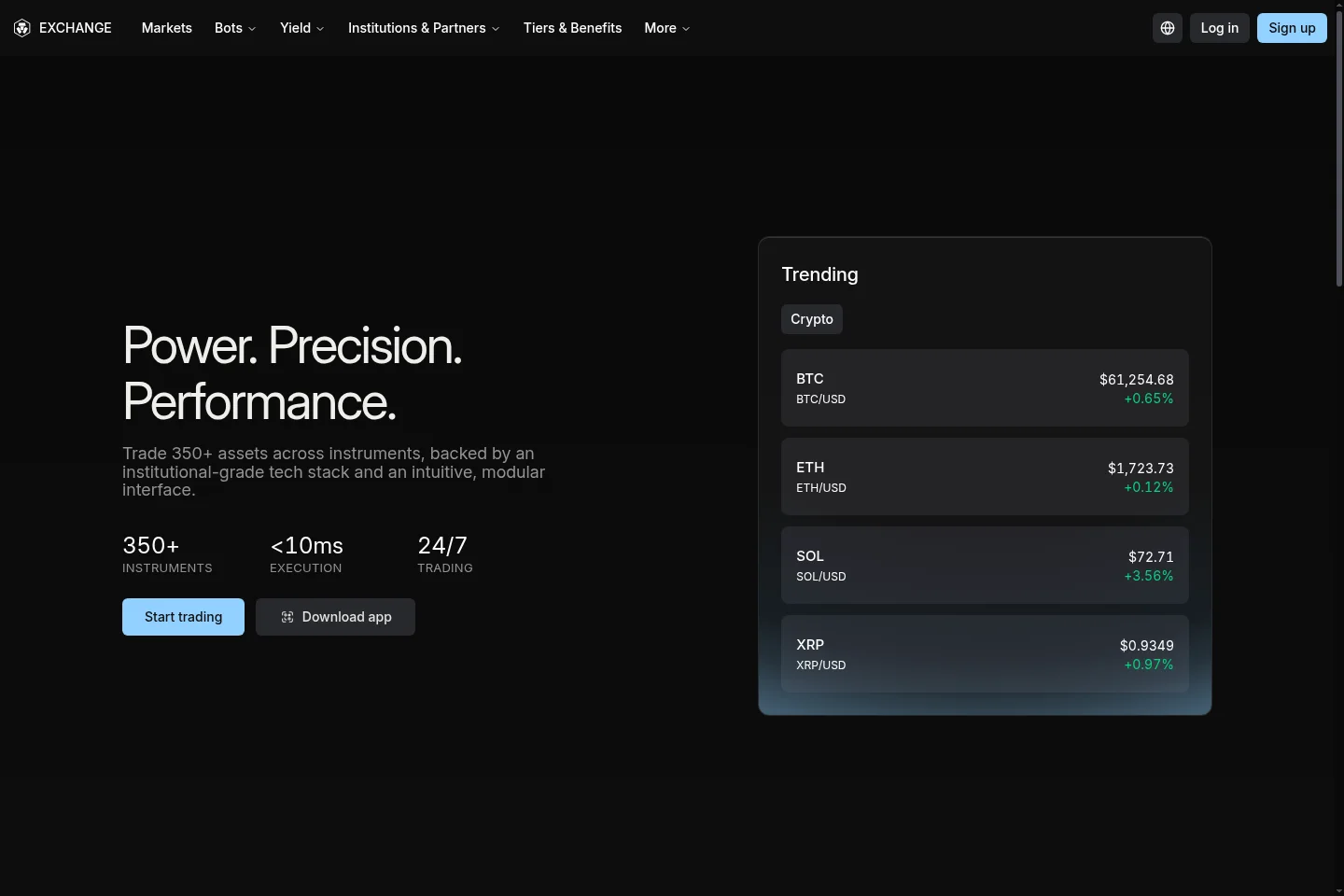
Crypto.com Exchange is most interesting when evaluated as a complete banking-and-trading route. The first spot tier is not exceptionally cheap without the qualifying CRO balance: 0.25% maker / 0.50% taker below $10,000 in 30-day volume. Its documented US retail ACH route, however, gives eligible customers a direct way to bring dollars into the Exchange. Whether the combination works depends on funding eligibility, order execution and the eventual withdrawal.
The familiar blue Crypto.com logo covers more than one service. Buying in the App, placing an Exchange order, using a card and opening a derivatives position are different transactions. This assessment keeps the centralised Exchange at the centre and treats the wider group’s products as separate account decisions. Exchange fees, US Exchange ACH.
1. Crypto.com Exchange at a glance
| Question | Documented answer | Practical consequence |
|---|---|---|
| What is being assessed? | Centralised Crypto.com Exchange, with retail cash and spot documentation | The consumer App quote is not the Exchange order-book tariff |
| History | Company disclosures date the business to 2016 | Longevity does not establish the current protection of a specific account |
| First ordinary spot tier | 0.25% maker / 0.50% taker below $10,000 | A $1,000 taker execution costs $5 before other components |
| Selected CRO condition | At least 50,000 CRO; first displayed row 0% maker / 0.44% taker | The balance, programme and account conditions must actually qualify |
| US ACH deposit | Minimum $1; published estimate 1–5 business days | Initial bank verification and settlement can affect availability |
| US ACH withdrawal | Minimum $100; estimate 1–3 business days | A small residual cash balance may need a different exit |
| Additional USD withdrawal layer | Rolling 30-day net usage; free portion up to $1m, then 0.05% | A rail described as free is not a blanket waiver of usage charges |
| European regulation | Group EEA licensing overview identifies several different permissions | Match the specific contract and service to the relevant entity |
Sources: company disclosure, spot schedule, ACH instructions, USD withdrawal bands, EEA overview.
2. Background and the limits of the group brand
Crypto.com’s company disclosures describe a business founded in 2016. The group now advertises activities across cryptocurrency trading, payments, custody and other financial services. For an Exchange user, the useful ownership question is which company signs the account agreement and owes the relevant contractual duties. A group-level history does not replace that identification. Company disclosure.
The US and European service structures also answer different regulatory questions. A money-transmission registration, an e-money permission and a derivatives-market authorisation have different scopes. The group’s EEA overview should therefore be read as a map of permissions, rather than one licence covering every product carrying the logo. This review does not treat a card benefit or a registration held by another group company as Exchange account protection. EEA licensing overview.
3. A product map before the price comparison
| Service or workflow | What the customer is doing | What needs a separate check |
|---|---|---|
| Crypto.com App purchase | Accepting a retail purchase or conversion quote | Spread, payment charge and App-specific fee preview |
| Exchange spot order | Buying or selling against a centralised order book | Maker/taker tier, pair, available balances and fill price |
| Exchange bank transfer | Moving supported fiat into or out of the account | Residence, bank-name match, transfer minimum and settlement |
| Margin or derivatives | Taking exposure with borrowing or contract mechanics | Product permission, collateral, interest/funding and liquidation |
| External crypto transfer | Sending an asset to another exchange or wallet | Exact network, address, memo and withdrawal quote |
| Developer connection | Reading data or submitting authorised API instructions | API scope, key security and permission to reuse market data |
The official developer overview lists REST, WebSocket and FIX-related categories and multiple trading products. That describes connectivity, not a grant of access to every instrument in every country. An API integration cannot convert an ineligible retail account into an approved derivatives client. Developer overview.
4. One brand, several transaction types
The registration guide offers a process for existing Crypto.com App users and a process for new Exchange customers. It still requires Exchange account and identity-verification steps. The presence of the App on a phone does not price an Exchange order or establish access to the same regional features.
This review concerns the centralised Exchange and its documented spot and cash operations. Derivatives, margin, staking, a card programme and tokenised securities have additional terms. A licence or feature belonging to another company in the group cannot be used to approve all of them for a reader.
5. Spot pricing before and after a CRO condition
The published spot table supplies these selected rows:
| 30-day spot volume | Maker without qualifying CRO | Taker without qualifying CRO |
|---|---|---|
| Below $10,000 | 0.25% | 0.50% |
| $10,000+ | 0.20% | 0.40% |
| $50,000+ | 0.15% | 0.25% |
For the first row, the displayed qualifying CRO arrangement has 0% maker and 0.44% taker, with the table identifying a balance of at least 50,000 CRO. Fee benefits depend on that programme’s actual conditions and account balance. The quoted benefit is not a reason to describe acquiring CRO as a risk-free way to save money.
On an illustrative $4,000 first-tier taker order, 0.50% is $20. At 0.44%, the commission would be $17.60, a difference of $2.40 for that execution. This is a fee comparison only. It excludes any cost, market risk or other condition involved in acquiring and maintaining the qualifying CRO balance.
The schedule says fee rates update daily at 04:00 UTC using the relevant account measures. Use the rate shown for the account and pair when the order is placed. A futures fee, liquidation charge or separate promotional row should not be inserted into a normal spot estimate. Fee conditions, fee overview.
6. US retail ACH is a documented Exchange route
The US retail ACH guide is useful because it concerns the Exchange itself. It documents USD bank transfers for eligible US retail users, with a $1 minimum deposit, an estimated 1–5 business days for deposits, a $100 minimum withdrawal and an estimated 1–3 business days for withdrawals. These are the operator’s processing estimates, not a test result or delivery guarantee.
The bank account must be in the customer’s name. Transfers from another person’s account or another crypto exchange are not the supported way to initiate this ACH cash deposit. Additional USD-transfer verification can include an SSN, home-address details and current proof of address. Passing the initial Exchange registration does not eliminate the cash-rail activation step.
The article’s US scope does not establish that every US state or every Exchange product is available. Confirm the state and the actual account offer before sending money. In particular, a US retail ACH document should not be used as evidence for US derivatives or for a European banking route.
7. The USD withdrawal charge is a separate layer
The USD withdrawal article, effective 1 May 2026, describes a rolling 30-day net USD fiat withdrawal calculation. Its published bands give a free portion up to $1 million and a 0.05% rate above it. The net measure and daily limits matter; it is not simply a fee on every ACH withdrawal.
Consider an eligible account with $900,000 already counted in its net rolling withdrawal measure. An additional $200,000 request would take that measure to $1.1 million. If the stated assumptions and applicable account limit permit the request, $100,000 crosses above the free band, producing $100,000 × 0.05% = $50. This is an illustration of the band, not a claim that a retail account can submit that amount in one day.
The source lists different daily withdrawal caps for client classifications. It also explains that deposits and qualifying OTC activity affect the net calculation. Use the operator’s current account calculation rather than treating a screenshot of the headline threshold as a full invoice. An absence of an ACH network fee and a net-withdrawal usage charge can both be true.
8. EEA scope and verification
Crypto.com publishes an EEA licence and registration page describing group permissions, including crypto-asset services. That overview should be matched to the company named in the customer’s Exchange agreement. It does not establish that every product advertised under the brand is offered by the same entity or covered by one permission.
For an EEA reader, verify the contracting company, allowed assets, fiat currency and actual payment instructions before borrowing the international spot table. This review does not infer a universal SEPA fee or country-level onboarding acceptance from the US ACH guide. UK and Swiss customers need their own regional check.
The Exchange registration instructions require email and phone verification and identity verification. The documented flow includes personal details and identity checks; existing App users still follow the Exchange-specific route shown to them. It gives preparation steps, not an assurance that a particular identity document or applicant will be approved.
9. After the trade: cash or crypto
A cash exit involves a sale, the account’s available withdrawal rail and any net-usage charge. A crypto exit instead involves the selected blockchain and its withdrawal quote. Compare those alternatives using the same starting amount and distinguish market movement from fees. Selling to USD, withdrawing USD and converting a token are not the same event.
For a crypto transfer, match network support and destination details before confirmation. For cash, check beneficiary-name requirements, the amount available to withdraw and pending account checks. A displayed trading balance is not proof that the full amount can immediately leave by the preferred method.
The Exchange is a reasonable candidate when an approved customer’s bank rail and intended order-book use fit together. It is less convincing when the comparison relies on the App’s branding, an assumed CRO benefit or a blanket “free withdrawal” claim. The useful number is the cost of the actual approved route through and out of the account.
10. Funding details that can change the result
| US Exchange cash step | Published condition | Why it deserves attention |
|---|---|---|
| Bank ownership | The bank account must belong to the Exchange customer | Another person’s transfer is not the supported funding route |
| Deposit minimum | $1 | A published minimum does not guarantee immediate trading or withdrawal access |
| Deposit timing | Typically 1–5 business days | New bank activation and individual checks can change the process |
| Withdrawal minimum | $100 | A balance below this threshold does not become an eligible ACH withdrawal |
| Withdrawal timing | Typically 1–3 business days | Banking estimates are not tested delivery guarantees |
| Cash verification | Additional SSN, home address and proof-of-address information can be requested | Ordinary account registration may not finish the USD-transfer onboarding |
| Returned payment | The guide describes a possible $40 administration charge for an erroneous return | Avoid sending an unsupported or mismatched transfer |
| High net USD withdrawals | Separate rolling usage bands and client-class daily limits | Do not equate an example above $1m with a permitted single retail request |
These conditions come from the US retail ACH guide and withdrawal usage schedule. They are not a European SEPA tariff. For an EEA customer, the correct starting point is the actual available funding instructions and contracting entity; an unknown local charge remains unknown.
11. When does a CRO fee benefit become meaningful?
The first-tier taker difference between 0.50% and 0.44% is 0.06 percentage points. On the same executed notional, that is $0.60 per $1,000 or $6 per $10,000. A qualifying zero-maker rate changes the calculation more strongly, but only for amounts that genuinely execute as maker under that programme.
There is no universal break-even answer without assigning a cost to acquiring and holding the required CRO, the period of exposure and any relevant programme condition. A customer who already holds a qualifying balance faces a different decision from someone buying it solely for a small commission reduction. Neither comparison establishes an expected CRO investment return. CRO and fee conditions.
12. Hacks, advertising rulings and enforcement history
| Date / matter | Documented record | Outcome and boundary |
|---|---|---|
| January 2022 security reporting | Crypto.com’s own monthly roundup linked reports of a roughly $34m hack and reports of its no-customer-loss position | The roundup is a company-curated index of reporting, not a forensic report or an Atlas reimbursement audit |
| 5 January 2022 ASA ruling | UK advertising watchdog upheld complaints about risk presentation and credit-card / reward claims in 2021 ads | Advertising compliance finding involving Forisgfs UK; not a finding that every Exchange account lost funds |
| 21 December 2022 NFT advertising ruling | ASA upheld a separate case concerning Foris DAX Global NFT promotion | Separate product and campaign; do not present it as a spot-wallet breach |
| 27 March 2025 SEC investigation closure | Crypto.com announced that the SEC closed its investigation without enforcement action | Company disclosure of an investigation outcome; not a court judgment approving every asset or product |
Sources: January roundup, ASA January ruling, ASA NFT ruling, company SEC statement.
The 2022 episode deserves inclusion because it contradicts an unqualified description of an incident-free brand. The source used here also has an important limitation: a monthly roundup links other publications rather than publishing the full technical investigation. Its headlines should not be expanded into a reconstructed attack mechanism or a verified, customer-by-customer repayment figure.
The advertising decisions raise another practical issue. A quoted reward or an easy credit-card purchase can dominate a promotion while leaving costs and risk less visible. For a reader comparing Exchanges, the right response is to examine the actual transaction and product terms. The historical UK ad findings do not themselves establish present US or EEA onboarding eligibility.
13. Security, custody and the difference between policies and proof
Identity checks, withdrawal approval and account-security controls address different failure modes. KYC identifies the customer; it does not eliminate phishing. A verified bank rail reduces some transfer mismatches; it does not prove that a malicious withdrawal request cannot occur. A displayed balance also remains a custodial claim until the asset is successfully transferred under the relevant agreement.
For an external transfer, verify both the asset and the supported blockchain. For account protection, reach support and software downloads through the official website rather than an unsolicited message. If API keys are used, grant only the functions needed and avoid withdrawal permission for a read-only tool. These are precautions, not evidence of a security test performed for this article. Account registration, developer interface.
14. Mobile and API use
The App and Exchange can coexist in a customer’s routine, but the convenience of a shared brand should not conceal the pricing boundary. The order preview, custody product and selected account determine what is being bought and which terms apply. A user switching from a simple purchase to order-book trading needs to understand limit prices and partial fills rather than assuming the cheaper percentage is automatically applied.
Professional connectivity adds another distinction: access to a public API endpoint does not necessarily grant permission to republish its data commercially. Atlas does not use this review as a claim that its own price or order-book feed is live. Exchange API overview.
15. Advantages, limitations and alternative approaches
| Potential advantage | Material limitation | Useful comparison |
|---|---|---|
| Direct documented US retail USD route | State/account approval, settlement and a $100 withdrawal minimum | A supported USD bank route at Kraken or another US-serving venue |
| Transparent Exchange spot tiers | App quotes and CRO conditions have different economics | Coinbase Advanced retail pricing versus institutional Coinbase Exchange |
| Several group financial permissions | Permissions belong to particular companies and activities | The exact EEA contract and a currently operating regional alternative |
| Developer connectivity | API scope, operational security and data rights need separate review | Public market-data access versus account trading permissions |
| Conditional fee reductions | Token exposure can exceed the saving from a small trade | Ordinary commission without acquiring a discount token |
The strongest fit is an eligible customer whose preferred cash rail, order-book use and withdrawal plan all work together. It is a weaker match for someone choosing only from an App promotion or expecting a group licence to answer every product-permission question. A self-custody DEX is a different alternative again: it changes custody and network costs rather than simply replacing one centralised trading commission.
16. Frequently asked questions
Is Crypto.com Exchange the same as the App?
No. The registration guide offers an Exchange route for existing App customers, but the trading interface, pricing and account steps remain product-specific. Apply the fee table or quote for the service actually being used. Registration guide.
What does a first-tier $1,000 spot trade cost?
Ordinary published commission is $2.50 as maker or $5 as taker. The qualifying CRO row differs. These figures exclude funding, spread, slippage, withdrawal and any cost of maintaining the CRO condition. Spot schedule.
Are US ACH withdrawals always free?
The ACH route and the net USD withdrawal usage schedule answer different questions. The latter applies a free portion up to $1m and a 0.05% rate on the relevant amount above it, subject to its net calculation and daily account limits. USD usage terms.
Can an EEA user copy the US funding instructions?
No. A US bank rail is not an EEA funding permission. The account must identify the European service company, supported currency and available local route. EEA overview.
Has the group faced security or regulatory controversies?
Yes. The record above includes 2022 security reporting and two upheld UK advertising cases. The later company announcement of a closed SEC investigation is a separate event. These should not be merged into one supposed wallet loss or one universal regulatory verdict.
17. Final assessment
Crypto.com Exchange can offer a coherent route from eligible fiat funding to an order-book trade and an eventual exit. Its ordinary entry commission, the CRO qualification and withdrawal minimums make the route more important than any single headline percentage.
The comparison is strongest when the customer selects a regional Exchange account first, prices that account’s order and then checks how the resulting asset or cash will leave. A recognizable App and a broad group ecosystem do not remove those decisions. The historical incident and advertising record should sit alongside the operational features, with each outcome attributed to the company or regulator that documented it.
Research checked on 23 November 2026. This is a review of official documentation; no account opening, trade, support-response or withdrawal test is claimed.
Sources and check dates
- Crypto spot schedule ·
- Crypto us ach ·
- Crypto sec closure ·
- Crypto withdrawal charges ·
- Crypto eea licenses ·
- Crypto api overview ·
- Crypto kyc ·
- Crypto fees ·
- Crypto january 2022 ·
- Crypto asa ruling ·
- Crypto asa nft ·
Operator, regulatory and court records support the relevant findings; third-party market data is identified in the text. Effective dates and unresolved checks remain beside the claim.