Gate’s most important comparison is between its global, EU and US services. They share a brand but have separate agreements, eligibility and product boundaries. The global agreement excludes the United States and several major European countries. Gate’s European contract instead identifies a Malta company with specified permissions, while a distinct Gate US agreement also exists. An article that simply calls Gate unavailable in America, or applies one global tariff everywhere, misses those distinctions.
This is a documentary audit of public product descriptions, fees, regional agreements and incident records. It does not involve access to internal systems, a technical security certification or personal trading. For the EU product, the checked ordinary spot rate is 0.10% maker / 0.10% taker; the account’s own regional schedule remains the starting point. Global agreement, EU agreement, US agreement, EU fees.
1. Gate at a glance
| Question | Documented starting point | Boundary |
|---|---|---|
| Background | Official media kit dates the business to 2013 and names founder Dr. Han | Company history, not an independent solvency finding |
| Global account | Separate global agreement with a substantial restricted-location list | The public global product menu is not worldwide eligibility |
| European account | Gate Technology Ltd, Malta, registration C 89337 | EU contract and fees differ from global terms |
| US account | Gate US, Inc. has a distinct user agreement | Existence does not establish access in every state or identical fees |
| EU entry spot fee | 0.10% maker / 0.10% taker | Volume or asset qualification can change the VIP tier |
| Product range | Global website advertises spot, derivatives, P2P, bots and other services | Each product needs its own regional permission and cost calculation |
| Historical security issue | 2018 Statcounter supply-chain attack targeted Gate.io users | ESET research and the operator statement have different evidentiary scopes |
Sources: official media kit, regional agreements, EU contract, US contract, EU tariff, ESET research.
2. Background, brand and ownership questions
Gate’s official media kit describes a business founded in 2013 by Dr. Han. Its current public site presents an extensive financial-products ecosystem rather than a spot exchange alone. For a customer, however, a founder biography and a broad corporate timeline do not identify the company that holds a particular balance. That requires the account agreement. Media kit.
The European agreement is particularly useful because it names Gate Technology Ltd, registration C 89337, and the Maltese authorisation identifier GTEC. The US agreement names Gate US, Inc. A reader should retain those identities when evaluating complaints, banking instructions, legal remedies or a security announcement. An incident involving a shared brand is not automatically a liability of every company using it.
3. Global, EU and US: three different routes
| Service | Relevant access evidence | What can be concluded |
|---|---|---|
| Global Gate | Global restricted list includes US, France, Germany, Netherlands, Spain, Austria and other locations | Those readers should not treat the global account as their approved route |
| Gate EU | EU agreement describes covered crypto and payment services and EEA passporting | Review this contract and its account conditions for the European service |
| Gate US | Agreement requires an eligible adult US/territory resident and includes screening/restricted-party terms | A US service exists; precise state and product availability still need the current offer |
| A global derivatives or on-chain product | Separate product and platform conditions | A menu item on another regional page is not permission for the selected account |
The US agreement’s October 2026 amendments had a separate effective date for California: 27 October rather than immediate effect on 13 October. By this review’s date both dates are historical. This is a useful example of why a dated regional agreement is more informative than a screenshot of a global registration button. US agreement.
4. European licensing and service scope
The EU agreement identifies Gate Technology Ltd as an MFSA-licensed Class 3 crypto-asset service provider under Malta’s implementation of MiCA. It lists operation of a trading platform, custody, exchange, execution and transfer services for eligible crypto-assets. It also describes a Payment Institution permission for specified cash-account and payment activities. These are the operator’s contractual disclosures of its permissions. EU legal document.
Crypto services and payment services remain different activities even when included in one contract. A payment permission does not guarantee a particular free SEPA withdrawal, and a crypto authorisation does not approve every global derivative, stock-linked product or reward arrangement. The instrument, provider and terms shown to the customer still matter.
The agreement also sets an adult-account requirement and other eligibility representations. An EEA residence therefore provides context for the regional service, rather than an unconditional promise that every applicant and asset will be accepted.
5. European spot fees: selected tiers
| EU VIP tier | 30-day spot-volume route | Asset-value route | Maker / taker |
|---|---|---|---|
| VIP 0 | €0 | €0 | 0.100% / 0.100% |
| VIP 1 | €60,000 | €2,000 | 0.099% / 0.099% |
| VIP 2 | €120,000 | €4,000 | 0.098% / 0.098% |
| VIP 3 | €240,000 | €10,000 | 0.097% / 0.097% |
| VIP 4 | €500,000 | €20,000 | 0.095% / 0.096% |
| VIP 5 | €1m | €40,000 | 0.090% / 0.095% |
| VIP 10 | €100m | €2m | 0% / 0.058% |
The schedule says either the relevant volume or asset criterion can qualify the account. Levels update on a 24-hour cycle. A level achieved through volume is described as retained for 60 days; an asset-based level requires the qualifying asset value to be maintained. Those rules matter more than simply quoting the lowest fee in the table. EU fee and qualification rules.
This is a selected EU table, not a complete global or US tariff. It should not be combined with a GT discount or a promotion from a different account unless the same regional programme expressly applies. This audit does not establish one universal global or US spot rate from the European page.
6. What the European entry fee costs
| Executed notional | Maker commission | Taker commission |
|---|---|---|
| 100 EUR | 0.10 EUR | 0.10 EUR |
| 1000 EUR | 1.00 EUR | 1.00 EUR |
| 10000 EUR | 10.00 EUR | 10.00 EUR |
At a constant €1,000 notional on each side, buying and later selling at 0.10% would produce €2 of commission. If fees are deducted from the available amount, the second notional is smaller: €1,000 becomes €999 after the first fee, then €998.001 after the second, or approximately €2 total at cent precision. Neither example includes price movement, spread, funding or withdrawal.
A higher tier should not be earned by assumption. The fee page describes account qualification and an update cycle; placing one large order is not the same as having the better tier already applied when that order is submitted. Holding assets to obtain a discount also introduces a custody and capital decision separate from commission savings.
7. The global product range
| Product category on the global site | What changes economically | What to check before comparison |
|---|---|---|
| Spot | Buying or selling an asset in a centralised account | Pair, role, regional fee and external transfer support |
| Futures and other derivatives | Contract exposure with collateral and settlement mechanics | Country permission, margin, funding and liquidation |
| Trading bots | Rules automate order submission | Executed-order fees, allocation and behaviour when the strategy stops |
| Copy trading | Another trader influences the execution strategy | Allocation, profit sharing, fill differences and exit controls |
| P2P | A counterparty and local payment method enter the transaction | Escrow terms, payment finality and dispute handling |
| On-chain or early-token tools | An asset can involve a different venue or custody workflow | Contract risk, supported network and the relevant service provider |
| Earn or structured products | The asset can be subject to reward, lockup or counterparty terms | Source of returns, redemption conditions and loss exposure |
These categories are visible in the current global product description. They identify questions to investigate, not a list of services automatically available through Gate EU or Gate US. An advertised zero commission on a conversion flow also should not be taken to mean that every possible execution has no spread or economic cost.
8. Funding, withdrawals and KYC
Start a transfer by matching the agreement, currency and beneficiary instructions to the selected account. The global agreement describes identity-document and compliance-review processing; the US agreement has its own identity verification and screening section. A process that collected documents through an authorised onboarding entity does not automatically remove continuing review requirements. Global terms, US terms.
For a crypto deposit, the ticker alone is insufficient. The sending and receiving services need to support the same network, and some assets require an additional memo or tag. For a cash deposit, the accepted beneficiary and name rules belong to that particular bank route. This audit does not turn an unverified local funding charge into “free.”
| Transfer question | Why the answer can vary | Evidence to use |
|---|---|---|
| Which account receives the money? | Global, EU and US services have different agreements | The selected account contract and displayed beneficiary |
| Is the fiat rail supported? | Currency, residence and bank/provider conditions matter | Current funding instructions for that account |
| What is the withdrawal cost? | An asset/network or bank route can have a separate tariff | The live quote and published regional schedule |
| Can the whole balance leave now? | Settlement, open orders and compliance reviews can affect availability | Withdrawable balance and account notices |
| What documents are needed? | Individual, business and enhanced checks differ | The actual verification request, not an old registration screenshot |
9. Predecessor history and the 2015 security crisis
Gate’s founder identifies Bter as Gate’s predecessor in his twelfth-anniversary letter. That link means the older business should not disappear from a historical assessment simply because the current name is different. A March 2015 forum post under the JUA.com name describes Bter as having suffered a major security incident and discusses proposed rebuilding support. The identity behind that forum account was not independently verified in this audit; it is a contemporaneous account, not a court record or an audited repayment statement. Founder letter, contemporary forum post.
Those records establish the predecessor relationship and a serious early security crisis, but they do not provide this audit with a complete customer-repayment register. A later positive user testimonial is also not enough to independently establish that every affected Bter customer was made whole. This review therefore does not invent a final recovery percentage.
10. The 2018 Statcounter incident
ESET’s November 2018 research describes a supply-chain attack against the Statcounter analytics service. Attackers modified third-party JavaScript loaded by websites and targeted Gate.io’s Bitcoin-withdrawal workflow. The security issue was therefore a malicious external web resource, rather than evidence in that report that an exchange-wide cold-wallet key had been stolen. ESET original research.
Gate’s own announcement says it removed Statcounter after being alerted and stated that users’ funds were safe. ESET’s updated research also says the malicious script was removed, while its conclusion explicitly says the researchers did not know how many bitcoins had been stolen. Those statements should retain their separate attribution. They do not support inventing either a precise customer-loss figure or an independently proven zero-loss result. Operator announcement, research findings.
The episode illustrates a practical issue beyond Gate: a website can depend on code controlled by another company. Personal two-factor authentication and exchange wallet policies address different parts of that attack surface. Removing one compromised script resolves that reported exposure; it does not amount to a permanent security certification.
Gate also published a 2022 response to disputed claims about a different alleged 2018 incident, stating that its users had not suffered personal-asset losses in that attack. This is the operator’s response, not an independent adjudication. It should not be merged with ESET’s separately documented Statcounter incident or used to assign an unverified loss amount. Operator response.
11. Ethereum Classic’s 2019 consensus attack
In a 12 January 2019 announcement, Gate said an Ethereum Classic 51% attacker had returned ETC then valued at about $100,000 on 10 January. Gate described raising its ETC confirmation requirement to 4,000 and adding detection for blockchain reorganisations. Contemporary Gate announcement.
This is a different risk from a stolen exchange signing key: a blockchain rollback can invalidate the deposit history on which an exchange relied. The returned amount in the announcement is not a verified final accounting of the entire incident, and its dollar value is historical. The operational lesson is that confirmation requirements and network security affect the deposit route as well as the exchange’s own wallet controls.
12. Reserve claims and what this audit checks
The official media kit presents Gate’s reserve framework and public reserve claims. These are useful leads for checking a dated report, the included assets and customer-liability coverage. This article does not independently recompute a current reserve ratio from the marketing page. Official media kit.
A percentage displayed on one day is also not a complete corporate balance sheet. Wallet assets, customer inclusion, liabilities outside the stated scope and legal control of assets are separate questions. For regional accounts, establish whether a cited global proof covers the company and account holding the balance.
13. Apps, APIs and day-to-day use
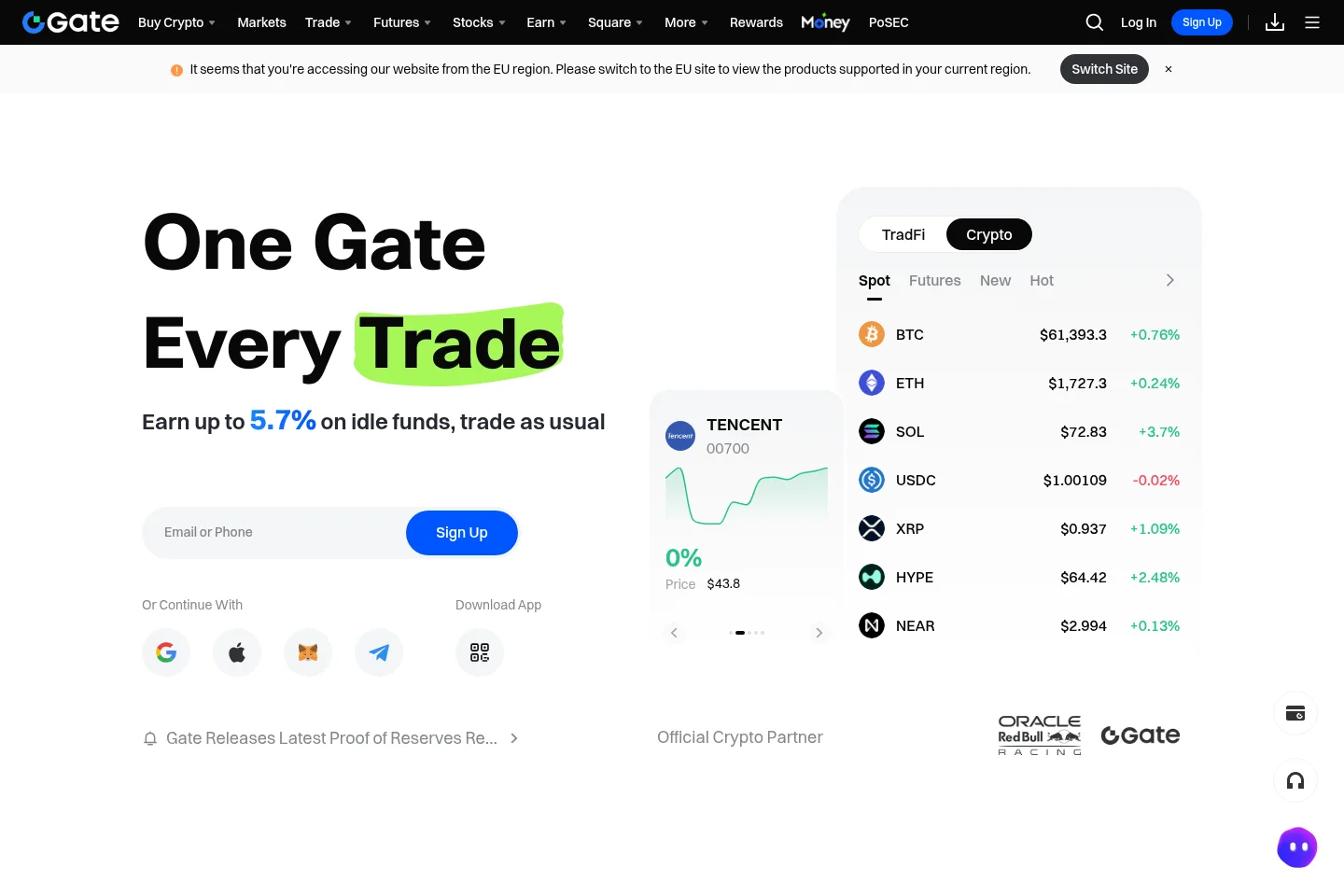
Gate’s global site advertises web, app and developer-oriented services. A large menu can be useful to an experienced customer, while increasing the chance that a new user enters a product with different collateral or redemption rules. The account, product and confirmation screen determine the transaction—not the fact that it appears under one login. Global platform description.
Use the official site to reach software and support. A market-data integration should have only the required permissions, and a public endpoint does not by itself establish commercial republication rights. No interface-speed, support-response or withdrawal-success test is claimed by Atlas.
14. Advantages and limitations
| Potential advantage | Material limitation |
|---|---|
| Distinct European and US service structures | Regional products cannot share one undifferentiated fee and access row |
| Detailed EU VIP qualification table | The lowest advertised fee can require substantial volume or capital |
| Broad global tool range | Several important US and European locations are restricted from the global service |
| Public reserve-related materials | Marketing claims require a dated scope-specific examination |
| Long documented operating history | The 2018 third-party-script attack remains relevant history |
| Multiple ways to fund or acquire assets | Bank, P2P and crypto transfers have different counterparties and risks |
15. Alternatives and suitable users
An EEA reader can compare the Gate EU spot tariff and account conditions with another EEA-serving provider. A US reader needs the actual Gate US offer for their state and should compare it with another supported US product. Someone excluded from the global agreement should not use the larger global menu as a reason to infer eligibility.
For an eligible trader, the platform is most relevant when the desired tools and transfer route exist within the same permitted account. A simpler broker or exchange can be easier to assess for occasional purchases; a DEX changes custody, network and contract risks rather than merely replacing Gate’s commission.
16. Frequently asked questions
Does Gate have a US service?
Yes. A separate Gate US, Inc. user agreement exists. That does not establish identical service in every state, or make the international account’s fees and features applicable to the US account. US terms.
What is the EU entry spot fee?
The checked European schedule lists 0.10% maker and 0.10% taker at VIP 0, with alternative volume and asset qualification for higher levels. EU fee schedule.
Can German or French customers just use the global service?
Both countries appear in the checked global restricted-location list. Gate’s separate EU agreement must be assessed on its own conditions. Global rules, EU agreement.
Was Gate involved in a security incident?
The documented 2018 Statcounter attack targeted the Gate.io withdrawal page through compromised third-party JavaScript. The operator and ESET describe the response, but the research does not establish a precise amount stolen. ESET, Gate announcement.
Is this a technical security audit?
No. It is a documentary audit of the public agreements, fee tables, product descriptions and cited incident records. It does not inspect internal systems or certify custody.
17. Final audit assessment
Gate is best evaluated as a set of regional services. The EU product provides a concrete contract and fee table; the US product has a distinct agreement; the global service has its own substantial exclusions. Matching those pieces is more useful than giving the brand a single worldwide fee or access label.
The broad product range can be valuable to an eligible customer, but it increases the importance of checking the actual instrument and exit route. The reserve material and historical security record belong in that assessment with dates and clear source attribution.
Prepared from the dated sources listed below. This is a documentary review; no account opening, trade, support-response or withdrawal test is claimed.
Sources and check dates
- Gate global terms ·
- Gate eu terms ·
- Gate us terms ·
- Gate eu fees ·
- Gate media kit ·
- Gate eset 2018 ·
- Gate home current ·
- Gate founder letter ·
- Bter jua 2015 ·
- Gate statcounter 2018 ·
- Gate 2018 response ·
- Gate etc 2019 ·
Operator, regulatory and court records support the relevant findings; third-party market data is identified in the text. Effective dates and unresolved checks remain beside the claim.