
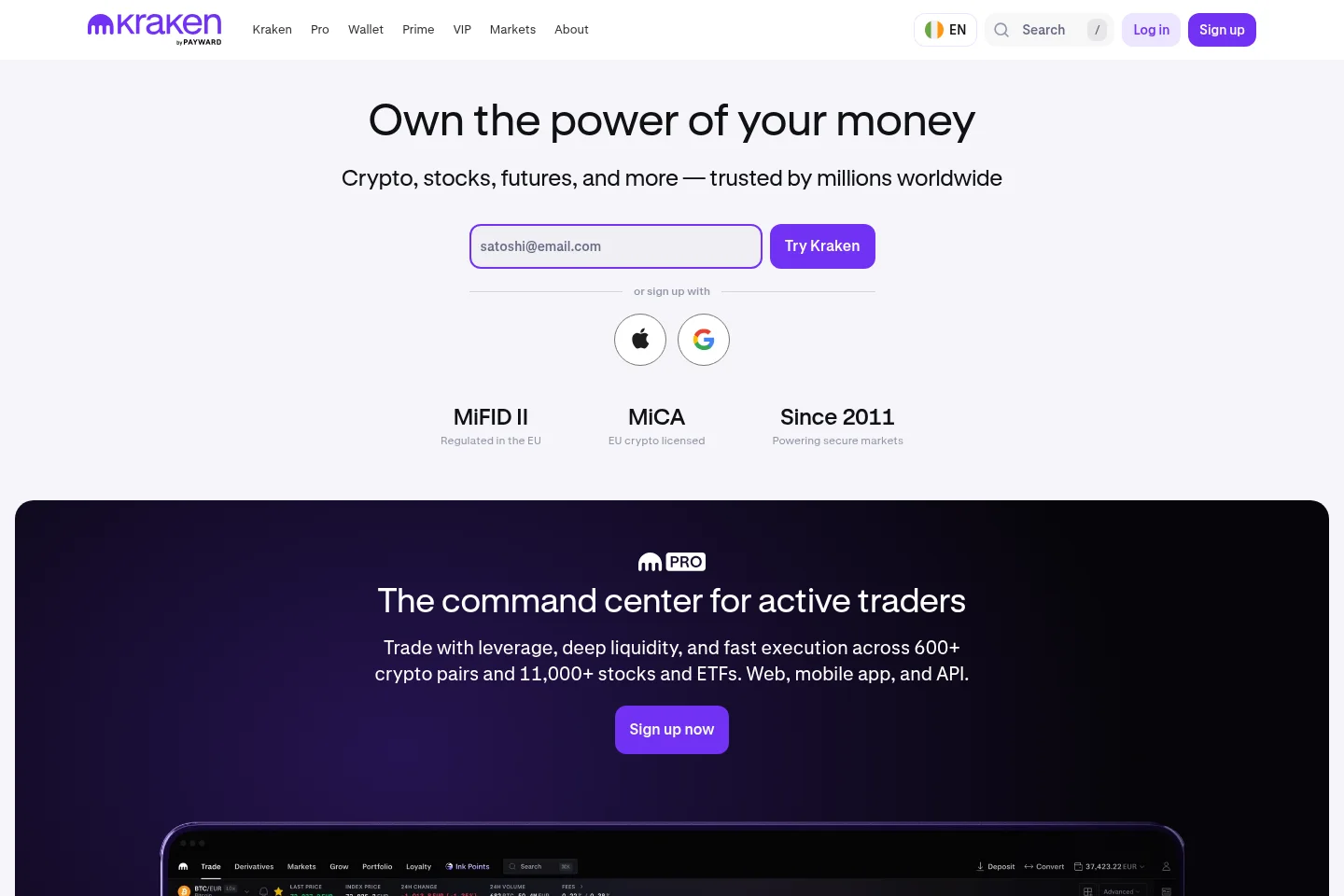
Kraken is one of the world’s longest-operating cryptocurrency exchanges. Founded in 2011, it has developed from a Bitcoin trading platform into a multi-asset financial services business offering cryptocurrency trading, derivatives, staking, traditional equities, tokenized stocks and institutional custody.
The exchange is known for its regulatory presence, euro and dollar banking infrastructure, professional trading products and comparatively extensive security disclosures. Unlike many competitors, Kraken also provides cryptographic Proof of Reserves reports that customers can use to verify their inclusion in periodic asset snapshots.
However, its reputation deserves closer examination. Kraken has faced regulatory penalties, a $3 million security exploit, controversies involving its co-founder Jesse Powell, and a 2026 insider-related data exposure incident. Its parent company is also pursuing litigation involving more than $25 million in assets allegedly mishandled by a former custody partner.
Trading fees have changed substantially. As of November 2026, standard Kraken Pro spot fees begin at 0.40% for makers and 0.80% for takers, considerably higher than the introductory rates quoted in many older exchange reviews.
This review examines Kraken’s ownership, products, fees, licensing, account security, financial transparency and historical controversies to determine where the platform stands in 2026.
1. Kraken at a Glance
| Category | Details |
|---|---|
| Exchange | Kraken |
| Founded | 2011; public trading launched in 2013 |
| Parent company | Payward, Inc. |
| Ownership | Privately held |
| Founders | Jesse Powell and Thanh Luu |
| Leadership structure | Co-CEO model announced for Arjun Sethi and Dave Ripley; entity and roles require current context |
| US origins | San Francisco, California |
| Market range | Official homepage advertises 600+ crypto pairs; this is not a token count |
| Spot trading | Yes |
| Pro spot fees | From 0.40% maker / 0.80% taker |
| Futures fees | From 0.02% maker / 0.05% taker |
| Margin trading | Available to eligible customers |
| Staking | Available in supported jurisdictions |
| Traditional stocks and ETFs | Available in the US and eligible EEA markets |
| Tokenized stocks | xStocks for eligible non-US users |
| European regulation | MiCA authorizations and EMI license in Ireland; MiFID authorization in Cyprus |
| UK regulation | FCA crypto registration and separately authorized investment activities |
| Security | 2FA, withdrawal controls, independent security reviews |
| Proof of Reserves | Yes, periodic Merkle-tree-based verification |
| Fiat payments | EUR, USD, GBP and other supported currencies |
| Mobile applications | Kraken, Kraken Pro |
| Institutional services | OTC, custody, APIs and derivatives |
| Identity verification | Mandatory |
Kraken’s product range is broader than a typical cryptocurrency spot exchange. Its exact capabilities depend on the customer’s country, account type and regulated service provider.
Sources: kraken home current, kraken fees, kraken reg overview, kraken mobile.
2. Background, Founders and Ownership
Kraken was established in 2011 by Jesse Powell and Thanh Luu, during the early development of cryptocurrency trading.
The exchange began serving customers in 2013. Its founders sought to address the security and operational weaknesses that had affected early Bitcoin marketplaces.
Kraken subsequently expanded its cryptocurrency catalogue, banking relationships and institutional infrastructure. It survived several major industry downturns, including the collapse of Mt. Gox, the 2018 cryptocurrency bear market and the failures of major digital-asset companies in 2022.
Who owns Kraken?
Kraken operates through companies within the Payward group.
Unlike Coinbase, Kraken’s parent company was still privately held as of November 2026.
Its shareholders include founders, employees and institutional investors. Exact ownership percentages are not comprehensively disclosed in public primary sources.
Leadership changes
Jesse Powell stepped down as CEO in 2022, with Dave Ripley taking over as part of the company’s leadership transition.
Arjun Sethi later joined as co-CEO, bringing experience in technology investment and corporate strategy.
Kraken subsequently expanded beyond cryptocurrency exchange services, investing in brokerage infrastructure, derivatives, tokenized securities and institutional products.
IPO plans
In November 2025, Payward confidentially submitted a draft registration statement for a potential US initial public offering.
The company had also announced an $800 million capital raise at an approximately $20 billion valuation.
A September 2026 report by CoinDesk indicated that the potential IPO had been pushed back until the second quarter of 2027 at the earliest.
That timeline was reported by industry sources rather than confirmed as a binding company commitment.
Source: CoinDesk on Kraken’s IPO plans
Sources: kraken origins, kraken leadership, kraken ipo filing, kraken raise 2025, kraken ipo report.
3. Regulation and Legal Structure
Kraken has established a substantial regulatory presence across Europe, the United States and other financial markets.
However, the company operates through multiple entities. A license held by one entity does not automatically cover every Kraken product worldwide.
European Union: MiCA authorization
Kraken operates its European cryptocurrency services under authorizations granted by the Central Bank of Ireland.
Its regulatory structure includes:
- Payward Europe Solutions Limited: Authorized as a Crypto-Asset Service Provider under MiCA.
- Payward Global Solutions Limited: Separately authorized to operate a crypto-asset trading platform.
- Payward Ireland Limited: Authorized as an Electronic Money Institution for applicable fiat services.
These authorizations are passported across the European Economic Area.
The MiCA framework establishes regulatory requirements for custody, exchange services, conflicts of interest, governance and customer disclosures.
MiFID II and European derivatives
Kraken’s European investment services are provided through Payward Europe Digital Solutions (CY) Limited.
The company is authorized by the Cyprus Securities and Exchange Commission under MiFID II.
This licensing structure is relevant to its derivatives and traditional securities businesses.
United States
Kraken maintains a FinCEN Money Services Business registration and applicable state money transmitter licenses.
Its wider US infrastructure includes SEC-registered brokerage and advisory entities.
Kraken Financial, its Wyoming state-chartered banking entity, provides qualified custody infrastructure for eligible institutional clients.
Customers should not assume that cryptocurrency held in an ordinary Kraken trading account receives federal deposit insurance.
United Kingdom
Kraken operates an FCA-registered cryptoasset business in the United Kingdom.
Related companies also hold authorizations covering certain derivatives and financial benchmark activities.
FCA registration for cryptoasset anti-money-laundering purposes is different from comprehensive authorization or compensation protection for every trading product.
Source: Kraken’s regulatory overview
Sources: kraken reg overview, kraken access.
4. Supported Cryptocurrencies and Trading Pairs
Kraken advertises more than 600 crypto pairs on its current homepage. A pair count is not the number of distinct tokens: BTC/USD and BTC/EUR are two markets for one crypto asset. Check the regional asset directory for the actual account.
The exchange supports major cryptocurrencies such as Bitcoin, Ethereum, Solana, XRP, Cardano, Dogecoin, Litecoin, Chainlink and Avalanche, alongside a substantial number of smaller projects.
Its catalogue includes utility tokens, DeFi assets, blockchain infrastructure projects, selected meme coins and stablecoins.
Stablecoins
Globally supported stablecoins include USDC, USDT and USDG, among others.
Availability is subject to regional regulations.
For example, Kraken’s EEA restrictions include the delisting of USDT, DAI, PYUSD and several other stablecoins for local trading.
European users should therefore check the asset’s regional status rather than relying on Kraken’s global listings.
Fiat pairs
Kraken supports direct fiat cryptocurrency markets, including selected EUR, USD and GBP pairs.
This is particularly useful for European investors who want to trade against euros without converting their balances into dollar stablecoins.
Source: Kraken’s EEA stablecoin restrictions
Sources: kraken home current, kraken stablecoins eea.
5. Trading Platforms: Kraken vs Kraken Pro
Kraken maintains two principal retail trading environments.
Standard Kraken
The standard Kraken interface focuses on accessibility.
Customers can purchase, sell, convert and monitor digital assets without interacting directly with a full trading order book.
The application also supports recurring purchases and selected additional financial services.
The main disadvantage is pricing. Simplified purchases may include a higher trading fee and an embedded spread.
Kraken Pro
Kraken Pro provides order-book trading and advanced execution tools.
Features include:
- Real-time order books and market depth
- Advanced charting and technical indicators
- Market, limit and supported conditional orders
- Spot and margin trading
- Futures access for eligible accounts
- Portfolio and order management
- Professional trading APIs
Kraken Pro is free to access. The exchange charges trading fees when orders execute.
For users making regular transactions, the distinction between Standard and Pro is important because their pricing models differ.
Sources: kraken mobile, kraken main fees.
6. Spot Trading and Order Execution
Spot trading allows users to exchange cryptocurrencies and supported fiat currencies at current or specified prices.
Kraken Pro uses a central limit order book.
Market orders generally execute immediately against available liquidity and incur taker fees.
Limit orders specify a price but do not guarantee execution. If they add liquidity to the order book, they can qualify for maker pricing.
However, a marketable limit order may execute immediately as a taker order.
Liquidity considerations
Trading volume alone does not establish execution quality.
A large order can move through multiple price levels, particularly in less liquid cryptocurrency markets.
Traders should evaluate the bid-ask spread, visible depth and execution costs for the specific market being traded.
Kraken’s established BTC and ETH markets may behave differently from smaller token pairs.
Sources: kraken fees, kraken mobile.
7. Margin Trading
Kraken supports margin trading for eligible accounts.
Margin allows customers to borrow funds or assets to increase the size of a position relative to their own collateral.
This can increase trading exposure but also magnifies potential losses.
Margin costs
Kraken’s margin pricing is separate from ordinary spot trading fees.
Costs can include an opening fee and recurring rollover charges.
For example, Kraken’s published margin schedule has shown Bitcoin opening and four-hour rollover fees in the approximate 0.01%–0.02% range, with different rates for other assets.
These charges can accumulate while positions remain open.
Liquidation risk
When account equity falls below the required maintenance level, Kraken may liquidate positions.
Customers can lose their margin collateral even when the underlying cryptocurrency experiences a relatively modest price movement.
Margin limits, borrowing eligibility and liquidation rules depend on the market and jurisdiction.
Sources: kraken fees.
8. Futures and Perpetual Derivatives
Kraken operates a substantial derivatives business through regulated and international venues.
Eligible traders can access cryptocurrency futures and perpetual contracts.
Unlike spot trading, derivatives provide contractual exposure to price movements without necessarily involving direct ownership of the underlying asset.
Standard futures fees
Kraken’s published entry-level futures commission schedule is:
| Execution type | Base fee |
|---|---|
| Maker | 0.02% |
| Taker | 0.05% |
Higher qualifying trading volume or other eligible criteria can reduce these rates.
Funding payments, margin requirements and liquidation costs are separate considerations.
Tokenized-equity perpetual futures
In February 2026, Kraken launched perpetual futures linked to tokenized equity markets for eligible non-US clients.
Products include exposure to major US technology companies, equity indices and gold-related instruments.
Kraken advertised leverage of up to 20x on selected products.
These instruments are available only where permitted and are not equivalent to buying underlying shares.
Source: Kraken tokenized-equity futures launch
Sources: kraken fees, kraken equity perps.
9. Traditional Stocks, ETFs and xStocks
Kraken expanded into traditional securities and tokenized assets during 2025 and 2026.
This is an important change to its business model.
Traditional stocks
Kraken offers traditional stock and ETF trading to eligible customers in the United States.
In August 2026, the company expanded access to US-listed equities across the EEA.
Kraken announced more than 7,000 US-listed equities for eligible European users through its MiFID-regulated infrastructure.
The offering was advertised with commission-free trading, although regulatory pass-through costs and other charges may apply.
Source: Kraken’s EEA stock trading launch
xStocks
xStocks are tokenized products linked to traditional shares and ETFs.
They are backed by underlying securities held within the issuer’s custody arrangements, but token holders do not automatically become registered shareholders of the underlying companies.
The products can provide transferable blockchain-based exposure to companies such as Apple, Tesla and Nvidia.
Eligible users may hold or transfer supported tokens through compatible blockchain infrastructure.
Geographic restrictions
xStocks are unavailable to US persons and customers in several restricted jurisdictions, including the UK, Canada and Australia.
EEA users also face specific eligibility and trading-interface requirements.
A tokenized share, a traditional share and a perpetual futures contract based on that share are three legally and economically distinct products.
Sources: kraken eea stocks, kraken xstocks availability, kraken equity perps.
10. Kraken Earn, Staking and Rewards
Kraken offers staking and selected reward-generating products to eligible customers.
On-chain staking
Supported assets include proof-of-stake cryptocurrencies such as Ethereum and Solana.
Staking rewards depend on network conditions, validator performance and applicable fees.
Kraken may offer flexible and bonded staking structures, depending on the asset and jurisdiction.
Bonded staking can introduce unbonding periods during which funds are unavailable for withdrawal or sale.
US staking availability
Kraken discontinued its earlier US staking-as-a-service program following a 2023 SEC settlement.
However, it launched a new on-chain staking product for eligible US customers in January 2025.
The initial relaunch covered selected states and territories, with availability subject to local restrictions.
Stablecoin rewards
Kraken also offers selected stablecoin reward programs.
These should not be confused with proof-of-stake network rewards.
Stablecoin incentives can depend on commercial arrangements, issuer structures, product conditions and regional rules.
Advertised annual percentage yields are variable rather than guaranteed returns.
Sources: kraken staking relaunch, kraken mobile.
11. Kraken+ Subscription
Kraken+ is a premium subscription offered through the standard Kraken app and web interface.
As of November 2026, the advertised subscription cost is approximately $4.99 per month, or the equivalent in supported local currencies.
The subscription includes zero standard trading fees on up to $10,000 of eligible monthly transaction volume through supported Buy, Sell and Convert features. The precise eligible functions and current subscription terms control.
Additional advertised benefits include certain enhanced stablecoin rewards, exclusive token promotions and priority support.
Important limitation
Kraken+ does not eliminate all transaction costs.
Spreads, payment processing fees and other applicable charges can still apply.
The subscription’s trading-fee benefit does not extend to ordinary Kraken Pro spot, futures, API or institutional trades.
A subscription therefore does not automatically make every Kraken transaction free.
Source: Kraken+ pricing and benefits
Sources: kraken plus.
12. Kraken Trading Fees in 2026
Kraken revised its fee structure with cross-platform qualification criteria.
As of November 2026, its standard Kraken Pro spot fees begin at 0.40% maker and 0.80% taker.
This is a meaningful change from the lower introductory fees frequently quoted in earlier reviews.
Kraken Pro spot fees
| Qualifying 30-day spot volume | Maker fee | Taker fee |
|---|---|---|
| $0+ | 0.40% | 0.80% |
| $2,500+ | 0.30% | 0.60% |
| $10,000+ | 0.22% | 0.38% |
| $25,000+ | 0.20% | 0.35% |
| $50,000+ | 0.15% | 0.30% |
| $100,000+ | 0.12% | 0.25% |
| $250,000+ | 0.10% | 0.22% |
| $500,000+ | 0.08% | 0.20% |
| $1 million+ | 0.06% | 0.18% |
| $10 million+ | 0.00% | 0.10% |
Additional professional tiers offer further taker-fee reductions.
Kraken’s cross-platform system can also consider qualifying futures volume and assets held on the platform when determining a customer’s trading fee tier.
The three measures are not simply added together. The most favorable applicable qualifying criterion determines the tier.
Standard Kraken fees
The simplified trading interface follows a different schedule.
| Transaction | Advertised trading fee |
|---|---|
| Instant Buy/Sell | 1.00% |
| Recurring purchases | 1.00% |
| Custom orders | 1.50% |
| Kraken+ eligible transactions | Standard trading fee waived within allowance |
Additional spreads and payment charges may apply. The standard fee page also states that small instant trades carry a fee of up to $2 instead of the 1% fee. A small-balance conversion uses another schedule, so neither case should be priced from the ordinary percentage alone.
Stablecoin and FX trading
Qualifying stablecoin and fiat currency pairs follow separate pricing schedules.
Standard stablecoin/FX order-book fees begin at approximately 0.20% maker and taker, with lower rates available at higher volume tiers.
Selected assets such as USDG and USDe can have special fee schedules.
Official Kraken Pro fee schedule
Sources: kraken fees, kraken main fees.
13. How Much Does a €1,000 Trade Cost?
Assume a customer purchases €1,000 worth of cryptocurrency, excluding market price changes and additional spread or payment costs.
| Transaction method | Illustrative trading fee |
|---|---|
| Kraken Pro maker, first tier | €4.00 |
| Kraken Pro taker, first tier | €8.00 |
| Kraken Pro maker, $10k+ tier | €2.20 |
| Kraken Pro taker, $10k+ tier | €3.80 |
| Instant Buy at 1% | €10.00 |
| Custom order at 1.5% | €15.00 |
| Kraken+ qualifying transaction | €0 standard trading fee, excluding other costs |
A €1,000 market purchase followed by a sale of the same notional value at the standard Kraken Pro taker rate would incur approximately €16 in trading fees.
The same pair of transactions through a 1% Instant Buy/Sell schedule would involve €20 in stated trading fees before spreads.
A card-funded transaction can become more expensive because payment processing charges may be added.
For example, an EEA debit-card deposit charged at 3.75% plus €0.25 would cost €37.75 on €1,000. That is a funding cost, separate from any subsequent trade.
These calculations demonstrate why the interface, funding method and execution type should be evaluated together.
Sources: kraken fees, kraken main fees, kraken deposit routes.
14. Deposits, Withdrawals and Banking
Kraken supports a wide range of fiat funding methods.
Available payment rails depend on the customer’s country and banking partner.
European SEPA transfers
For eligible European customers, Kraken supports SEPA and SEPA Instant deposits.
Its published fee schedule includes several free EUR deposit methods, generally with minimum deposits starting at €1.
Standard and instant SEPA processing can range from near-instant to several business days depending on the provider.
EUR withdrawals
Typical published withdrawal terms include:
| Method | Minimum | Fee | Indicative processing |
|---|---|---|---|
| SEPA via Bank Frick | €2 | €1 | Up to 5 business days |
| SEPA via Banking Circle | €2 | €1 | Up to 5 business days |
| SEPA Instant via ClearJunction | €3 | €0.90 | Near-instant where supported |
| SEPA via Openpayd | €2 | €1 | Up to 3 business days |
| International SWIFT | €100 | €5 | 1–5 business days |
Banks may conduct additional checks, and processing times are not guaranteed.
USD payments
Eligible US customers can access ACH and other supported domestic banking services.
Some ACH deposits become available for trading before the funds become eligible for withdrawal.
Withdrawal holds
Kraken applies temporary withdrawal holds to selected funding methods.
Certain card and digital-wallet purchases can trigger a 72-hour hold. ACH Plaid deposits may be subject to a seven-day withdrawal hold.
These controls can affect both fiat and cryptocurrency withdrawals. The hold documentation limits the affected value to the purchased amount rather than automatically locking the entire account balance; trading itself can remain available.
Official cash funding information
Official withdrawal information
Sources: kraken deposit routes, kraken withdrawal routes, kraken withdrawal holds.
15. Registration, Verification and KYC
Kraken requires identity verification before customers can use its regulated services.
The process generally includes creating an account, supplying personal information, verifying identity and completing applicable compliance checks.
Customers may need to provide a passport or national identity document, residential information and details about their economic activity.
Enhanced verification may require additional documents concerning employment, income or source of wealth.
Source-of-funds checks
Kraken can request transaction records, bank statements or cryptocurrency transfer histories when required by its compliance processes.
Some customers experience additional verification after unusually large transactions or changes in account activity.
An account can be temporarily restricted while a review is conducted.
These checks are particularly relevant to users moving substantial cryptocurrency balances between exchanges, private wallets and financial institutions.
Sources: kraken kyc.
16. Security Architecture and Custody
Kraken provides several security mechanisms intended to protect customer accounts and cryptocurrency holdings.
These include two-factor authentication, withdrawal security controls, device monitoring and account-level access restrictions.
Global Settings Lock
One distinctive Kraken feature is Global Settings Lock.
It restricts changes to sensitive account settings and helps prevent unauthorized modification of account information.
Cold storage
Kraken states that substantial portions of the cryptocurrency assets it controls are maintained in offline custody arrangements.
Cold storage reduces exposure to certain online attacks, although it does not remove operational or insider risk.
Account security
Kraken recommends hardware-based authentication and other strong account protections.
Customers should pay particular attention to impersonation scams in which attackers pose as Kraken employees.
No exchange security system can guarantee protection against every phishing attempt, social-engineering attack or compromised personal device.
Sources: kraken address security, kraken mobile.
17. Proof of Reserves and Financial Transparency
Kraken is notable for providing periodic cryptographic Proof of Reserves reports.
Its system combines independent review procedures with Merkle-tree technology.
Customers can verify that their in-scope balances were included in a snapshot of the exchange’s liabilities.
September 2026 Proof of Reserves
Kraken’s September 30, 2026 snapshot published the following reported reserve ratios:
| Asset | Reported reserve ratio |
|---|---|
| Bitcoin (BTC) | 103.2% |
| Ethereum (ETH) | 100.7% |
| Solana (SOL) | 101.7% |
| XRP | 102.7% |
| Cardano (ADA) | 100.9% |
| USDC | 105%+ |
| USDT | 105%+ |
| USDG | 103.9% |
These figures relate to the assets and methodology included in that particular snapshot.
They do not mean that the entire company had an equivalent excess of assets over all liabilities.
Limitations of Proof of Reserves
Proof of Reserves is valuable but does not replace a complete financial audit.
A snapshot cannot guarantee that funds will remain available after the reporting date.
It may also fail to identify undisclosed obligations, temporary borrowing arrangements or other liabilities outside the review’s scope.
Customers should therefore treat Proof of Reserves as an additional transparency mechanism rather than absolute evidence of solvency.
Official Kraken Proof of Reserves
Sources: kraken reserves current.
18. Major Hacks, Controversies & Regulatory Actions
The documented incidents below have different scopes: a deposit-system exploit, support-data exposure, regulatory cases and third-party custody allegations. This review does not treat the absence of a comparable event in its sources as proof that no other incident has occurred.
However, describing its security or regulatory history as spotless would be misleading.
The exchange has faced significant technical vulnerabilities, insider-related incidents, regulatory penalties, founder controversies and custody litigation.
Timeline of major incidents
| Year | Incident | Reported financial impact | Outcome or status |
|---|---|---|---|
| 2021 | CFTC action over illegal retail margin transactions | $1.25 million penalty | Settled |
| 2022 | OFAC sanctions violations involving Iran | $362,158.70 settlement | Settled; compliance improvements |
| 2022 | Workplace culture controversy involving Jesse Powell | No established customer loss | Public controversy; leadership transition |
| 2023 | SEC staking enforcement | $30 million settlement | US staking program discontinued |
| 2023–2025 | SEC exchange-registration lawsuit | No penalty from dismissed case | Dismissed with prejudice |
| 2023–2025 | Investigation concerning Jesse Powell and a nonprofit organization | No established Kraken customer loss | Investigation closed without charges |
| 2024 | Deposit-system exploit involving CertiK | Approximately $3 million temporarily withdrawn | Funds substantially returned |
| 2025–2026 | Insider-related data access and extortion | Approximately 2,000 accounts potentially viewed | Investigation disclosed in April 2026 |
| 2025–2026 | Etana Custody dispute | More than $25 million allegedly misappropriated | Litigation and recovery proceedings |
18.1. The $3 Million CertiK Exploit — June 2024
In June 2024, Kraken disclosed a critical vulnerability in its deposit and funding systems.
The flaw allowed a user to receive credit for funds that had not actually been deposited.
According to Kraken’s Chief Security Officer, Nick Percoco, nearly $3 million was withdrawn through exploitation of the vulnerability.
Kraken stated that the affected assets came from company treasury funds rather than customer balances.
The incident became especially controversial when blockchain security company CertiK identified itself as the party that discovered the flaw.
Kraken accused the researchers of exceeding legitimate security-testing boundaries and initially withholding funds.
CertiK disputed Kraken’s characterization of events and accused its security team of acting unreasonably.
The confrontation became a public dispute over the boundaries between responsible vulnerability disclosure and unauthorized exploitation.
Reported outcome: Kraken’s official post says it patched the bug and that client assets were not affected. Its security chief subsequently stated that the funds had been returned, apart from a small amount associated with fees. The competing descriptions of the researchers’ conduct remain attributed to the parties.
No broad customer reimbursement program was reported because Kraken stated that customer funds had not been affected.
Source: The Block — Kraken’s $3 million exploit
18.2. Insider Data Exposure and Extortion — April 2026
On April 13, 2026, Kraken publicly disclosed an extortion attempt involving unauthorized access to internal customer-support information.
The case involved two separate insider-related incidents, including one in 2025 and another identified before the April 2026 disclosure.
According to Kraken, people with access to support systems improperly viewed or recorded limited customer information.
The exchange reported that approximately 2,000 accounts may have been viewed.
The attackers subsequently threatened to release videos showing internal systems and customer information unless Kraken complied with their demands.
Kraken stated that its core infrastructure had not been compromised and that customer funds had not been at risk.
It also reported revoking the individuals’ access, notifying affected customers and cooperating with law enforcement.
Outcome: Kraken refused to pay the extortionists. No verified customer-fund loss was established in the incident reports reviewed.
The longer-term criminal investigation outcome was not independently confirmed as of November 23, 2026.
The case illustrates a risk that technical wallet security alone cannot eliminate: individuals with legitimate system access can still expose sensitive customer information.
Source: CoinDesk — Kraken insider security incidents
18.3. SEC Staking Settlement — February 2023
In February 2023, the US Securities and Exchange Commission charged Kraken entities with failing to register their crypto staking-as-a-service program.
The regulator argued that the program involved the offer and sale of securities without the required registration.
Kraken agreed to discontinue the relevant US staking program and pay $30 million in disgorgement, interest and civil penalties.
The settlement did not establish that Kraken had stolen customer assets.
It concerned the regulatory classification and operation of the staking product.
Outcome: The original program was discontinued for US customers. Kraken subsequently introduced a new staking offering in eligible US jurisdictions in January 2025.
Source: SEC staking settlement
18.4. SEC Exchange Lawsuit — 2023–2025
In November 2023, the SEC sued Kraken, alleging that it operated as an unregistered securities exchange, broker, dealer and clearing agency.
The complaint also raised concerns about the handling and commingling of certain customer assets.
Kraken disputed the allegations.
On March 27, 2025, the SEC announced a dismissal of the lawsuit with prejudice.
Importantly, the SEC explicitly stated that the dismissal reflected a policy decision rather than a judgment about the merits of the original allegations.
Outcome: The case was dismissed without the court making a final determination that the SEC’s allegations were either proven or disproven.
Source: SEC dismissal announcement
18.5. OFAC Sanctions Settlement — November 2022
In November 2022, Kraken agreed to pay $362,158.70 to resolve potential civil liability related to US sanctions against Iran.
The US Treasury found that the exchange had processed 826 transactions totaling approximately $1.68 million for individuals who appeared to have been in Iran.
The issue arose because Kraken’s geolocation controls had not consistently blocked transactions conducted after account registration.
The Treasury classified the apparent violations as non-egregious and recognized Kraken’s voluntary disclosure and cooperation.
Kraken also agreed to invest another $100,000 in sanctions compliance controls. This was a commitment in the settlement, rather than an independently measured Atlas compliance expenditure.
Outcome: The matter was settled, and Kraken implemented additional geolocation restrictions and compliance measures.
Source: US Treasury OFAC settlement
18.6. CFTC Margin Trading Penalty — September 2021
The Commodity Futures Trading Commission concluded that Kraken had illegally offered certain leveraged retail cryptocurrency transactions to US customers without the necessary registration.
The regulator imposed a $1.25 million civil penalty.
Kraken was also required to cease the unlawful activity identified in the order.
Outcome: The case was settled through the CFTC’s enforcement order.
Source: CFTC enforcement announcement
18.7. Etana Custody Dispute — 2025–2026
One of Kraken’s most serious recent counterparty disputes involves Etana Custody, a company that previously provided custodial services.
In September 2025, Kraken-related companies filed litigation against Etana.
CoinDesk reported on May 4, 2026 that Kraken-related companies expanded their allegations, claiming that more than $25 million in client-related custodial assets had been misappropriated. The report describes a second amended complaint; the allegations are attributed to the plaintiffs.
According to Kraken’s court filings, Etana allegedly commingled custody funds, used assets for unauthorized expenses and investments, and concealed financial shortfalls.
These are allegations made by Kraken against its former custody partner, not final judicial findings of fraud.
The dispute highlights a separate risk from a cryptocurrency exchange hack: assets can become difficult to recover when a third-party financial intermediary experiences operational or financial failure.
Status at this review: The retrieved Justia docket reproduction confirms the case filed on September 9, 2025, but its displayed docket was last retrieved on February 26, 2026. It therefore does not establish the complete November 2026 procedural status. A final merits ruling, recovery amount or comprehensive customer compensation outcome was not confirmed.
Source: CoinDesk — Kraken’s Etana lawsuit
Sources: kraken bug 2024, kraken exploit primary, kraken return primary, kraken insider primary, kraken staking case, kraken sec dismissal, kraken ofac, kraken ofac detail, kraken cftc, kraken etana report, kraken etana docket.
19. Jesse Powell: Founder Controversies and Investigation
Kraken co-founder Jesse Powell has been one of the cryptocurrency industry’s more outspoken executives.
His public statements and management style have generated controversy, although these issues should be evaluated separately from Kraken’s treatment of customer assets.
Workplace culture controversy in 2022
In June 2022, The New York Times reported allegations of internal conflict over Powell’s statements and discussions about social and political subjects.
The reporting described disputes involving workplace communication, gender identity and company culture.
Kraken also published a culture document setting out its internal principles.
Employees who disagreed with those principles were offered an opportunity to leave with a severance package.
The episode generated criticism of Powell’s leadership and concerns about the company’s workplace environment.
Powell later stepped down from the CEO position as part of a leadership succession.
The public record does not establish that the workplace controversy directly caused his departure.
Source: The Block — Kraken’s workplace culture controversy
FBI investigation involving a nonprofit organization
In 2023, US federal investigators searched Powell’s home in connection with allegations involving the Verge Center for the Arts, a nonprofit organization.
The matter concerned claims of unauthorized access to the organization’s electronic accounts and communications.
Powell denied the allegations.
In July 2025, CoinDesk reported that court-filed material described the US Department of Justice ending this investigation without criminal charges. The report says a letter confirmed closure on April 8, 2025; this review did not obtain the original letter.
The matter was unrelated to an allegation that Kraken customer cryptocurrency had been stolen.
Reported outcome: The investigation discussed in that report closed without charges. That is the status of this specific matter, not a statement about every possible dispute involving Powell.
Source: CoinDesk — Investigation into Jesse Powell closed
How should these events affect Kraken’s reputation?
Founder conduct, corporate governance and exchange custody security are separate areas of risk.
The Powell controversies raise questions about leadership and workplace culture. They do not establish that Kraken was insolvent or that its founders misappropriated customer deposits.
By 2026, the company was operating under a broader management structure and multiple regulatory jurisdictions.
Sources: kraken culture report, kraken powell probe report.
20. Customer Support and Complaint Handling
Kraken offers a support center, account assistance and live support channels for eligible customers.
The company also maintains documentation concerning deposits, withdrawals, security settings and account verification.
Common support issues involve delayed transfers, additional identity checks, withdrawal holds and account access.
Account restrictions
Kraken can suspend selected functions while investigating suspicious transactions or completing compliance reviews.
The account holder may be asked for supporting documentation.
The time required to complete a review depends on the circumstances and cannot be reliably predicted from general published support information.
Phishing and impersonation
Some cryptocurrency scams involve criminals impersonating exchange support personnel.
Users should independently verify the official support channel before responding to account-security requests.
A message claiming that immediate action is necessary to avoid losing assets should not be treated as authentic merely because it uses the company’s branding.
The existence of customer complaints does not by itself establish systemic misconduct. Individual cases require evidence concerning the transaction, support response and applicable account terms.
Sources: kraken withdrawal holds, kraken kyc.
21. Kraken Mobile Applications
Kraken provides separate mobile experiences for mainstream investors and active traders.
Kraken app
The standard application focuses on buying and selling assets, viewing portfolio balances, recurring purchases and accessing eligible financial products.
Its interface is designed for straightforward portfolio management.
Kraken Pro app
Kraken Pro offers more detailed market data, professional trading tools and order management.
Advanced users can work with order books, charts and supported derivative products, subject to account eligibility.
Security features
Mobile users can enable device-level authentication and account security controls.
These features should be combined with strong account credentials, phishing-resistant authentication and careful management of linked email accounts.
Sources: kraken mobile.
22. Institutional Trading and Custody
Kraken serves professional trading firms, asset managers and other institutional clients.
Its institutional services include OTC execution, trading APIs, market connectivity and custody infrastructure.
Trading APIs
Kraken provides REST and WebSocket interfaces for automated systems.
Its institutional business also offers professional connectivity suitable for sophisticated execution workflows.
OTC services
Large investors may use OTC execution arrangements rather than placing the entire transaction directly into a public spot order book.
This can help manage execution logistics and market impact, although actual prices and fees depend on the transaction and service agreement.
Qualified custody
Kraken Financial provides qualified digital-asset custody services for eligible institutional clients.
This business has a different regulatory and operational structure from an ordinary retail exchange account.
In January 2026, Kraken announced that its custody solution had been selected to support certain backing assets associated with Ethena’s USDe ecosystem.
Source: Kraken institutional custody announcement
Sources: kraken ethena custody, kraken reg overview.
23. Countries and Regional Restrictions
Kraken serves customers in numerous jurisdictions, but product availability is not universal.
A customer’s legal residence can determine which corporate entity serves the account and which trading functions are permitted.
| Region | Important considerations |
|---|---|
| European Economic Area | MiCA-regulated crypto services; separate investment-service rules |
| Latvia | EUR SEPA funding; EEA stablecoin restrictions |
| United States | State-specific access, staking restrictions and securities regulation |
| United Kingdom | FCA registration; local derivatives and promotion restrictions |
| Canada | Local regulatory and product eligibility rules |
| Australia | Local product and derivatives restrictions |
| Other markets | Availability depends on national regulation and service entity |
Important restrictions for EEA customers
European users should pay particular attention to stablecoin listings, xStocks eligibility and derivatives authorization.
A globally advertised Kraken product is not necessarily available in Latvia or elsewhere in the EEA.
For US spot customers, the current geographic page excludes Maine and New York and says US residents can use USD cash funding only. This is a different question from whether a separate US derivatives or securities account is eligible.
Sources: kraken access, kraken stablecoins eea, kraken xstocks availability.
24. Kraken Compared With Other Exchanges
Kraken competes with large centralized trading platforms, including Coinbase, Binance, Bitstamp and Bybit.
The comparison below focuses on market positioning rather than a universal ranking.
| Exchange | Main advantages | Main limitations |
|---|---|---|
| Kraken | Broad crypto selection, Proof of Reserves, regulated services, derivatives and equities | Higher entry-level Pro fees |
| Bitstamp | Established European banking, MiCA authorization, institutional infrastructure | Smaller coin catalogue and retail transition issues |
| Coinbase | Retail accessibility, institutional services, extensive ecosystem | Simple trading flows can be costly |
| Binance | Extensive markets and advanced trading products | Product availability varies substantially by country |
| Bybit | Derivatives-focused trading and professional tools | Jurisdiction-specific regulatory restrictions |
Kraken vs Bitstamp
The differences are especially relevant in Europe.
Under the verified November 2026 schedules, Kraken’s first-tier spot fees are 0.40% maker and 0.80% taker.
Bitstamp’s traditional Pro schedule begins at approximately 0.30% maker and 0.40% taker.
However, Bitstamp customers transitioned to Robinhood may face different trading fees and available order types.
Compare the asset catalogue for the actual regional account rather than treating a global market count as a guarantee of access. Kraken also provides cryptographic Proof of Reserves verification for the in-scope assets.
Bitstamp has a more concentrated listing strategy and a strong institutional focus under Robinhood ownership.
The best execution venue depends on the specific pair, available account features and actual execution costs.
Sources: kraken fees, bitstamp fees, bitstamp robinhood migration.
25. Pros and Cons
Advantages
- Operating history extending back to 2011.
- MiCA authorization and substantial international regulatory coverage.
- A broad crypto-market range; the current homepage advertises 600+ pairs.
- Periodic customer-verifiable Proof of Reserves reports.
- Established professional trading platform.
- Spot, margin, futures and institutional products.
- Traditional stocks and tokenized securities for eligible users.
- Free SEPA deposits through supported providers.
- Extensive account security controls.
- Broad developer and API infrastructure.
Disadvantages
- Relatively expensive entry-level Kraken Pro spot fees.
- Additional spreads and payment charges on simplified purchases.
- Complex product and licensing differences across jurisdictions.
- Mandatory KYC and potential withdrawal restrictions.
- Some major stablecoins unavailable to EEA users.
- Past regulatory fines and enforcement actions.
- Significant 2024 vulnerability involving approximately $3 million.
- Insider-related customer data exposure disclosed in 2026.
- Ongoing counterparty litigation involving Etana Custody.
- Leveraged products involve substantial liquidation risk.
Sources: kraken fees, kraken insider primary, kraken reg overview.
26. Who Is Kraken Best For?
European cryptocurrency investors
Kraken is relevant to investors who need EUR banking, a regulated service provider and access to a broad selection of cryptocurrencies.
However, the increased introductory trading fees can make its Pro platform comparatively expensive for occasional small trades.
Experienced traders
Kraken Pro provides order-book execution, sophisticated market data and access to leveraged products.
Traders generating enough qualifying volume or maintaining sufficient assets may receive substantially lower fees.
Institutional clients
Kraken’s custody, connectivity, regulated derivatives infrastructure and expanding multi-asset services make it relevant to professional market participants.
Beginners
The standard app is accessible, but users should evaluate the full quoted transaction cost rather than relying only on the advertised percentage fee.
Users concerned about exchange transparency
Kraken’s periodically published Proof of Reserves reports offer an additional level of customer-verifiable information.
This does not eliminate custody risk, but it is a meaningful transparency feature that not every centralized exchange provides.
Sources: kraken main fees, kraken fees, kraken reserves current.
27. Frequently Asked Questions
Is Kraken a legitimate cryptocurrency exchange?
Yes. Kraken is an established cryptocurrency exchange with regulated entities operating in several jurisdictions, including MiCA-authorized subsidiaries in Ireland.
Its regulatory status does not guarantee that every financial product or customer balance is protected against loss.
Who owns Kraken?
Kraken operates within the Payward group. The reviewed company disclosures describe private funding and a confidential IPO submission; an IPO timetable reported by third parties is not a completed public listing.
Has Kraken ever been hacked?
Kraken disclosed a significant deposit-system exploit in June 2024 involving approximately $3 million in company assets.
It also disclosed insider-related customer data exposure and an extortion attempt in April 2026.
Neither incident was reported as a catastrophic platform-wide theft of customer wallet balances.
Were customers reimbursed after the 2024 exploit?
Kraken stated that customer assets were not affected. The disputed funds were returned by CertiK, apart from a relatively small amount associated with transaction costs.
A general customer compensation program was therefore not reported for that incident.
Was Jesse Powell charged with a crime?
CoinDesk reported in July 2025 that the nonprofit-related investigation closed without charges. This answer concerns that specific reported matter; the original closure letter was not obtained for this review.
Did Kraken pay an SEC fine?
Yes. Kraken agreed to pay $30 million in 2023 to settle SEC charges concerning its former US staking-as-a-service program.
A separate SEC lawsuit concerning exchange registration was dismissed in March 2025 without a determination on the merits.
Does Kraken publish Proof of Reserves?
Yes. Kraken publishes periodic cryptographic Proof of Reserves reports using a Merkle-tree verification mechanism for supported assets and balances.
Is Kraken insured?
Customers should not assume that cryptocurrency balances held in an ordinary Kraken exchange account are protected by bank deposit insurance.
Protection depends on the asset, service, legal entity and applicable law.
Can I withdraw crypto to a private wallet?
Yes, subject to account verification, security holds, supported blockchain networks and other applicable restrictions.
Is Kraken cheaper than Bitstamp?
Not automatically. Kraken’s November 2026 introductory Pro spot fees are higher than Bitstamp’s traditional first-tier Pro rates.
However, the relevant comparison depends on trading volume, the specific product and whether a Bitstamp retail account has migrated to Robinhood.
Is Kraken available in Latvia?
Yes, Kraken provides services to eligible Latvian residents through its European regulatory framework.
SEPA funding is supported, but product eligibility and EEA stablecoin restrictions apply.
Sources: kraken access, kraken insider primary, kraken sec dismissal, kraken staking case, kraken reserves current.
28. Final Verdict: Is Kraken Worth Using in 2026?
Kraken remains one of the most established participants in the cryptocurrency industry.
Its longevity, regulatory infrastructure, extensive trading products and cryptographic Proof of Reserves provide substantial reasons for customers and institutions to consider the platform.
Its expansion into traditional securities, tokenized assets and derivatives also reflects a business model that is no longer limited to cryptocurrency spot trading.
However, Kraken’s history is not without serious problems.
The 2024 deposit-system exploit exposed a genuine technical vulnerability. The 2026 insider-related incident demonstrated the potential danger of unauthorized access to customer information. Regulatory settlements and the dispute involving Etana Custody also show that operational, compliance and counterparty risks remain relevant.
These events should not be treated as equivalent. The 2024 exploit affected company treasury assets that were substantially recovered. The 2026 data exposure did not establish a loss of customer funds. The SEC and OFAC matters concerned regulatory obligations, while the Etana case involves disputed allegations against a former external custody partner.
The distinction matters when evaluating the company’s actual history rather than combining unrelated events into a single accusation of fraud or insolvency.
Overall assessment: Kraken is particularly relevant for users who value a broad asset catalogue, regulated European operations, advanced trading features and verifiable reserve reporting.
Its main commercial weakness is the relatively high starting spot trading fee schedule. Customers who trade frequently should calculate their effective fees rather than rely on older reviews or historical pricing.
Kraken’s security record is stronger than that of many collapsed cryptocurrency businesses, but it is not incident-free. Its transparency mechanisms, regulatory history and the outcome of ongoing disputes all deserve continued scrutiny.
Sources: kraken fees, kraken insider primary, kraken etana report.
Research Methodology
This review uses publicly available sources checked through November 23, 2026.
Sources include Kraken’s official fee schedules, regulatory disclosures, funding documentation, Proof of Reserves reports, product announcements, SEC and CFTC enforcement records, US Treasury publications and independent reporting on security incidents and legal controversies.
For disputed events, allegations have been distinguished from admitted conduct, regulatory findings, settlements and final legal outcomes.
No personal transactions, exchange withdrawals, customer-support tests or security penetration tests were conducted for this review.
Fees, supported assets, regulatory permissions and account eligibility can change. Customers should verify the current conditions that apply to their jurisdiction and legal service provider.
Crypto assets and leveraged financial products carry a risk of substantial loss.
Sources and check dates
- Kraken home current ·
- Kraken fees ·
- Kraken reg overview ·
- Kraken mobile ·
- Kraken origins ·
- Kraken leadership ·
- Kraken ipo filing ·
- Kraken raise 2025 ·
- Kraken ipo report ·
- Kraken access ·
- Kraken stablecoins eea ·
- Kraken main fees ·
- Kraken equity perps ·
- Kraken eea stocks ·
- Kraken xstocks availability ·
- Kraken staking relaunch ·
- Kraken plus ·
- Kraken deposit routes ·
- Kraken withdrawal routes ·
- Kraken withdrawal holds ·
- Kraken kyc ·
- Kraken address security ·
- Kraken reserves current ·
- Kraken bug 2024 ·
- Kraken exploit primary ·
- Kraken return primary ·
- Kraken insider primary ·
- Kraken staking case ·
- Kraken sec dismissal ·
- Kraken ofac ·
- Kraken ofac detail ·
- Kraken cftc ·
- Kraken etana report ·
- Kraken etana docket ·
- Kraken culture report ·
- Kraken powell probe report ·
- Kraken ethena custody ·
- Bitstamp fees ·
- Bitstamp robinhood migration ·
Operator, regulatory and court records support the relevant findings; third-party market data is identified in the text. Effective dates and unresolved checks remain beside the claim.