
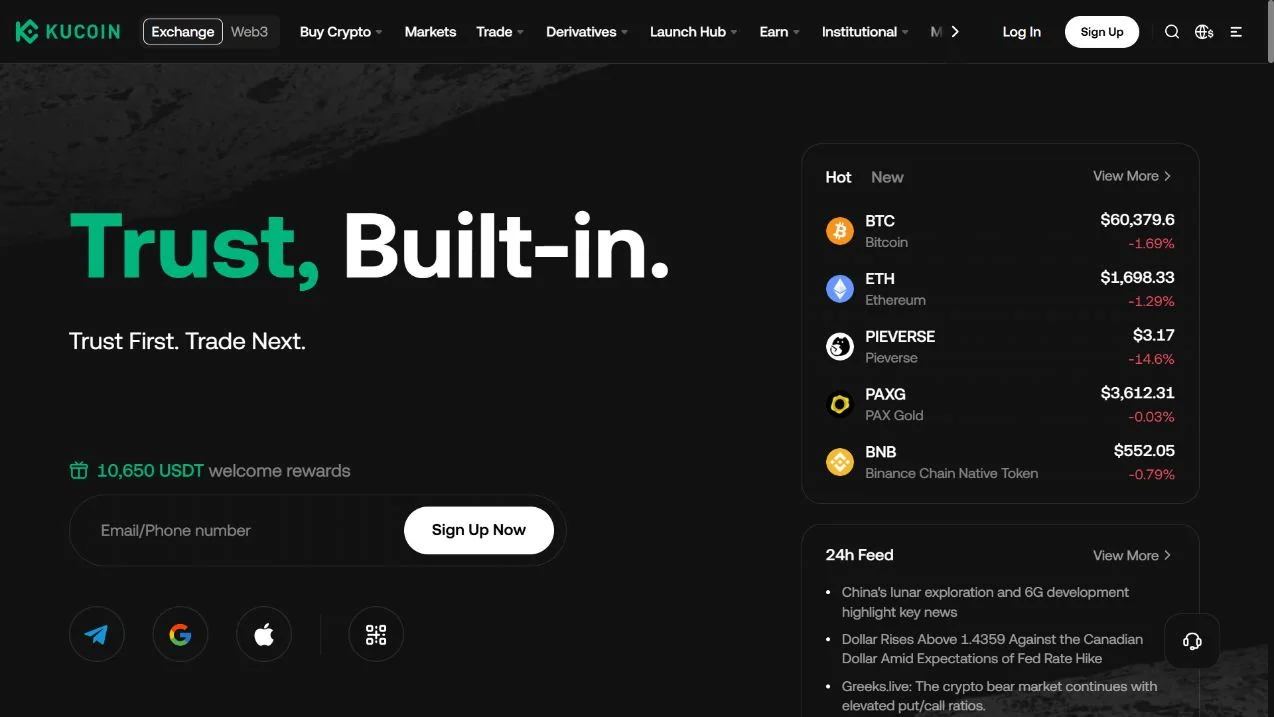
KuCoin’s appeal is its trading range, but its 2026 assessment must begin with access and legal history. The global terms exclude the United States, France and the Netherlands among other locations. The US record also includes a January 2025 corporate guilty plea and a March 2026 CFTC consent order. In Europe, a MiCAR authorisation and permission to commence business have been separate questions. Global agreement, DOJ resolution, CFTC order announcement, FMA notice.
For an eligible account, the official spot-fee guide uses 0.10% maker / 0.10% taker reference pairs, with an explicit warning that some pairs differ. That makes a pair-specific check more useful than a blanket claim that every KuCoin trade costs 0.10%. Security history also matters: KuCoin publicly described a serious hot-wallet private-key compromise in 2020 and later reported recovery and coverage arrangements. Fee guide, company security letter.
1. KuCoin at a glance
| Topic | Documented finding | Qualification |
|---|---|---|
| Origins | DOJ records date founding to about September 2017 | Historical statement, not a current shareholder register |
| Global terms | US, France, Netherlands and other restricted locations | A public website or app does not establish eligibility |
| Spot fee reference | 0.10% maker / 0.10% taker on the guide’s reference pairs | Some pairs differ; account tier and KCS settings matter |
| 2020 security event | Operator described leakage of hot-wallet private keys | Recovery and coverage figures are company statements |
| 2025 US corporate case | PEKEN guilty plea; more than $297m in monetary penalties | Founders’ deferred-prosecution agreements are a separate outcome |
| 2026 CFTC case | $500,000 penalty and permanent injunction conditional on the relevant registration requirement | A minimum two-year exit in another case is not an automatic reopening date |
| EU service | KuCoin EU Exchange GmbH received authorisation in November 2025 | FMA’s May 2026 notice still distinguished commencement restrictions from a lifted new-business ban |
2. Background, operators and founders
The January 2025 DOJ announcement describes KuCoin as founded in or about September 2017 and identifies PEKEN GLOBAL LIMITED as an operator. It records the roles of co-founders Chun Gan, also known as Michael, and Ke Tang, also known as Eric. Their management and legal outcomes belong in the history because the resolution required them to leave management and operations. DOJ release.
The same legal name is described as Seychelles-based in the 2025 DOJ release and as incorporated in the Turks and Caicos Islands in the March 2026 CFTC release. This article retains the dates and wording of those records rather than inventing the details of a restructuring. For a current account, the contracting party still needs to be identified from the applicable agreement. CFTC release.
The brand, the global account and the European company should not be merged into one undifferentiated operator. That distinction affects which tariff, restriction or court record is relevant to the reader.
3. The 2025 US guilty plea and founder agreements
On 27 January 2025, PEKEN pleaded guilty to operating an unlicensed money-transmitting business. The DOJ described failures involving AML/KYC, suspicious-activity reporting and FinCEN registration. The monetary terms included $184.5m criminal forfeiture and approximately $112.9m in fines, together more than $297m. DOJ case announcement.
The resolution also provided for KuCoin to leave the US market for at least two years. The DOJ said prosecution of Gan and Tang would be deferred for two years, that each agreed to forfeit about $2.7m, and that neither would retain a management or operational role. A deferred prosecution should not be described as the same legal result as the company’s guilty plea.
The DOJ’s discussion of billions in suspicious transactions also needs its proper meaning. A monitoring failure or a suspicious transaction is not a judicial finding that every dollar moving through the exchange was criminal proceeds. The admissions, financial terms and required US exit are serious enough without changing that distinction.
4. The 2026 CFTC order
On 30 March 2026, the CFTC announced a federal consent order against Peken Global concerning direct US access to KuCoin’s electronic trading and order-matching system without foreign-board-of-trade registration. The order imposed a $500,000 civil monetary penalty and a permanent injunction against the charged future violations. CFTC announcement.
The release says the CFTC did not seek additional disgorgement in that case, taking account of the circumstances including cooperation and the parallel criminal forfeiture. It also reports dismissal with prejudice of claims against Mek Global, PhoenixFin and Flashdot. Those outcomes should not be collapsed into a statement that every KuCoin-related defendant was convicted or that all restrictions disappeared.
For a US reader, there is no sound basis to treat the 2025 minimum two-year exit as an unconditional future reopening date. The 2026 order and the current global terms must be considered as well. The checked terms continue to list the US and its territories among restricted locations. Global restrictions.
5. Europe: authorisation and commencement are different
The Austrian FMA notice dated 18 May 2026 says KuCoin EU Exchange GmbH received a crypto-asset service authorisation on 27 November 2025. It explains that a later new-business prohibition was imposed after key AML and sanctions-compliance roles were no longer filled as required. That prohibition was lifted once those roles were filled again. FMA notice.
However, the same notice states that commencing business remained inadmissible under a different administrative decision dated 18 February 2026, because other supervisory conditions—including governance and senior-management functions—had not been fully met. A headline about the lifted ban therefore did not establish that the service could immediately start accepting business.
This dated notice does not by itself establish the complete November onboarding position. This review does not infer a later permission that it has not obtained. An EEA customer should establish the present authorised service and operational status before treating the EU company as an available account. Separately, the global terms exclude France and the Netherlands, so those customers cannot simply substitute the global domain.
| Record | What it establishes | What it does not establish |
|---|---|---|
| November 2025 authorisation, described by FMA | A named EU company received an authorisation | That every later condition remained satisfied |
| February 2026 administrative decisions | More than one regulatory constraint existed | That lifting one decision automatically lifted the other |
| May 2026 new-business-ban lifting | The specified AML/sanctions role issue had been addressed | Immediate permission to commence all business |
| Current global restricted list | France, Netherlands and US are among exclusions | Positive approval for every unlisted European country |
6. The 2020 hot-wallet compromise
KuCoin’s retrospective company letter describes a September 2020 attack that compromised private keys of several hot wallets. The operator says the attacker had penetrated its internal network and that affected hot wallets were redeployed after vulnerabilities were addressed. This is the company’s account of its security incident and response. Company letter.
The same letter gives the following recovery and coverage breakdown:
| Company-reported category | Historical amount | Share stated by company |
|---|---|---|
| Recovery with exchange and project partners | $222m | 78% |
| Recovery with law-enforcement and security organisations | $17.45m | 6% |
| KuCoin / insurance-fund coverage of the remainder | $45.55m | 16% |
These figures total about $285m under that particular historical account. They should not be silently replaced by a different article’s valuation, or presented as an independently reconciled Atlas repayment ledger. The company says users sustained no loss, but a company coverage statement is not a universal policy insuring every future account event.
The relevance for a customer is direct: a password can be uncompromised while an exchange-level key is attacked. Technical account settings and institutional custody controls address different failure modes. A later feature expansion or licence does not erase the earlier event.
7. Spot fees and the KCS setting
The fee guide describes several inputs: the account’s fee level, whether the execution is maker or taker, whether KCS Pay Fees is enabled and the asset used to collect commission. Its 0.10% / 0.10% example expressly does not cover every pair. Official fee guide.
For a reference execution of 100, 1,000 or 10,000 USDT at 0.10%, commission is 0.10, 1 or 10 USDT respectively. That is a percentage illustration, not a fiat-redemption guarantee for USDT or a statement that the same rate applies to every listed asset.
| Fee factor | Question to answer | Common comparison error |
|---|---|---|
| Pair | What rate does the selected trading page show? | Assuming the reference 0.10% applies universally |
| Account tier | Which tier is actually active when the order is placed? | Applying a tier the account has not reached |
| Execution role | Did the order rest or match immediately? | Treating every limit order as maker |
| KCS payment | Is the programme enabled and available for the transaction? | Assuming a token holding alone guarantees a stated discount |
| Fee asset | Which token is deducted on this execution? | Expecting the displayed gross purchase quantity to be the net amount credited |
The guide generally discusses the asset after the slash as the fee token, while warning that some transactions collect the same coin and can credit a smaller net quantity. The transaction record is therefore more informative than multiplying an advertised rate and assuming the deduction always appears in a separate cash balance.
8. Trading tools and product boundaries
| Public product category | What it adds | Separate condition to inspect |
|---|---|---|
| Spot | Order-book asset purchases and sales | Pair, fee tier and withdrawal network |
| Margin | Borrowing-related exposure | Interest, collateral and liquidation |
| Futures | Contract rather than ordinary spot ownership | Funding/settlement, margin and regional permission |
| Bots | Algorithmic order submission | Repeated-order costs and the stop/exit behaviour |
| Copy trading | Strategy execution influenced by another trader | Allocation, profit sharing and different fill prices |
| Convert / purchase routes | A quoted acquisition or conversion flow | Quote, spread and payment-provider charge |
| On-chain and early-token services | A different asset or venue workflow | Contract, custody and listing-status distinctions |
These categories appear in the current public product description. They are a description of the advertised range, not approval for a restricted customer to use them. Reward products and promotions also need their own terms; historical returns do not establish a future yield.
9. Funding, KYC and withdrawals
The global agreement permits location and compliance checks, including access-location verification. The 2025 DOJ account also explains the historical transition to mandatory KYC for active users in 2023. A review should not repeat an old anonymous-trading pitch as a description of current onboarding. Terms, DOJ account.
For a cash purchase, identify whether the counterparty is the exchange, a payment provider or another P2P user. Bank-transfer, third-party card and crypto-deposit routes do not have one shared cost or dispute process. The public menu’s payment options are not a verified universal bank tariff. Public product and purchase routes.
For a crypto withdrawal, establish the exact supported network and any destination memo or tag. An open order, margin liability, settlement condition or compliance review can affect the amount available to move. This assessment does not establish a fixed withdrawal price or completion time for every asset.
10. Execution, liquidity and mobile use
A broad asset selection can be useful, but each pair has its own liquidity. A low reference commission does not determine the spread or the depth available for a large order. Smaller markets can require a different execution plan from BTC or ETH even within the same platform.
The public web and app range also does not resolve access. An installable app can still serve a customer who is restricted from trading. Use the account’s actual jurisdiction, product and confirmation screen; do not treat an app-store country or public chart as approval. No live liquidity benchmark, account-opening test or withdrawal test is claimed here.
11. Advantages and limitations
| Potential strength | Material limitation |
|---|---|
| Broad advertised asset and trading-tool range | US and several European locations are excluded from the global service |
| A documented reference spot-fee model | Pair exceptions and KCS/account settings affect the actual fee |
| Detailed company account of the 2020 response | The major hot-wallet incident remains part of custody history |
| A separate European authorisation record | The dated FMA notice also identifies a distinct commencement constraint |
| Several funding/acquisition categories | Provider, banking and crypto-transfer terms differ |
| Current public legal records are available | Corporate plea, founder DPAs and CFTC orders have different outcomes |
12. Alternatives and suitable readers
US readers should begin with a currently eligible US product. The global KuCoin restrictions and court record make a generic global fee comparison insufficient. EEA readers should establish a current operational regional service rather than assume that an authorisation headline resolves the issue.
For an eligible international account, the meaningful comparison is a specific asset pair, trading workflow and withdrawal route. A user prioritising a simple bank-funded purchase may value a smaller, clearer product range; an experienced trader may value more tools while accepting their additional complexity. The decision should also include custody and incident history, not only the number of listings.
13. Frequently asked questions
Is KuCoin available to US users?
The checked global terms exclude the US and its territories. The legal record includes a minimum two-year exit in the 2025 corporate resolution and a separate 2026 CFTC order. Neither should be treated as an automatic permission to return on a guessed date. Terms, CFTC.
Are all spot fees 0.10%?
No. The guide uses that rate for reference pairs and expressly warns that some pairs differ. The live pair, account tier and fee-payment setting determine the relevant rate. Fee guide.
Were the founders convicted in the same way as the company?
The DOJ release records a corporate guilty plea and separate two-year deferred-prosecution agreements for Gan and Tang, plus management-exit and forfeiture terms. Those are different legal outcomes. DOJ release.
Was KuCoin hacked?
Yes. Its own letter describes the September 2020 hot-wallet key compromise and later recovery and coverage arrangements. The reported allocations and no-user-loss statement remain attributed to the operator. Company letter.
Does the European authorisation prove current onboarding is permitted?
Not by itself. The FMA’s May 2026 notice distinguished a lifted new-business ban from a separate continuing commencement restriction at that date. A later operational permission must be established separately. FMA notice.
14. Final assessment
KuCoin has a substantial advertised trading toolkit and a fee model that can be evaluated at the pair level. Its availability and legal record, however, are decisive parts of the product. The US cases and the European distinction between authorisation and commencement cannot be replaced by a generic worldwide feature list.
An eligible customer’s comparison should combine the actual pair fee, funding and exit route, account scope and the documented 2020 custody incident. That gives a more useful answer than either an old no-KYC pitch or an unsupported claim that a later licence resolves every risk.
Prepared from the dated sources listed below. This is a documentary review; no account opening, trade, support-response or withdrawal test is claimed.
Sources and check dates
- Kucoin terms ·
- Kucoin doj 2025 ·
- Kucoin cftc 2026 ·
- Kucoin eu regulator ·
- Kucoin fees ·
- Kucoin security letter 2021 ·
- Kucoin home current ·
Operator, regulatory and court records support the relevant findings; third-party market data is identified in the text. Effective dates and unresolved checks remain beside the claim.