
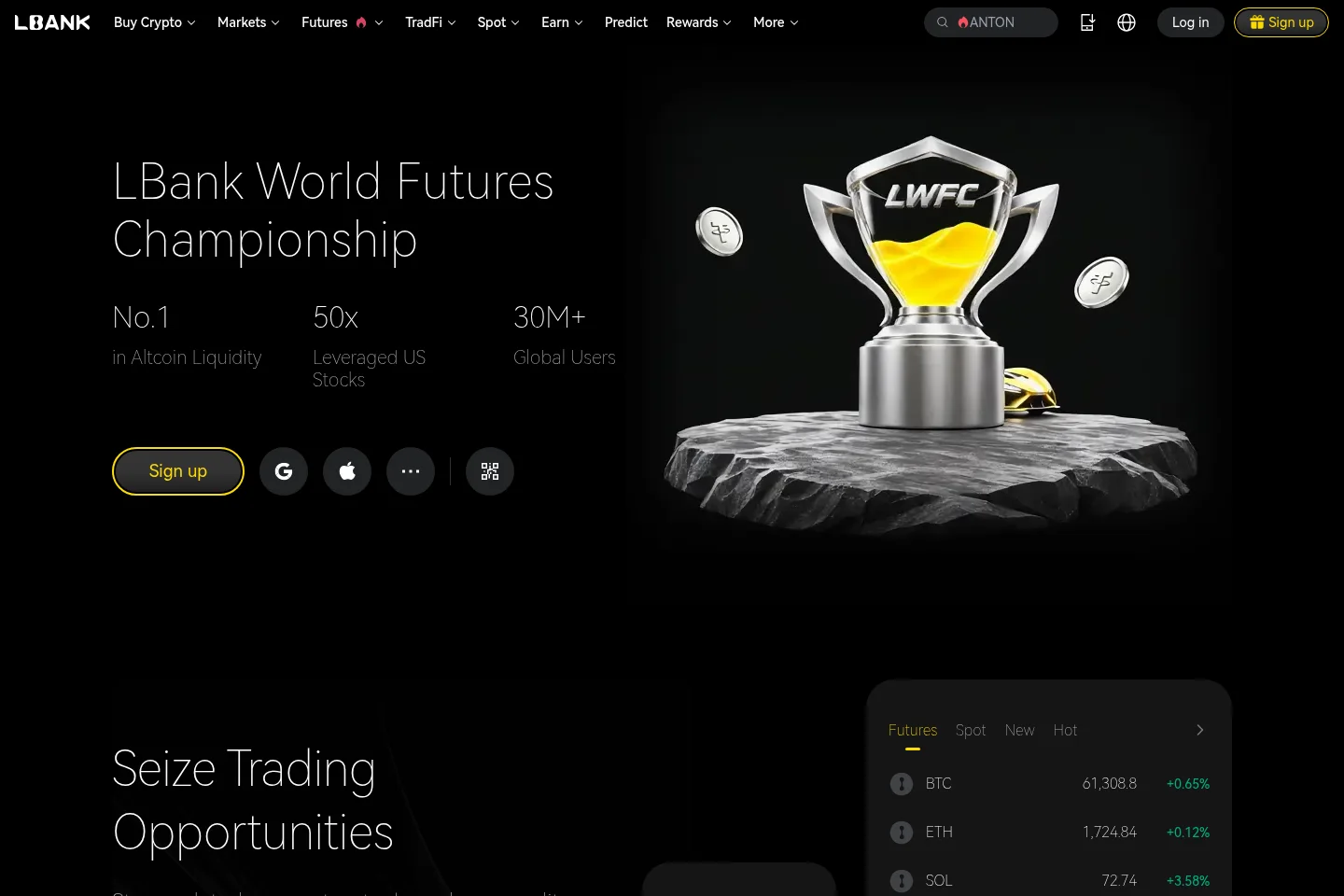
LBank’s basic spot fee is easy to quote: the checked VIP0 schedule shows 0.10% maker / 0.10% taker. The harder questions concern the market being traded, the route used to fund it and whether the customer’s country is actually supported. For a smaller listed asset, a one-dollar commission on a 1,000 USDT trade can be less important than the price available when it is time to exit. Fee schedule.
This overview treats LBank as a listing-and-execution decision. It also revisits a frequently recycled controversy: Hacken’s criticism from 2018 and the same researcher’s later, more favourable reassessment. Those records should retain their dates; neither an old negative report nor a later improvement claim is a current Atlas technical audit. Researcher’s updated account.
1. LBank at a glance
| Question | Checked finding | Reader implication |
|---|---|---|
| Entry-level spot fee | VIP0 0.10% maker / 0.10% taker | Calculate commission separately from spread and withdrawal |
| Higher tiers | Lower published maker/taker rates | Qualification and actual account rate need confirmation |
| KYC | Official FAQ describes identity verification and account/region requirements | Do not rely on an old no-KYC claim |
| United States | Excluded by the service agreement | Not a US retail recommendation |
| EU | Italy and Spain appear in a restricted list | Other EEA countries still require affirmative country/product verification |
| Historical criticism | Hacken explains its 2018 concerns and a later reassessment | Historical criticism is not a current criminal finding |
| Liquidity | Must be assessed for a particular pair and amount | No live order-book ranking is claimed here |
Sources: fees, KYC FAQ, agreement, Hacken account.
2. Products and the reason to investigate a listing
The public platform advertises spot, futures and other services. A listing can provide a route to a particular token, but it is not an endorsement of the token’s economics, issuer or contract security. A new listing may also have a different fee event or less dependable exit liquidity than an established BTC or ETH pair. Public platform, fee exceptions.
For a reader considering a less widely listed asset, start with the asset contract and supported network. Two assets can share a ticker. Then inspect the exact market, not an exchange-wide count of coins. Deposit status, the buy quote and the eventual receiving wallet need to describe the same asset and chain.
The contract and legal counterparty remain separate questions from the number of listings. This overview does not invent a founder biography, headquarters or current licence from a third-party comparison table. The checked agreement is the relevant starting point for account obligations. User service agreement.
3. Spot fees by tier
| Published tier | Maker | Taker | Taker commission on 1,000 USDT |
|---|---|---|---|
| VIP0 | 0.10% | 0.10% | 1.00 USDT |
| VIP1 | 0.08% | 0.08% | 0.80 USDT |
| VIP2 | 0.065% | 0.07% | 0.70 USDT |
| VIP3 | 0.05% | 0.06% | 0.60 USDT |
| VIP4 | 0.04% | 0.05% | 0.50 USDT |
| VIP5 | 0.03% | 0.04% | 0.40 USDT |
| VIP6 | 0.02% | 0.035% | 0.35 USDT |
| Top SVIP row | 0% | 0.03% | 0.30 USDT |
The official fee page, checked 23 November 2026, says certain tokens may not follow the stated rate during specific periods and directs customers to actual transaction records. A VIP table is therefore a tariff framework, not proof of a personalised rate on every asset.
The table also demonstrates why maker and taker must remain separate. They are equal at VIP0 and VIP1 but diverge at later tiers. A review that reports only the lowest maker number can materially understate the cost of an immediately executed order.
4. Commission examples at the ordinary rate
| Executed notional | Maker commission | Taker commission |
|---|---|---|
| 100 USDT | 0.10 USDT | 0.10 USDT |
| 1000 USDT | 1.00 USDT | 1.00 USDT |
| 10000 USDT | 10.00 USDT | 10.00 USDT |
These examples cover one execution at VIP0. They exclude funding, spread, price impact and withdrawal. On 1,000 USDT, reducing the taker rate from VIP0’s 0.10% to VIP3’s 0.06% saves 0.40 USDT per execution, under the displayed tariff. That saving should be compared with the actual requirements and any cost of obtaining a higher tier.
A round trip has two executed notionals. If the first purchase leaves a smaller balance after commission, or the asset’s price changes before the sale, the second commission is calculated on that changed sale value. Simply doubling one fee is a planning shortcut, not an exact account reconciliation.
5. The listing question: can the position be exited?
For a 100 USDT trade, the visible best bid and ask may be sufficient to understand much of the immediate price cost. For 10,000 USDT, several order-book levels may be consumed. The same percentage trading fee can therefore produce a very different total execution cost at different sizes.
The relevant evidence is a timestamped book for the exact pair, side and amount. Reported 24-hour exchange volume is not a substitute for that book. Nor does a large number of listed tokens tell the reader how much of one token can be sold near the displayed price.
Atlas’s liquidity tool is still a clearly marked demonstration rather than a live LBank measurement. This article does not attach fabricated spreads, depth or execution tests to the exchange. A later comparison will need suitable data rights and simultaneous venue snapshots.
6. Funding: direct balance, purchase provider or P2P
The public platform’s purchase routes should be assessed as separate transactions. A third-party card provider can have its own identity checks, quote and fees. P2P adds a counterparty and an off-platform fiat transfer. A crypto deposit uses the sending network and the platform’s supported receiving network. Public product menu.
The useful number is the amount received after the whole route. A provider can advertise zero explicit commission while offering a less favourable conversion price. A P2P quote can include a premium even when no separately itemised platform fee is charged.
No universal cash-deposit or bank-withdrawal fee is inferred from the existence of a payment button. Before funding, establish that the desired exit route is available to the same country and account type. Buying a token and later discovering that the intended cash route is unavailable is a different problem from paying a few basis points more for execution.
7. Withdrawals and operational conditions
A crypto withdrawal requires an asset/network match, a usable address, any memo/tag and the current fee/minimum. These details are not interchangeable across networks. A low-fee route is useful only if the receiving wallet or exchange accepts it.
The KYC FAQ warns that accounts or regions required to complete verification cannot deposit, trade or withdraw without it. That account restriction is separate from network maintenance or an asset-specific withdrawal suspension. KYC FAQ.
This overview has not completed a personal withdrawal or timed a support response. It does not turn an unverified complaint into a general finding that withdrawals always fail, or an operator assurance into a guaranteed settlement time. The current account’s route and conditions need to be documented before funds are committed.
8. Identity verification: what the current FAQ says
The July 2026 FAQ describes identity verification as part of security and compliance, with instructions for document-related issues and missing country options. Its important qualification is that the mandatory restriction applies to the regions/accounts required to complete KYC. Official FAQ.
That is more precise than either “no KYC” or “every account worldwide has identical requirements.” A platform can have different verification triggers while still excluding a country entirely. Completing identity checks does not override a service restriction.
Claims about encryption and confidentiality in the FAQ are the operator’s statements. This article does not independently certify its storage design, GDPR compliance or resistance to data theft.
9. US and European restrictions
| Location | Agreement finding | How this overview handles it |
|---|---|---|
| United States | Personal accounts excluded; US-incorporated/operating entities also restricted | No US retail availability claim |
| Italy | Appears in a service-restriction list | Not treated as supported merely because it is absent from another summary |
| Spain | Appears in the same detailed restriction list | Country-specific exclusion retained |
| Other EEA country | No blanket EU permission established by the checked documents | Verify entity, country and product |
| Other international location | Full restricted list and sanctions provisions apply | Country acceptance is separate from product eligibility |
Source: service agreement. The document contains more than one presentation of restricted jurisdictions, and the detailed list includes Italy, Spain and Kazakhstan where a shorter list is less complete. This inconsistency should be resolved conservatively: a reader should not use the shorter list to claim support contrary to an explicit exclusion elsewhere in the same agreement.
The existence of European payment currencies or a translated interface cannot resolve a licensing question. A useful licence check names the actual legal entity, regulator and authorised service, rather than displaying a generic compliance logo.
10. The 2018 criticism and later reassessment
Hacken’s current page says its 2018 research raised significant concerns about LBank’s liquidity transparency and security infrastructure and concluded that the exchange did not meet its reliability standards at that time. The same page explicitly presents a later assessment as of 2025, describing improvements since the earlier research. Hacken’s updated account.
That chronology matters. Quoting only the 2018 criticism as if it were a new 2026 test would omit the researcher’s revision. Quoting only the later positive statements as an unconditional security guarantee would omit both the history and the author’s warning that conditions change.
The original 2018 PDF was not successfully retrieved for this review. The account above is therefore attributed to the author’s accessible retrospective, not represented as a fresh inspection of the original report. Old concerns about volume patterns are also not a judicial finding of present-day wash trading.
11. What can be said about hacks and scandals?
The retrieved records support discussing the research controversy and the platform’s current restrictions. They do not justify a “zero incidents for ten years” guarantee. Absence of a separately confirmed wallet-loss event in this article is not proof that no compromise, operational loss or dispute has ever occurred.
Equally, a review should not invent a founder scandal to fill a template. Named accusations, legal claims and convictions require specific records and outcomes. The historical researcher’s criticism should remain a criticism about its stated topics and dates, rather than being upgraded into criminal conduct.
For a customer, the unresolved questions are practical: current counterparty, usable country, actual asset/network, execution size and ability to withdraw. Those can be examined without pretending that a single historical rating settles the entire custody risk.
12. A useful comparison table
| If your priority is… | Compare this | Avoid this shortcut |
|---|---|---|
| Buying a smaller listed token | Contract, network, pair and exit depth | Assuming every asset with the same ticker is identical |
| Lower commission | Actual tier and maker/taker role | Using the top VIP maker rate for a new taker account |
| Cash funding | Provider quote and final crypto received | Treating a zero fee label as zero conversion cost |
| European access | Country-specific terms and authorised provider | Calling all Europe supported from a payment menu |
| Security history | Dated incident/research records and later revisions | Presenting an old negative or positive rating as a current guarantee |
Our comparison tool keeps regional products separate. For an eligible trader, a listing advantage can matter, but it should be weighed against the exit route rather than converted automatically into a higher safety score.
13. Frequently asked questions
What is the ordinary LBank spot fee?
The checked VIP0 tariff is 0.10% maker and taker, subject to the page’s pair/period exceptions and the account’s actual rate. Fees.
Can US users open an ordinary personal account?
The agreement excludes US personal accounts and contains additional entity restrictions. Agreement.
Is Spain or Italy automatically supported because LBank has European payment options?
No. Both appear in the detailed restriction list. Payment availability does not override it. Country terms.
Does the old Hacken report prove LBank is unsafe today?
It is a dated criticism. The author later published a revised assessment; neither document substitutes for current, product-specific checks. Research chronology.
14. Editorial conclusion
LBank’s ordinary commission is straightforward; its usefulness depends more on the exact market and exit route. A listing-focused trader should examine liquidity at the intended size and verify the receiving network before funding.
The history also calls for dates rather than slogans. Retain Hacken’s original concerns and later revision, preserve explicit US/European exclusions, and leave unknowns visible. That produces a more useful decision than an unsupported security score or a recycled claim that the platform has never had an incident.
Prepared from the dated sources listed below. This is a documentary review; no account opening, trade, support-response or withdrawal test is claimed.
Sources and check dates
- LBank spot VIP fee schedule ·
- Hacken retrospective and revised LBank assessment ·
- LBank identity-verification FAQ, July 2026 ·
- LBank user service agreement and country restrictions ·
- Lbank home current ·
Operator, regulatory and court records support the relevant findings; third-party market data is identified in the text. Effective dates and unresolved checks remain beside the claim.