
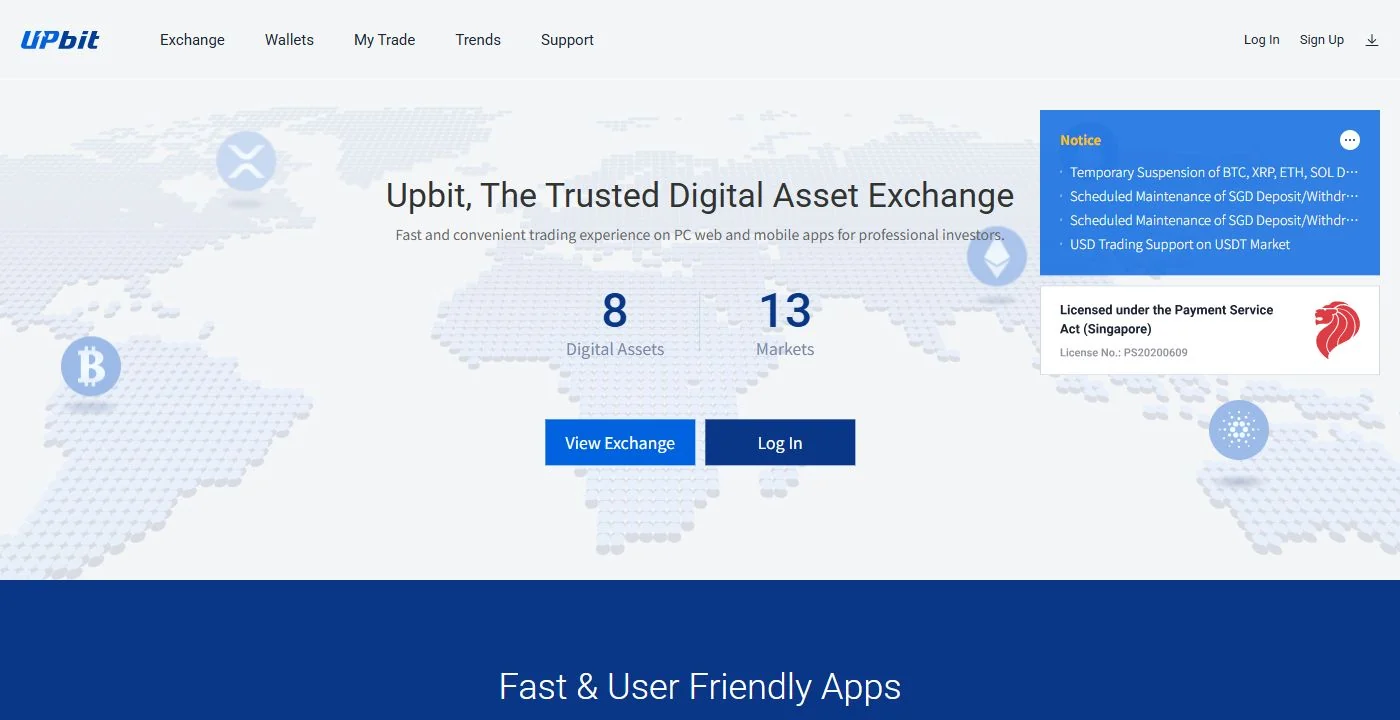
Upbit should not be assessed as one worldwide account. Its Korean service and Upbit Singapore Pte. Ltd. have separate customer rules, currencies and documents. An English Singapore fee table is not a tariff for a Korean won account, and a Korean bank requirement should not be imposed automatically on Singapore users. Singapore terms, Korean customer policy.
The current Singapore guide shows 0.25% for SGD markets and 0.20% for USDT markets, including GST. Its order examples also contain an illustrative 0.10% rate; that example is not the rate displayed in the tariff table. Reading the two together prevents an avoidable pricing error. Trade guide.
1. Two regional services at a glance
| Topic | Korea | Singapore |
|---|---|---|
| Account documentation | Korean customer-confirmation policy | Upbit Singapore Pte. Ltd. terms |
| Fiat market discussed here | KRW, with real-name bank conditions | SGD |
| Confirmed commission in this review | No Korean fee percentage inferred from Singapore | SGD 0.25%; USDT 0.20%, including GST |
| Bank connection | K Bank real-name account required for KRW-market access under the checked policy | Registered same-name Singapore bank account, subject to the terms’ permitted alternatives |
| Foreign applicant | Specific residence documents and remaining-stay conditions | Residence and identity checks under Singapore terms |
| US/EU audience | Not a general international KRW account recommendation | English service is not proof of US or EU permission |
Sources: Korean identity requirements, customer policy, Singapore terms, Singapore fees.
2. What the Singapore platform actually offers
The checked trade guide documents SGD and USDT markets, limit and market orders, and stop-limit orders in supported markets. A limit order can remain unfilled; a market order uses available liquidity. A stop-limit instruction creates a limit order when triggered and is not a guarantee of execution at the stop price. Official guide.
This is a more useful product description than transferring every feature from an international competitor’s menu. The guide does not establish a general entitlement to futures, margin, lending or copy trading. Features and markets must be verified for the regional account rather than assumed from the Upbit brand.
The public homepage advertises mobile apps and notifications. App availability is a distribution channel, not a separate permission to open an account from an unsupported country. Singapore homepage.
3. Singapore trading fee table
| Market | Published rate | Tax treatment | Minimum order in the guide |
|---|---|---|---|
| SGD | 0.25% | GST included | 0.5 SGD |
| USDT | 0.20% | GST included | 0.5 USDT |
The guide’s table applies the stated rates across the displayed order categories and warns that events or order type may affect the actual fee shown on the order screen. Stop-limit support is limited to some markets. Trading guide.
Do not add GST again to a rate already described as GST-inclusive. Also do not add maker and taker together as though every execution pays both. They describe the role of the execution; the actual order screen and fee history supply the transaction-specific charge.
4. Cost at different sizes
| Executed market notional | SGD commission at 0.25% | USDT commission at 0.20% |
|---|---|---|
| 100 units | 0.25 SGD on 100 SGD | 0.20 USDT on 100 USDT |
| 1,000 units | 2.50 SGD on 1,000 SGD | 2 USDT on 1,000 USDT |
| 10,000 units | 25 SGD on 10,000 SGD | 20 USDT on 10,000 USDT |
These columns use different currencies. A 0.05-percentage-point rate difference does not by itself mean the USDT route is cheaper for someone starting with SGD. Acquiring USDT, trading the desired pair and converting back can add costs and another exposure.
The guide’s buy calculation adds the fee to the order value, while its sell calculation subtracts it from sale proceeds. A planned 1,000 SGD order can therefore require additional cash for commission under the documented buy formula. The guide’s numerical 0.10% illustration explains the formula, not the current 0.25% SGD tariff. Calculation method.
5. Tick sizes, minimum orders and execution
The guide sets price increments by market and price band. That affects which limit prices can be entered. For example, a price shown with many decimals on a chart is not necessarily a valid order price for a given SGD band. Minimum orders also apply independently of an account’s maximum permissions. Tick-size tables.
A tight quoted spread is only one execution measure. For a larger amount, inspect the cumulative offers or bids needed to complete the order. This article does not claim a measured Upbit spread or depth advantage; live comparable books have not been connected to Atlas.
6. Singapore KYC and bank transfers
The terms require applicants to be at least 18 and describe identity verification using personal, residence, taxpayer and bank information, with additional information for companies and related parties. Limits can change as information is collected over the life of the account. Singapore terms.
Fiat withdrawals are generally to a registered, same-name Singapore bank account, or another account permitted under applicable law. Third-party bank transfers are prohibited. Digital-asset destination registration and evidence of wallet control can also be required. The terms describe additional checks that can delay or prevent a withdrawal.
Those requirements matter more than a generic claim of “fast withdrawals.” This review does not invent a universal bank charge, approval time or daily limit without a current regional schedule. It also does not turn a displayed fiat reference value into withdrawable cash when the necessary registered bank route is absent.
7. Korea: domestic and foreign-customer documents
| Applicant / condition | Checked Korean documentation | Consequence |
|---|---|---|
| Domestic individual | Resident registration card or driving licence; same-name financial account | Passport and temporary/copy documents are not the listed domestic verification route |
| KRW-market user | Linked K Bank real-name account | Completed KYC alone is not sufficient for KRW access |
| Eligible foreign resident | Specified foreign-resident/overseas-Korean/permanent-resident ID plus residence evidence | A foreign passport alone is not the documented route |
| Residence evidence | Issued within 90 days; remaining-stay condition applies | Short remaining stay or non-resident status can prevent verification |
| KYC incomplete | Trading and transfers restricted | A deposit may not be reflected as an ordinary usable balance |
Sources: identity checklist, customer-confirmation policy. The foreign-resident rules are materially different from Bithumb’s current foreign-applicant exclusion. They should not be collapsed into a claim that all Korean exchanges use the same nationality rule.
The policy also distinguishes completed customer confirmation from verification of the real-name bank account. Without the latter, the KRW market remains unavailable even where other market permissions may exist. Any nationality, residence and account conditions still have to be checked for the individual applicant.
8. What US and EU readers should conclude
Neither a Korean KRW account nor a Singapore SGD account should be presented as a general US version of Upbit. The Singapore terms make eligibility residence-dependent and refer to additional restricted-country guidance. This review has not established a blanket EU crypto-service authorisation or a nationwide US retail service. Singapore terms.
An expatriate who meets local requirements has a different account question from a visitor seeking access with a foreign passport. A local payment licence also has a defined provider and activity. Upbit Singapore’s homepage states it is a MAS-licensed Major Payment Institution for Digital Payment Token Services; that statement does not passport the service into the EU. Operator’s licence description.
9. The 2019 ETH theft
In its 7 January 2020 notice, Upbit apologised for the previous November’s ETH theft and stated that the missing 342,000 ETH had been fully covered using its own assets. It also published details of a point-in-time crypto/fiat asset review and planned staged transfer reopening. Original follow-up notice.
The coverage statement is the operator’s account of reimbursement. The accompanying historical asset ratios are a snapshot around the start of 2020, not proof of current reserve coverage in 2026. Planned January reopening dates in the notice likewise belong to the historical response.
The size is retained in ETH rather than repriced at a later market peak. That preserves what was actually stolen and avoids turning price appreciation into an apparent increase in the number of coins lost.
10. Police attribution and limited recovery
The Korean police’s November 2024 report describes the theft of 342,000 ETH from an anonymised Exchange A in November 2019 and attributes it to North Korean actors, explaining its investigative basis and international cooperation. It records recovery and return of 4.8 BTC, not recovery of all the missing ETH. Original police report, police release page.
The police document does not name Upbit in that anonymised description. Upbit’s own notice separately confirms its matching 2019 ETH theft. Keeping those source scopes explicit is preferable to pretending that the police paper spells out an exchange name it withholds.
The 4.8 BTC figure concerns proceeds recovered through the investigation. It should not be rewritten as 4.8 ETH, or confused with the operator’s separate statement that it covered the customer-asset shortfall.
11. Korean AML actions in 2025
The FIU’s February 2025 publication announced a three-month partial restriction concerning new customers’ crypto transfers, alongside executive/staff measures and findings about customer due diligence, transaction restrictions and reporting. The scheduled period was 7 March–6 June 2025; the document explicitly distinguished existing customers and ordinary trading/fiat functions from the targeted new-customer transfers. Regulator announcement.
In November 2025, the FIU announced its deliberated KRW 35.2 billion administrative-fine decision concerning the inspection findings, while expressly describing advance notice, an opportunity to submit opinions and later confirmation of the amount. That document is not evidence that the same figure was finally paid without challenge. November publication.
These are historical regulatory records, not a current blanket trading ban or a criminal conviction of every executive. This review does not claim to have verified a final outcome of all subsequent administrative or court challenges. The February announcement alone cannot establish the current operational position of an account in November 2026.
12. Advantages and limitations
Upbit’s regional guides provide concrete market and identity details. The Singapore fee table is simple to model, while the Korean rules explain why local banking and residence can matter more than language. For an eligible local customer, those are useful, practical distinctions.
The limitations are equally concrete: separate regional accounts, local funding dependencies, market-specific order rules and a material theft/AML history. A global ranking by volume would not resolve any of those issues. Compare the service available to the reader, not the strongest statistic associated with the brand somewhere else.
13. Frequently asked questions
Is Upbit Singapore’s SGD fee 0.10%?
The current table shows 0.25%, including GST. The 0.10% figure appears in an illustrative calculation below it. Guide.
Can foreign residents ever complete Korean Upbit KYC?
The official Korean checklist describes a route for specified foreign-resident documents, subject to residence and other conditions. A passport-only international signup is not that route. Checklist.
Does KYC automatically unlock KRW trading?
No. The checked policy separately requires the linked real-name K Bank account. Policy.
Was the 2019 loss fully recovered by police?
The police record describes 4.8 BTC recovered and returned. That is distinct from Upbit’s statement that it covered the missing ETH using company assets. Police report, company notice.
14. Final market overview
Upbit is a regional-market decision. The useful starting point is which operator can accept the applicant, which local bank route works and which market supplies the desired asset. Singapore’s straightforward commission table and Korea’s more specific identity/banking rules should remain separate.
Its history is also best understood by separating theft, operator coverage, police recovery and regulatory action. That approach gives a US or EU reader a realistic account of a local-market platform without inventing a worldwide service or a universal fee.
Prepared from the dated sources listed below. This is a documentary review; no account opening, trade, support-response or withdrawal test is claimed.
Sources and check dates
- Upbit Singapore customer terms ·
- Upbit Korea customer-confirmation and bank policy ·
- Upbit Singapore trading guide and fee table ·
- Upbit Korea identity-document checklist ·
- Upbit home current ·
- Upbit January 2020 notice covering the ETH theft ·
- Original Korean police ETH-theft investigation report ·
- Korean police November 2024 release page ·
- Korean FIU February 2025 Dunamu enforcement announcement ·
- Korean FIU November 2025 administrative-fine procedure ·
Operator, regulatory and court records support the relevant findings; third-party market data is identified in the text. Effective dates and unresolved checks remain beside the claim.