
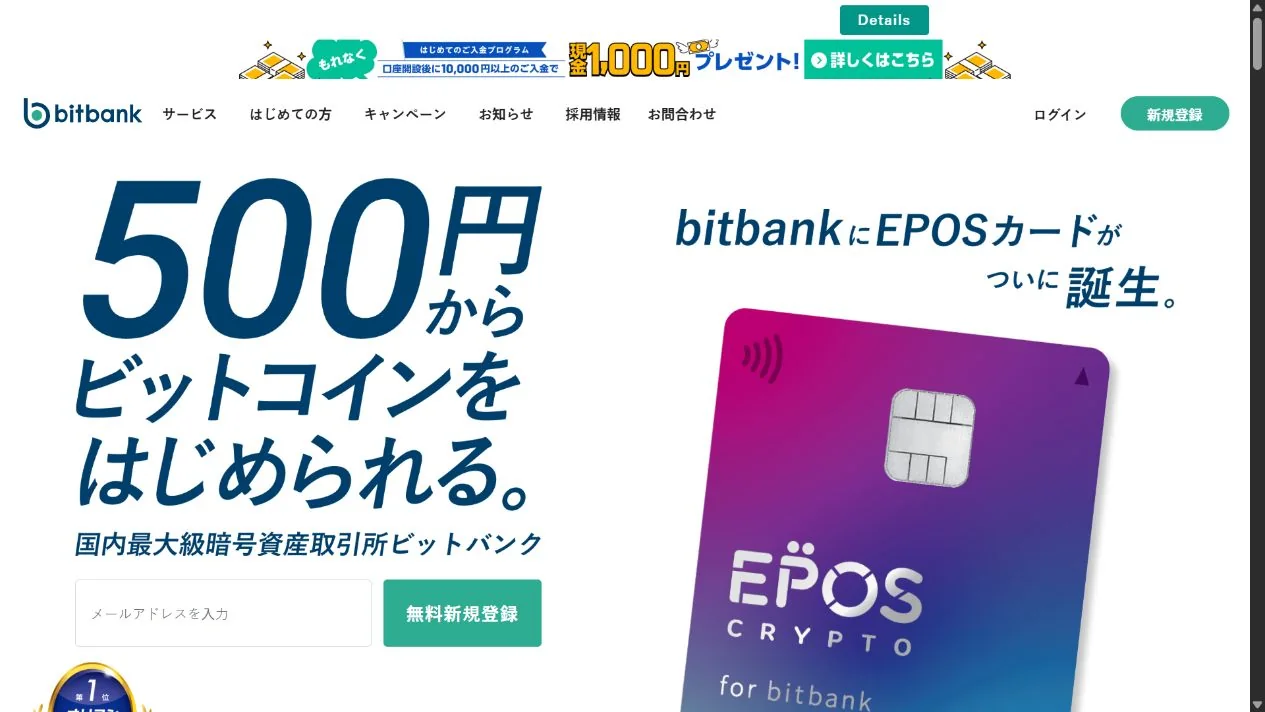
A maker rebate is a useful detail, but it is the wrong starting point for most international readers evaluating bitbank. The personal service is built for residents of Japan, with domestic yen banking. If you live in the US or Europe, an English help centre does not create an overseas retail account.
For an eligible Japan resident, the more interesting comparison is between BTC/JPY, other JPY order books and the cost of moving assets out. The live fee table checked on 24 November 2026, dated 16 October on the page, makes an important distinction: Bitcoin has zero maker commission; ETH and several other pairs offer a negative maker rate.
1. Who this exchange is for
| Reader / task | Assessment |
|---|---|
| Eligible Japan resident using JPY order books | Worth comparing pair-specific execution and exit costs |
| Passive ETH/JPY order-book trader | Published maker rebate can matter if orders actually fill |
| Small buyer planning frequent BTC withdrawals | Fixed coin withdrawal charge can dominate |
| US resident seeking a domestic exchange | The reviewed Japanese personal account does not provide that route |
| EU resident seeking a euro account | No retail EUR/SEPA offering established |
| Overseas company | Separate institutional eligibility; not this personal-account review |
The trade-off is a specialised Japanese venue with a clearly identified local registration, rather than a universal fiat gateway. The right comparison starts with yen and the reader’s actual residency.
2. Company history and the SBI ownership change
The corporate profile identifies Bitbank, Inc., established in May 2014, with Noriyuki Hirosue as co-founder and CEO. The company history distinguishes the 2014 business from the launch of the bitbank.cc exchange in March 2017. Those are different milestones, so either date needs its label.
The current profile lists SBI Group as 100% shareholder. SBI’s 25 June 2026 announcement describes the agreement to acquire the business through SBICAH GK, subject to clearance and other conditions. The announcement names Hirosue, MIXI and CERES in the transaction context.
These sources support the reported ownership transition. The June agreement alone was not proof of completion; the later profile is the source for the current 100% listing. We have not independently reconstructed the exact closing date or all intermediate holding-company records.
3. Japanese registration, without a safety shortcut
Japan’s Financial Services Agency provider list identifies bitbank, inc., Kanto Local Finance Bureau registration No. 00004, registered 29 September 2017. It distinguishes this entity from other Japanese providers such as bitFlyer and BitTrade.
| Record | What it establishes | What it does not establish |
|---|---|---|
| FSA exchange-provider list | Named registered Japanese provider | Guaranteed token value or trading profits |
| Corporate profile | Company and reported shareholder information | Universal US/EU account eligibility |
| Separate lending registration | Different legal activity and dates | Every lending product being risk-free |
| Industry association membership | Membership in the named body | A public insurance policy for customer losses |
The Japanese registration is the relevant domestic record. It is not a MiCA passport or a US state money-transmitter permission. A listed cryptocurrency is also not endorsed as an investment by the Japanese authorities.
4. US and EU residents: the personal-account restriction
The overseas-residency notice says the service is for customers residing in Japan and that ordinary personal accounts can be opened by Japan residents. It separately directs overseas enterprises to another process. Existing personal customers moving abroad are told to withdraw and arrange account closure.
This is a residency boundary, not a claim that all foreign nationals are excluded. Conversely, being a foreign national living in Japan does not automatically establish eligibility: accepted documents, personal circumstances and the account terms still apply.
For a reader resident in the United States or an EU country, Atlas marks the reviewed Japanese personal product unavailable. We do not manufacture US state exceptions or assume a local European bank account will work. There is no separately verified bitbank.US or EU retail product in this review.
5. KYC and a translation discrepancy
The English identity-document guide, updated 14 November 2026, says foreign nationals currently use mail verification. A Japanese smartphone guide updated 15 November includes foreign nationals using a residence card in its smartphone process.
That is a material discrepancy for a non-Japanese resident of Japan. The newer Japanese workflow is more specific, but the account’s current verification options should settle what is actually enabled. The English sentence should not be repeated as an unqualified permanent rule.
| Onboarding detail | Practical importance |
|---|---|
| Japanese residence | Basic scope of the personal offering |
| Supported current identity document | Not every foreign ID or visa is equivalent |
| Face/document checks | Smartphone eligibility has its own process |
| Name, including registered kana | Must align with the bank withdrawal details |
| Purpose, occupation and asset information | Part of the described application |
No speed promise is inferred from a “fastest” onboarding claim. We did not submit an application, identity document or residence card.
6. Order-book fees: Bitcoin is the exception
The live Japanese schedule lists:
| Selected pair | Maker | Taker |
|---|---|---|
| BTC/JPY | 0.00% | 0.10% |
| ETH/JPY | −0.02% | 0.12% |
| BNB/JPY | −0.02% | 0.12% |
| XRP/JPY | −0.02% | 0.12% |
| SOL/JPY | −0.02% | 0.12% |
A negative maker rate means a rebate for qualifying executions. It is not a negative spread or a promise that placing an order generates income. An unfilled order earns no execution rebate, and the asset’s price movement can easily exceed the small fee amount.
The schedule’s campaign footnote allows applicable fee-free promotions to change a pair’s tariff during an event. No active campaign or VIP entitlement is assumed here. The Atlas base profile uses BTC/JPY specifically, rather than presenting the ETH rebate as a platform-wide rate.
7. PostOnly and the price of waiting
The PostOnly guide explains how this limit-order option avoids taker placement. If a submitted order would immediately execute against an opposing order, it is cancelled rather than treated as a taker order under the described rules.
The same guide notes that PostOnly is disabled in trading modes other than Normal Mode, including circuit-break and reopening-related modes. The setting is therefore not a universal guarantee across all market states.
| Choice | Economic trade-off |
|---|---|
| Marketable order | Prioritises execution but can pay taker fees and consume depth |
| Passive limit order | Controls the limit price but may wait or never fill |
| PostOnly limit | Avoids taking under the described normal-mode behaviour; can cancel |
| Order placed during a special mode | Different matching rules and available options can apply |
For a strategy that genuinely needs a completed purchase now, an unfilled zero-fee order is not equivalent to a filled taker order. Compare both the price and whether the task is completed.
8. What the fee difference means in yen
These are Atlas arithmetic examples for ¥100,000 of execution value, with fixed notional, no price change, spread, slippage or transfer charges. They are not performed trades.
| Execution | Commission / rebate |
|---|---|
| BTC/JPY maker | ¥0 |
| BTC/JPY taker | ¥100 charge |
| ETH/JPY maker | ¥20 rebate |
| ETH/JPY taker | ¥120 charge |
| ETH maker entry plus taker exit, ¥100,000 each | ¥100 net charge |
The last row uses two deliberately equal notionals. An actual closing amount can differ after fees and market movement. The calculation shows that one passive leg does not make a mixed round trip free.
The maker rebate is small relative to market exposure: a 0.1% adverse move on the same ¥100,000 is ¥100, five times the ¥20 rebate. This comparison illustrates scale, not a forecast of what prices will do.
9. JPY deposits and the bank exit
The fee table shows no exchange charge for JPY deposits, while the sending bank’s transfer fee is borne by the customer. The bank-registration guide requires a domestic Japanese financial institution and a withdrawal account in the registered user’s name. Overseas bank accounts cannot be registered for this route.
The JPY withdrawal fee notice and live schedule distinguish withdrawals below ¥30,000, charged ¥550, from those at or above that threshold, charged ¥770.
| Withdrawal value | Published fixed charge | Charge / withdrawal value |
|---|---|---|
| ¥10,000 | ¥550 | 5.50% |
| ¥30,000 | ¥770 | About 2.57% |
| ¥100,000 | ¥770 | 0.77% |
A zero-maker BTC purchase can therefore still be followed by a noticeable cash-out charge. Check the current minimum and available balance before requesting a withdrawal; a fee schedule is not an arrival-time guarantee.
10. BTC, ETH and BNB withdrawal routes
Selected rows observed in the same live schedule were:
| Asset | Network | Published withdrawal charge |
|---|---|---|
| BTC | Bitcoin | 0.0006 BTC |
| ETH | Ethereum | 0.005 ETH |
| ETH | Arbitrum | 0.00042 ETH |
| ETH | OP Mainnet | 0.00042 ETH |
| BNB | BNB Smart Chain | 0.0016 BNB |
The table lists no exchange deposit charge for these routes. The sender can still pay a blockchain fee. The quoted withdrawal charge is an exchange route tariff, not a measurement of the network’s minimum fee at that instant.
For an illustrative 0.01 BTC withdrawal, a 0.0006 BTC charge equals 6% of the withdrawal amount; at 0.1 BTC it equals 0.6%. Check whether the account deducts a fee from the entered amount or requires additional balance before interpreting the amount received.
The lower ETH charge on Arbitrum or OP Mainnet is useful only if the destination accepts ETH on that exact network. A cheaper incompatible route does not complete the transfer.
11. Dealer quotes, margin and yield are different decisions
The site separates the order-book exchange, dealer service, margin, lending and staking sections. An order-book maker/taker tariff should not be applied to a dealer quote without checking its spread and execution terms.
Likewise, a historical bitbank Trade derivatives description is not an inventory of today’s products. The current corporate history contains old launches; their presence does not mean every historical feature remains available.
For margin, examine interest, collateral, forced closing and potential losses. For lending or staking, identify the counterparty, lock-up or redemption conditions and reward deductions. SBI group ownership does not turn any of these balances into a guaranteed bank deposit.
12. Security settings and the limits of a badge
The current account-security guide evaluates settings using passkeys, password status and 2FA. It explains that retaining a password alongside a passkey can change the account’s displayed security level. This is a practical settings assessment, not a certification that the exchange cannot be attacked.
An independent platform-security review would need more than an account badge: wallet controls, key governance, software processes and incident handling all matter. No new audit, penetration test or reserves examination was performed by Atlas.
The live site also links to official API documentation. The existence of a trading API does not establish that a third-party bot is safe. Use the minimum permissions needed, check the software handling the key and distinguish reading market data from creating orders or moving funds.
13. Hacks, founder cases and the unrelated Iranian BitBank
SBI’s June 2026 acquisition announcement describes bitbank as having maintained zero hacking incidents since founding. That is an attributed statement at the announcement date, not an independently verified promise that no incident of any kind has ever occurred.
The primary records collected here did not establish a major Japanese bitbank wallet theft or a founder criminal judgment. We do not add an invented scandal to fill a required section, nor use the absence of a located case as a safety guarantee.
There is a specific name-confusion issue. In its 18 September 2026 clarification, the Japanese company says the Iranian “BitBank” referenced in US OFAC reporting is a separate, unrelated exchange and that some media used the Japanese logo incorrectly. The company identifies no capital or business affiliation with that namesake.
An allegation concerning one of these names cannot be transferred to the other on spelling alone. Match the legal entity, country, domain and regulatory record before treating a sanctions story as part of this exchange’s history.
14. Liquidity and comparison with other Japanese venues
The JPY quote currency is central to the comparison. A BTC/JPY book, a USD stablecoin book and a dealer quote serve different routes. A liquidity ranking average does not show the depth available for the reader’s actual pair and amount.
Use a common timestamp and size, inspect the executable levels and add the relevant taker fee or realised maker classification. Include a bank or coin withdrawal if moving out is part of the task. The published fee table cannot supply an independent spread or slippage measurement.
Domestic alternatives include the Japanese products at bitFlyer, Coincheck and BitTrade. Their overseas or historical product variants should not be assumed to share the same conditions. No relative winner is asserted without an equivalent route comparison.
15. App, support and moving abroad
The account guides cover a mobile app and web workflow. Atlas has not tested app usability, verification duration or support response speed. The newer Japanese guide’s extra eligibility detail is useful, but it does not justify an invented rating for the user experience.
The overseas-residency notice gives an especially important exit instruction: complete withdrawals before account closure, since access and withdrawal procedures are unavailable after the closure process is completed. A customer relocating abroad should plan the operational sequence rather than merely update an address and assume the account remains eligible.
Keep trade fills, the applied pair fee, bank records and blockchain transaction identifiers. They help reconcile a maker rebate, a cash withdrawal charge and the eventual received amount, which are three different ledger events.
16. Atlas conclusion
Bitbank merits a place in a Japanese yen trading comparison because its pair-specific tariff and domestic registration are clear enough to examine. The BTC/JPY exception, passive-order trade-off and fixed withdrawal charges are more useful than a blanket claim that the exchange pays everyone to trade.
For a US or EU resident seeking a new personal account at home, this is primarily a regional reference, not an available substitute for a local provider. For an eligible Japan resident, the decision turns on the pair, order behaviour, size and exit route—and the account’s current verification conditions.
17. Frequently asked questions
Does every maker order earn 0.02%?
No. The live schedule checked here lists BTC/JPY at 0% maker. ETH/JPY and selected other pairs show −0.02%, and eligibility depends on actual maker execution and applicable conditions.
Can I register a US or European bank for yen withdrawals?
The inspected bank-registration guide permits domestic Japanese financial institutions and excludes overseas bank accounts for this route.
Can a foreign national living in Japan apply?
Residence and citizenship are separate. The newer Japanese smartphone guide describes a residence-card route, while the English page contains a conflicting mail-only sentence. Confirm the actual workflow and personal eligibility; neither article guarantees approval.
Is the Japanese exchange the Iranian BitBank in OFAC reporting?
The Japanese company’s dated clarification expressly distinguishes the entities and denies any affiliation. Match the country and legal name rather than sharing a sanctions claim based on the brand name.
Does the Japanese registration protect the value of a coin?
No. A registered exchange-provider record does not guarantee an asset’s market value or a customer’s trading result.
Prepared from the dated sources listed below. This is a documentary review; no account opening, trade, support-response or withdrawal test is claimed.
Sources and check dates
- COMPANY ·
- HISTORY ·
- Notice Regarding Conclusion of Basic Agreement and Share Transfer Agreement for Acquisition of Shares of Bitbank, Inc. (to Make it a Wholly Owned Subsidiary) ·
- ex27-japan-fsa ·
- 海外在住中もしくは海外移住予定の方へ ·
- What documents can I use for identification to open an account ? ·
- 「サクッと本人確認」での口座の開設方法を教えてください ·
- Bitbank live Japanese trading and transfer fee table ·
- What is PostOnly? ·
- How to Register a Bank Account ·
- 日本円の出金手数料はいくらですか? ·
- About security strength ·
- Official Documentation for the bitbank.cc APIs and Streams. ·
- Regarding Overseas Media Reports on U.S. OFAC Sanctions Against an Iranian Digital Asset Exchange ·
Operator, regulatory and court records support the relevant findings; third-party market data is identified in the text. Effective dates and unresolved checks remain beside the claim.