
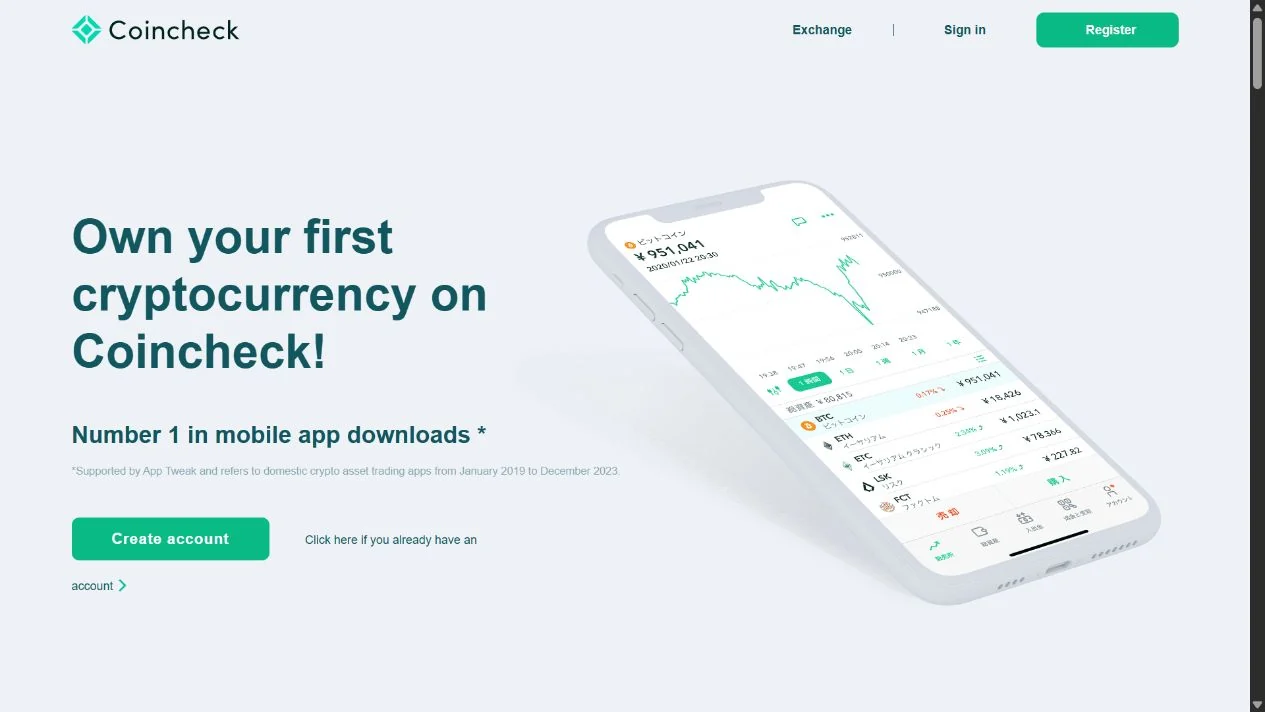
Coincheck can charge no explicit BTC or ETH order-book commission while a simple Marketplace purchase still carries a meaningful cost in its quoted price. Understanding that difference is more useful than calling the whole exchange “free.”
It is also a Japanese resident service. Its parent’s Nasdaq listing and Dutch incorporation do not turn the Japanese app into a US exchange or a European retail account. This review, checked 24 November 2026, follows the money from yen funding to execution and withdrawal, then examines the 2018 hack and later disclosures.
1. Verdict for the intended user
| Reader / purpose | Assessment | Essential qualification |
|---|---|---|
| Eligible Japan resident buying BTC/ETH on the exchange | Published zero commission merits comparison | Spread, depth and withdrawal costs remain |
| Beginner using Marketplace | Simpler quoted workflow | The quote can include a material fee equivalent |
| Small buyer withdrawing coins frequently | Compare the complete route | Variable transfer tariffs can dominate |
| US or EU resident opening a personal account | Outside the reviewed domestic service | Parent-company geography is not account permission |
| User unwilling to accept a major historical custody breach | The 2018 hack is a material objection | Reimbursement does not erase the event |
Coincheck’s appeal is a domestic yen route with several product interfaces. Its main weakness as an international recommendation is simple: a large audience cannot open the Japanese account being reviewed.
2. Operating company, listed parent and history
Historical company disclosures date Coincheck, Inc. to 28 August 2012. The operating company should be distinguished from Coincheck Group N.V., the listed holding company.
The business-combination closing announcement says the parent’s shares and warrants would begin Nasdaq trading on 11 December 2024 under CNCK and CNCKW. That is a stock-market milestone, not a US crypto-exchange licence.
The August 2026 group filing identifies Coincheck, Inc. as a principal Japanese operating subsidiary and lists 100% group voting ownership at 30 June 2026. It also describes the June 2025 merger of the intermediate M1 holding company into Coincheck. Old statements that Monex directly owns the Japanese company can therefore describe an earlier structure.
This review does not apply another group company’s institutional or overseas permissions to the Japanese personal account.
3. Japanese registration and the date of the hack
The current FSA exchange-provider list records Coincheck, Inc. under Kanto Local Finance Bureau No. 00014, with registration dated 11 January 2019.
The 2018 theft preceded that registration. The FSA’s contemporary material describes Coincheck as operating under the transitional/quasi-provider position while its registration application was pending. It would be misleading to imply that its present registration had already been granted when the hack occurred.
| Record / event | Relevant date | Meaning |
|---|---|---|
| NEM incident | 26 January 2018 | Historical security failure |
| First business-improvement order | 29 January 2018 | Regulatory response |
| Exchange-provider registration | 11 January 2019 | Later Japanese registration |
| Listed-parent trading commencement | 11 December 2024 | Corporate securities-market event |
These milestones concern different risks and legal roles. None guarantees a customer’s investment value.
4. Eligibility: Japan, age and US/EU residents
The current personal onboarding guide excludes people under 18 or aged 75 and above, and those resident outside Japan. The review consequently covers the ordinary 18–74 Japan-resident personal scope, subject to the remaining checks.
There is no verified Coincheck.US account or European retail version of this Japanese offering. An EU resident cannot infer access from the Dutch parent’s legal form. A US resident cannot infer it from CNCK trading on Nasdaq.
Residency and nationality are separate. The foreign-national guidance describes residence-card or special-permanent-resident documentation for foreign nationals living in Japan. That is not approval of every foreign document or applicant; the current guide contains additional conditions for certain document categories.
5. Verification, tax residence and travelling
The account guide uses the app for personal onboarding, including passkey registration, important notices, application details and identity documents. The foreign-national FAQ describes particular document submissions through the web rather than email.
The 2026 tax-residence guide requires new accounts opened from 1 January 2026 to submit tax-residence information. Where tax residence includes another country, it describes supplying that country and relevant taxpayer identification information. This is a reporting step, not proof that a nonresident can open an account.
The travel-access notice separately restricts access while in unsupported countries. Its list is dated 1 August 2026 and includes the United States. The guide also says the app is distributed only in Japan and cannot be newly downloaded or updated outside Japan.
| Distinction | Why it matters |
|---|---|
| Japanese residence | Basic account-opening scope |
| Foreign nationality | Document requirements can differ |
| Additional tax residence | Declaration can be required |
| Temporary physical location | Login/service access can still be restricted |
| App distribution country | An existing account does not guarantee an overseas update |
6. Exchange versus Marketplace
The Exchange is the order-book workflow. The Marketplace is a quoted buy/sell service. Their pricing should be compared using the amount of the target asset received for the same debit, not just the presence of a “transaction fee: free” label.
The general fee page lists a Marketplace fee equivalent of 0.1–5.0%, with 1.7–7.0% for certain assets, subject to market conditions; it warns that exceptional circumstances can exceed the stated range. These are disclosed pricing ranges, not an assertion that every purchase always pays the maximum.
A quoted price already includes the relevant price adjustment. Adding a guessed spread again can double-count costs. Compare the complete quote against a contemporaneous executable order-book alternative, including any commission and transfer requirement.
7. Order-book commission by asset
The exchange fee schedule covers exchange and API execution and distinguishes maker, taker and Itayose auction matching.
| Selected asset on the exchange | Maker | Taker | Itayose |
|---|---|---|---|
| BTC | 0% | 0% | 0% |
| ETH | 0% | 0% | 0% |
| XRP | 0% | 0% | 0% |
| ETC | 0.05% | 0.10% | 0.05% |
| IOST | 0.05% | 0.10% | 0.05% |
| FNCT | 0.05% | 0.10% | 0.05% |
Zero explicit BTC/ETH commission does not mean all listed assets are commission-free. Itayose has its own column because auction matching on reopening differs from ordinary continuous trading.
The schedule says a JPY amount-specified purchase deducts commission within that amount and a sale deducts it from execution proceeds. For a nonzero-fee asset, those charging details affect what is available for the next leg.
8. A quote comparison without inventing a live spread
Suppose two hypothetical routes begin with ¥100,000 and the same contemporaneous BTC reference price. An order-book route charging zero commission still has an execution price; a Marketplace quote may embed a premium. The following values illustrate scale only.
| Assumed quoted cost component | Amount on a ¥100,000 basis |
|---|---|
| 0.5% | ¥500 |
| 1.0% | ¥1,000 |
| 3.0% | ¥3,000 |
| Published JPY bank withdrawal | ¥407 |
These percentages are assumptions, not measured Coincheck spreads. They show why a small difference in the purchase quote can outweigh the later fixed bank fee. The meaningful figure is the final asset quantity or cash received after the full route.
A passive order that never fills also cannot be treated as a completed low-cost purchase. Include execution certainty in the decision alongside the quoted price.
9. Deposits and JPY withdrawals
The public funding schedule lists a fee-free exchange-side JPY bank deposit, with the customer bearing the bank’s transfer cost. Convenience-store and Quick Deposit methods have separate tariffs. A JPY withdrawal is listed at ¥407.
| Selected funding option | Published charge |
|---|---|
| JPY bank transfer | No Coincheck deposit charge; bank cost separate |
| Convenience-store deposit below ¥30,000 | ¥770 |
| Convenience-store deposit ¥30,000–¥300,000 | ¥1,018 |
| Quick Deposit below ¥30,000 | ¥770 |
| Quick Deposit ¥30,000–¥499,999 | ¥1,018 |
| Quick Deposit ¥500,000+ | 0.11% of deposit + ¥495 |
For example, the last formula gives ¥1,045 on ¥500,000: ¥550 plus ¥495. That is route arithmetic, not a tested deposit. Availability, exact limits and withdrawal holds must be checked in the account before using a faster funding method.
10. BTC and ETH transfer fees vary
The general fee page describes variable external-transfer tariffs. Its displayed BTC charge tiers range from 0.0005 to 0.016 BTC, and ETH tiers from 0.005 to 0.16 ETH. We do not present the lowest tier as a permanently current withdrawal fee.
| Route | What is documented | What must be checked before sending |
|---|---|---|
| BTC external transfer | Network-related tier schedule | Actual tier, minimum and received amount |
| ETH external transfer | Separate tier schedule | Actual route and current charge |
| Transfer between Coincheck users | No remittance fee in the schedule | Recipient eligibility and subsequent external exit |
| Normal crypto deposit | No exchange deposit fee | Sender’s network fee and correct destination |
At an assumed 0.0005 BTC charge, a 0.01 BTC transfer incurs a fee equivalent to 5% of that amount. A higher tariff would cost more. That example is not an observed withdrawal quote.
The correct network, memo/tag where relevant, minimum and account permissions remain essential. A token name by itself is insufficient transfer instruction.
11. Leverage, recurring purchases and staking
The current leverage FAQ lists no transaction, transfer or liquidation fee for the described leverage service but charges 0.04% per day on marked position value, with spread additional. It assesses positions held at the stated Japanese daily boundary.
For a hypothetical ¥1,000,000 marked position, 0.04% is ¥400 per assessed day, before spread or market movement. This is not the BTC/ETH spot order-book commission. A zero transaction-fee label does not make maintaining a leveraged position free.
Recurring purchase plans and staking likewise have their own price and reward provisions. The general tariff describes a separate recurring-plan price adjustment and a staking distribution formula. No displayed reward or annual rate is treated as a guaranteed net investment return.
12. The January 2018 NEM theft
The contemporary company incident notice records the 26 January event and a series of suspensions. Its timeline was revised as the investigation developed; an early time later struck out should not be repeated as the final established time.
The FSA’s 2018 review describes approximately 523 million XEM, valued then at about ¥58 billion, leaving online-managed storage, with around 260,000 affected customers. Later group accounts use a different historical quantity and yen amount. These numbers should retain their source and valuation context rather than be combined into one supposedly exact dollar headline.
The central security fact does not depend on a modern currency conversion: a large quantity of customer NEM was removed from a hot wallet and ordinary service access was disrupted. The event is material to any assessment of the company’s custody history.
13. Compensation was in yen, not replacement NEM
The 12 March 2018 compensation notice set compensation at ¥88.549 multiplied by eligible NEM holdings at 23:59:59 JST on 26 January 2018. Payment was to the customer’s Coincheck yen balance, rather than directly to the registered bank account.
| Question | What the notice says |
|---|---|
| Settlement asset | JPY |
| Reference holdings | Eligible balance at the specified January timestamp |
| Announced payment date | 12 March 2018 |
| Same event as resumed NEM trading? | No; compensation and service reopening were separate |
| Unverified customer | Compensation eligibility did not remove KYC requirements for withdrawing JPY |
Describing this as every customer receiving the same number of NEM back would be incorrect. A cash compensation formula and recovery of the original tokens are different outcomes.
14. Regulatory response and compensation litigation
The FSA’s contemporaneous English explanation describes the January business-improvement order and requirements to investigate causes, prevent recurrence and protect customers. The later 2018 FSA review records the 2 February inspection and a second 8 March improvement order.
A March 2025 group securities filing describes litigation over the compensation calculation. It says most cases had been resolved and that, as of 31 December 2024, one remaining claim sought approximately ¥5 million. That is a dated company litigation disclosure, not proof that the case remains open today or that a founder was criminally convicted.
The inspected August 2026 interim material does not establish the final disposition of that specific claim. No current closure, payment or founder judgment is invented to fill the gap. Regulatory orders, civil compensation disputes and criminal allegations must remain separate.
15. The 2020 domain and email incident
Coincheck’s 2 June 2020 first notice disclosed unauthorised access to its account at the domain registrar and changes to domain information. It said some customer support emails sent between 31 May and 1 June could have been intercepted.
The initial notice estimated around 200 customers in scope and listed possible exposure of email contents, including personal details or ID selfies where customers had sent them. The company said it had no identified customer-asset impact at that point, corrected domain information and temporarily suspended crypto transfers during the investigation.
This was a different incident from the 2018 NEM wallet theft. It illustrates the importance of email and domain infrastructure even when wallet balances are not reported stolen. The first-notice scope should not be mistaken for an independently verified final forensic finding.
16. Custody disclosure and what accounts can show
The August 2026 filing explains customer-asset segregation and the Japanese requirement to keep at least 95% of customer crypto in cold wallets. It separately discusses crypto borrowed from customers to support Marketplace execution and cover transactions.
That distinction matters. Ordinary safeguarded customer assets, the company’s own inventory and a lending arrangement have different legal and economic roles. A headline balance without its accounting category can be misleading.
Listed-company financial reporting provides more documentary material to inspect; it is not continuous proof of withdrawal availability or insurance against all losses. Atlas has not independently audited wallets, reconciled all liabilities or assessed the efficacy of the current security system.
17. Liquidity, tools and the app
Coincheck’s no-commission BTC and ETH markets are sensible places to begin an equivalent-pair comparison. The next questions are spread, depth at the intended amount and the cost of moving out. No synthetic volume figure or ranking score is treated as an executed order.
The fee schedule explicitly covers API exchange execution as well as the exchange interface. A bot does not inherit a fee-free result on every asset or guarantee an order will fill. Use narrow API permissions and review fills and account activity.
The personal onboarding workflow is app-based, but that does not establish an independently tested usability score. We did not measure app response, support latency or account-opening time, and the travel-distribution restriction is more relevant to some readers than a generic “easy app” label.
18. Alternatives and the full-route decision
For an eligible Japan resident, compare bitFlyer and bitbank on the same JPY purchase and withdrawal route. Coincheck’s zero BTC/ETH order-book commission and ¥407 cash exit can be useful comparison points, but they do not settle execution quality or the current coin-transfer tier.
For residents of the US or Europe, compare appropriately available domestic services instead. Coincheck’s parent listing is not a workaround for Japanese residency requirements.
The decision is strongest when the user deliberately chooses the exchange workflow, understands quoted Marketplace costs and accepts the documented incident history. It is weakest when “free trading” is taken to mean a free complete journey or when a listed parent is mistaken for a custody guarantee.
19. Frequently asked questions
Is Coincheck completely free to use?
No. Selected exchange markets have zero explicit commission, but Marketplace quotes, funding, external transfers and other products can carry costs.
Can a US or EU resident open the Japanese personal account?
The current guide excludes applicants resident outside Japan. No separate US or European retail account is established by this review.
Did users get their stolen NEM back in 2018?
The cited compensation notice describes a yen formula credited to account balances. It does not describe returning the same quantity of NEM to each customer.
Does Nasdaq listing make customer crypto insured?
No such protection follows from the holding company’s securities listing. The operating entity, asset treatment and relevant service terms remain the important checks.
Is the 2020 incident the same hack as 2018?
No. The 2020 notice concerns domain-registration access and potentially intercepted support emails; the 2018 event involved the NEM hot wallet.
Prepared from the dated sources listed below. This is a documentary review; no account opening, trade, support-response or withdrawal test is claimed.
Sources and check dates
- Coincheck company disclosure — establishment date ·
- Thunder Bridge Capital Partners IV, Inc. and Coincheck Group N.V. Announce Closing of Business Combination ·
- Coincheck Group August 2026 interim filing ·
- ex27-japan-fsa ·
- Coincheck current personal-account onboarding guide ·
- Coincheck document guidance for foreign nationals in Japan ·
- Coincheck new-account tax-residence declaration ·
- Coincheck unsupported travel locations and app distribution ·
- Fee ·
- Trading fee ·
- Coincheck leverage service charges ·
- Coincheck incident chronology (January 2018) ·
- FSA response to the Coincheck incident (2018 review) ·
- Coincheck NEM compensation notice (March 2018) ·
- FSA January 2018 press conference — incident response ·
- Coincheck Group March 2025 filing — dated compensation-litigation disclosure ·
- Coincheck domain-registration incident first notice (June 2020) ·
Operator, regulatory and court records support the relevant findings; third-party market data is identified in the text. Effective dates and unresolved checks remain beside the claim.