
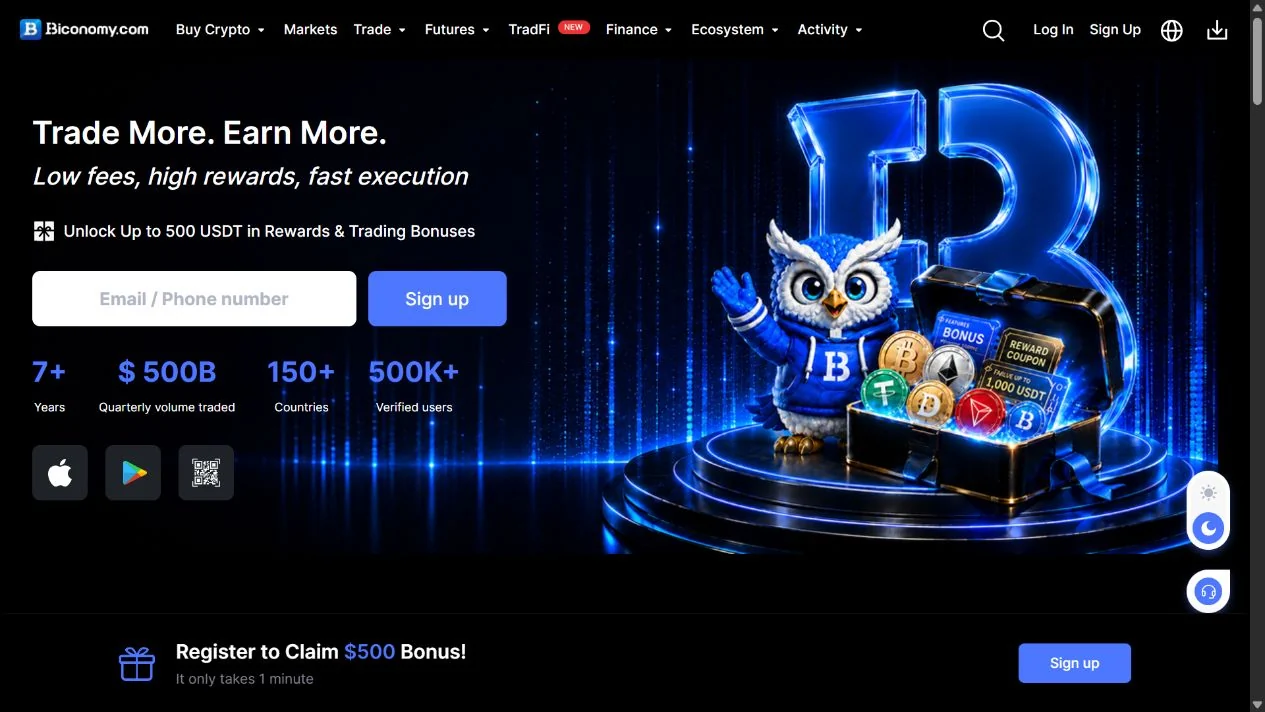
Biconomy.com: identify the exchange before comparing it
Biconomy.com is the centralised exchange assessed here. It must not be confused with the Biconomy blockchain infrastructure protocol, its token, or a similarly named website. That distinction affects ownership research, regulatory warnings, security history and even which KYC policy applies.
The exchange offers a documented 0.10% default spot commission and publishes network-specific withdrawal information. The more difficult questions concern legal-entity clarity, regional eligibility and inconsistent identity-verification wording across its documents. Those are substantive findings, not reasons to fill a review with unverified registration claims.
The decision in one table
| Question | Finding |
|---|---|
| Which website? | biconomy.com, the centralised exchange |
| Default spot tariff | 0.10% maker / 0.10% taker in April 2026 guide |
| BTC/USDT and ETH/USDT example minimum | 10 USDT in the same guide |
| No-document withdrawal claim | New FAQ says 100,000 USDT/day, subject to compliance and risk controls |
| US service | No verified domestic offering or state-specific route established |
| EU service | Named authorised local provider not established |
| Key documentary concern | FAQ and broader AML wording need to be read together |
Sources: spot rules, individual KYC FAQ, AML policy.
1. Brand, business and ownership
The exchange’s official website markets spot, futures, Earn, launch services and third-party purchases. It also promotes a self-custody wallet as a different product. A self-custody wallet’s security model must not be imported into a centralised exchange balance. Exchange catalogue
We have not established a complete current ownership chart or verified beneficial-owner register for the global exchange. Nor do we use a similarly named protocol’s founders to fill that gap. A token ticker, an executive profile and a legal operator are different identifiers.
Before a substantial deposit, request the exact account agreement and contracting entity. The useful information includes a company number, jurisdiction, complaints route and the legal basis for offering the selected service in the customer’s country.
2. Why a Malaysian agreement is not a global agreement
Research surfaced a Biconomy Exchange Malaysia agreement that expressly identifies Biconomy Exchange Malaysia Sdn. Bhd. and biconomy.my. It is not sufficient evidence of who contracts with a biconomy.com customer. Malaysia-specific agreement
| Similar-looking evidence | Correct handling |
|---|---|
| Biconomy infrastructure protocol | Separate project; do not borrow its team or audits |
| Biconomy.com exchange | Subject of this article |
| Biconomy.my agreement | Evaluate its stated local entity and domain separately |
| Biconomy FX warning | Match the warned domain before attribution |
| Exchange wallet app | Separate custody and product terms |
This is more than a naming issue. Applying the wrong agreement can produce a false conclusion about eligibility, dispute resolution or who owes the customer money.
3. US residents: a route has not been substantiated
The global materials reviewed do not establish a separately eligible US product, a state-by-state service list and matching payment arrangements. Atlas therefore marks US access unverified for this profile rather than inferring nationwide permission from a registration form. Global AML framework
A reference to OFAC screening does not mean an exchange is authorised in every US state. It describes a compliance control. Similarly, a USDT market is not a US dollar bank account. A US resident should obtain an explicit supported-country and state answer from the actual provider before considering funding.
4. European Union and other countries
We did not establish a named MiCA-authorised provider and country-specific service scope for this global product. An English or European-language interface does not supply that missing evidence. The AML policy describes sanctions screening and risk-based restrictions, but it is not a positive eligibility matrix for every EU country. AML policy
| Regional question | Evidence still needed |
|---|---|
| EU spot account | Exact authorised provider and country coverage |
| EU derivatives | Product-specific permission and customer classification |
| US account | Domestic provider and state availability |
| Other jurisdictions | Current residence, nationality and sanctions checks |
| Travel or relocation | Whether the existing account can remain active |
Omission from a prohibited list cannot resolve all of these. The comparison tools retain an unverified status where the underlying evidence does not support an available route.
5. Spot commission: the April 2026 change
An official adjustment took effect on 10 April 2026, followed by a detailed guide on 15 April. The guide gives 0.10% maker and 0.10% taker as the default spot rates. It identifies BTC/USDT and ETH/USDT minimum order examples of 10 USDT. Pair-specific exceptions remain possible. Spot fee and order rules
| Order behaviour | Default guide rate | Important distinction |
|---|---|---|
| Limit order resting on the book | 0.10% maker | A resting order is not guaranteed to fill |
| Market order | 0.10% taker | Execution can cross several price levels |
| Immediately matching limit order | 0.10% taker | “Limit” does not automatically mean maker |
| Unfilled order remainder | No executed notional yet | Monitor or cancel the remaining exposure |
The guide’s discussion of removing trading restrictions through KYC should be read alongside the newer identity FAQ below. We do not conceal the different formulations.
6. What a 0.10% tariff costs
These are illustrative calculations at the published default, with no discount, price movement or spread. They are not records of trades placed by Atlas.
| Executed value | One trade | Two equal-value trades | Ten such round trips |
|---|---|---|---|
| 500 USDT | 0.50 USDT | 1 USDT | 10 USDT |
| 5,000 USDT | 5 USDT | 10 USDT | 100 USDT |
| 50,000 USDT | 50 USDT | 100 USDT | 1,000 USDT |
Trading frequency matters even when the displayed percentage looks small. A strategy that repeatedly turns over the same balance can pay substantially more than a one-off buyer. The exit trade may also have a different notional after a price change, so the equal-value assumption is deliberately visible.
The calculator treats the public rate as requiring confirmation of the current account and pair. It does not convert a promotional discount into the default tariff.
7. VIP offers and the exchange token
The website promotes an exchange token and VIP-related benefits. The April adjustment described a tier programme being introduced in phases. Without a verified current tier table and qualification rule, we do not manufacture discount percentages or assume a token holder receives every advertised benefit. Exchange products, spot guide
For a proposed discount, compare the expected commission saving with the exposure required to obtain it. If holding a volatile token is necessary, its price movement can outweigh the saving. A reward headline is also different from an amount that can be withdrawn immediately.
8. Crypto deposits and network-specific withdrawal charges
The official fee table’s indexed Japanese version exposed populated withdrawal rows when other extracted versions did not. These are reference observations from the public schedule, not executed transfer quotes. Network fee schedule
| Asset/network | Published minimum withdrawal | Published charge |
|---|---|---|
| BTC / Bitcoin | 0.0001 BTC | 0.00002 BTC |
| BTC / BNB Smart Chain | 0.000020 BTC | 0.000006 BTC |
| ETH / Ethereum | 0.003 ETH | 0.0014 ETH |
| ETH / Base | 0.0004 ETH | 0.0001 ETH |
| USDT / Ethereum | 20 USDT | 1 USDT |
| USDT / Tron | 10 USDT | 1.5 USDT |
| USDT / BNB Smart Chain | 10 USDT | 0 USDT |
A BTC representation on BNB Smart Chain is not native Bitcoin settlement. Choosing the cheaper row is sensible only if the destination accepts that exact asset and network. The source labels the deposit rows free, but a sending wallet or originating exchange can still charge its own fee.
9. The complete exit cost
For a holder with 100 USDT, a 1.5 USDT withdrawal charge is 1.5% of the balance, before any trading or conversion cost. On 10,000 USDT the same charge is 0.015%. These are arithmetic comparisons using the published Tron reference fee, not a prediction that the charge remains fixed.
| Cost layer | What to capture before confirming |
|---|---|
| Purchase or conversion | Gross input, actual output and trading fee |
| Spread and depth | Executable quote at the intended size |
| Withdrawal | Correct chain, current minimum and final charge |
| Recipient | Supported asset and credited amount |
| Cash-out after transfer | Receiving venue’s conversion and banking costs |
A cheap withdrawal can still be an expensive overall route if two extra conversions are needed. Compare net arrival at the final destination rather than the network fee in isolation.
10. Card purchases and bank funding
The exchange markets third-party purchases. We did not verify a complete current USD or EUR bank deposit-and-withdrawal route with provider, country coverage and both charges. Product catalogue
The comparison tool therefore leaves banking routes absent rather than inventing free SEPA or ACH service. At checkout, inspect the processor’s legal name, fiat debit and crypto delivery amount. A card acceptance screen does not answer whether the global exchange is available in the customer’s jurisdiction.
11. KYC: the newer FAQ and the wider policy
The individual FAQ says non-KYC users can deposit, trade and withdraw up to 100,000 USDT per 24 hours. It gives 1,000,000 USDT for individual level 2 and describes level 3 as unlimited. It separately requires KYC for C2C, and for South Korean deposits and withdrawals. Withdrawals remain subject to compliance and risk controls. Individual FAQ
| Document | Meaning for the reader |
|---|---|
| Newer individual FAQ | Publishes default ceilings and exceptions |
| March 2026 AML policy | Describes ongoing CDD, enhanced review and information requests |
| April spot guide | Says KYC removes trading restrictions |
| Actual account request | Must be resolved before assuming an exit is available |
The FAQ accepts passports and national IDs and says verification is unavailable for Chinese citizens. KYC FAQ These statements do not create a universal right to transact anonymously. Resolve the current account requirements before making a large deposit.
12. Enhanced checks and document handling
The AML framework describes risk-based reviews, identity details, source-of-funds questions and additional scrutiny for unusual activity. Compliance policy A basic withdrawal ceiling therefore should not be interpreted as exemption from all later questions.
Keep original funding records and transaction hashes. Submit documents only through the verified service, and never disclose a wallet seed phrase or authentication code to an alleged support agent. We did not upload identity documents or measure approval time, and assign no invented onboarding score.
13. Security and reserves
The company claims a high proportion of cold storage on its homepage and links a proof-of-reserves offering. We did not independently reconcile current balances, inspect a full financial audit or establish personal insurance coverage. The percentage in a marketing statement should stay attributed to the company. Company security description
| Claim or control | Appropriate next check |
|---|---|
| Cold-storage percentage | Defined asset scope, timestamp and independent evidence |
| Reserve page | Asset ownership, liabilities included and snapshot date |
| Authentication control | Recovery process and withdrawal-authorisation protection |
| Bug bounty | Scope and remediation evidence, rather than logo alone |
A self-custody wallet product is particularly easy to misread here. It does not mean the customer controls the private keys behind a centralised exchange balance.
14. Regulatory alerts and name confusion
Malaysia’s Securities Commission published an investor-alert update on 22 October 2026 naming both “Biconomy” and a separate “Potential clone entity - Biconomy.” The update is a genuine primary regulatory publication. Its short announcement does not by itself settle every domain and entity relationship. SC announcement
We distinguish that record from a CNMV warning naming biconomyfxmartxch.live, a different domain. Neither should be broadened into a founder criminal conviction or silently applied to the infrastructure protocol. A country-specific authorisation warning also does not establish that every customer worldwide experienced theft. CNMV named-domain warning
15. Hacks, founder allegations and operational complaints
We did not establish a major global Biconomy.com customer-wallet theft or a founder conviction from the primary evidence reviewed. That is a bounded research finding, not proof that the complete history is clear.
| Reported issue | Evidence required before treating it as an exchange event |
|---|---|
| Withdrawal complaint | Account status, chain, timestamp and provider response |
| Alleged hack | Affected system, verified transactions and incident statement |
| Founder scandal | Identified individual and court or regulator record |
| Clone website | Exact domain and relationship to the genuine service |
Anonymous complaints can be useful leads. They are not interchangeable with a documented theft, judgment or regulator finding.
16. Trading interface, apps and liquidity
The company provides app and browser access and markets multiple trading products. Platform catalogue We did not benchmark app performance, place orders or test support response times. No claim of personally achieved execution quality appears here.
The exchange’s inclusion follows Atlas’s dated additional-venue screening, rather than a measured live BTC or ETH fill. For a particular pair, compare contemporaneous bid/ask depth at the intended size and include the account fee. A venue’s aggregate volume does not demonstrate that a small newly listed token has an easy exit.
17. Alternatives and reader questions
For an eligible account focused on mainstream assets, compare a clearly documented local provider such as Kraken, Bitstamp or Bitvavo where supported. For a specific token available only on a smaller venue, start with issuer research and withdrawal compatibility rather than the token count.
Is this the Biconomy infrastructure protocol?
No. This article examines the biconomy.com centralised exchange and does not borrow the protocol’s team or audit record.
Is KYC unnecessary?
The newer FAQ publishes conditional non-KYC access, but C2C, South Korean users and ongoing risk checks have exceptions. Other policy documents contain broader verification requirements.
Is the zero USDT withdrawal row universally free?
It is a network-specific public reference. Confirm the exact chain and current account quote, and include sending, conversion and receiving costs.
What must be resolved before shortlisting it?
The account’s contracting entity, local eligibility, current pair tariff and a supported exit. Those are more useful than a blanket safety rating.
Prepared from the dated sources listed below. This is a documentary review; no account opening, trade, support-response or withdrawal test is claimed.
Sources and check dates
- Biconomy Spot ·
- Biconomy Kyc ·
- Biconomy Aml ·
- Biconomy Main ·
- Biconomy Malaysia Terms ·
- Biconomy Chainfees ·
- Biconomy Sc ·
- Biconomy Cnmv ·
Operator, regulatory and court records support the relevant findings; third-party market data is identified in the text. Effective dates and unresolved checks remain beside the claim.