
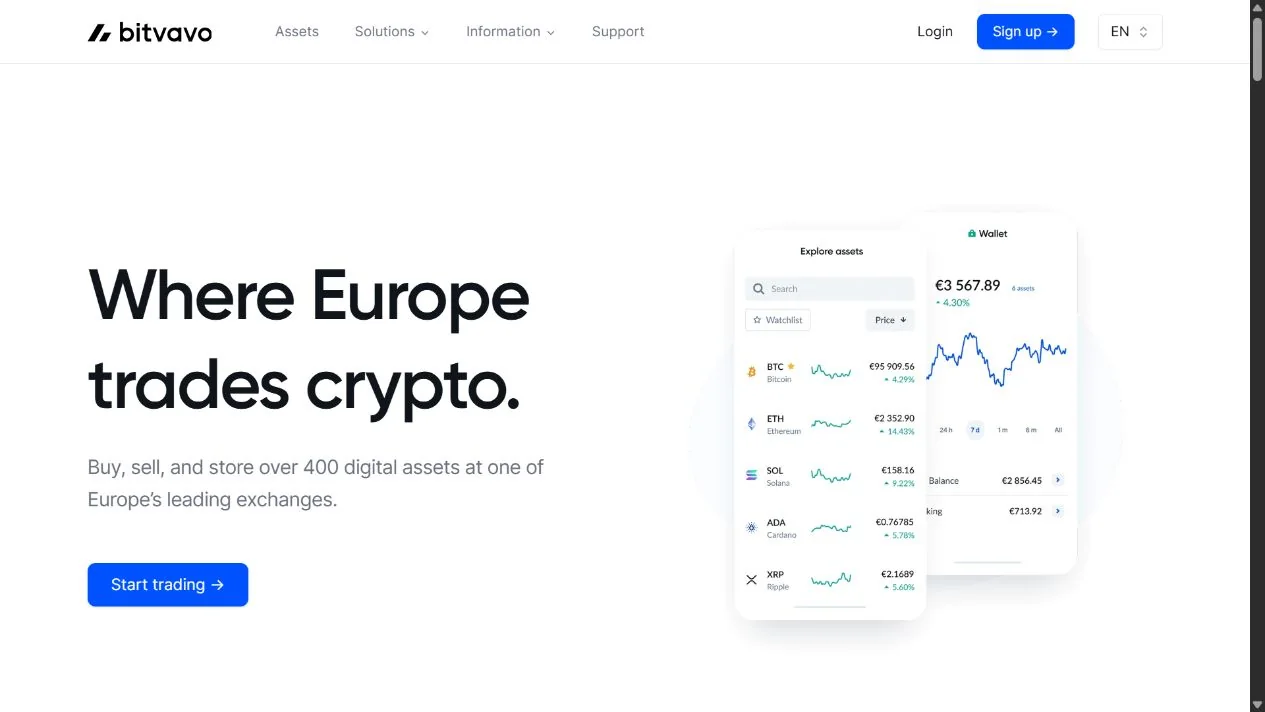
Bitvavo is worth comparing when the journey begins and ends in euros. Its attraction is straightforward: an order book with direct EUR markets, a published tiered tariff and SEPA funding. The harder questions concern eligibility, the extra cost of convenient funding and the boundaries between ordinary custody, lending and the account guarantee.
This assessment uses public documents checked on 24 November 2026. The European service is the subject of the review. There is no verified US version in the inspected offering, and a page displayed in English is not evidence that Americans can open an account.
1. The practical verdict
| Reader | Assessment | Main qualification |
|---|---|---|
| Eligible European buying directly with EUR | A sensible comparison candidate | Compare the actual pair, order type and funding route |
| Investor paying by card or PayPal | Convenient funding has a separate cost | A 1% deposit charge can exceed the trading commission |
| US resident | Outside the reviewed account offering | Do not substitute European availability for US permission |
| Trader routing through USDC | Potentially lower explicit trading fees | Two executions, FX exposure and spreads still matter |
| User seeking yield on idle assets | Requires a separate product decision | Lending and staking do not inherit every MiCA safeguard |
The strongest reason to shortlist Bitvavo is the complete euro route. An advertised low fee on an intermediate stablecoin market is less useful if the funding or conversion leg consumes the saving.
2. Company, history and the contracting parties
The user agreement identifies Bitvavo B.V., Dutch Chamber of Commerce number 68743424, and Bitvavo Custody B.V., number 80118844. The second company has a distinct role in lending. A foundation is used for asset segregation under the documents; these legal roles should not be collapsed into a single claim that everything is protected in the same way.
The company’s July 2025 leadership statement dates its founding to 2018 and identifies Mark Nuvelstijn as a co-founder. It also records his departure as CEO. That is historical evidence, not a reason to present him as the current chief executive.
We have not reconstructed the complete current shareholder register. A familiar founder’s name does not establish who ultimately owns every operating or custody entity.
3. European licence: scope matters
Bitvavo’s trading rules identify an AFM MiCA authorisation under number 41000010. The stated scope includes operating a crypto trading platform, custody and transfer services. The same rules expressly distinguish lending, staking, margin and price-guarantee services from services regulated under MiCA.
| Question | What the inspected documents establish |
|---|---|
| Named European provider | Bitvavo B.V. |
| Published MiCA reference | AFM 41000010 |
| Can authorisation and commercial rollout differ? | Yes; the rules reserve the right to limit markets |
| Is lending provided by the same legal party? | Bitvavo Custody B.V. is identified for lending |
| Does a licence insure the market value of crypto? | No such protection follows from these documents |
For a prospective customer, the licence is relevant to the service and legal entity. It does not answer whether a particular asset, payment method or leveraged feature is available to that account.
4. Supported countries and the US boundary
The country help article lists Austria, Belgium, Bulgaria, Czech Republic, Denmark, Estonia, Finland, France, Germany, Ireland, Italy, Latvia, Lithuania, Luxembourg, Malta, Netherlands, Norway, Poland, Portugal, Romania, Slovakia, Slovenia, Spain and Sweden. It also describes conditional registration in certain associated territories, with additional supported-document or IBAN requirements.
The separate payment-country page displays 25 countries and includes Hungary, which is absent from that help list. It directs Belgian and Spanish readers to local sites. Hungarian onboarding therefore needs confirmation; the two pages should not be silently treated as identical.
The United States is outside the account-residency offering described in the European agreement. No state-by-state US onboarding route or separate US exchange was verified. A US citizen residing abroad should also obtain an account-specific answer about personal eligibility rather than relying on a supported European postal address.
5. Identity checks before funding
The verification guide requires identity verification and describes uploading a valid document and recording a short face-verification video. Accepted document types depend on the jurisdiction; a generic list of passports, cards and licences does not mean each is accepted for every applicant.
| Check | Why it can affect the journey |
|---|---|
| Identity and face verification | Registration alone does not complete onboarding |
| Residential eligibility | A supported bank does not establish supported residence |
| Bank ownership | The payer and account holder must match applicable rules |
| Additional information | Ongoing checks can arise after initial approval |
| Destination wallet checks | Crypto withdrawal has its own requirements |
The API error documentation confirms practical barriers including unverified identity, phone or bank account, cooldowns, unapproved addresses and withdrawal limits. These are operational conditions, not evidence that the exchange has lost the requested assets. They can nevertheless make an urgent transfer unavailable.
The current IBAN guide makes an especially useful distinction: Netherlands and Germany customers must verify the IBAN at the first deposit. In other covered countries, delayed verification can allow up to €1,000 in cumulative deposits and trading first. IBAN verification is still required before either euro or crypto withdrawals. Permission to trade a small balance therefore does not mean the exit route is ready.
6. Trading fees by market
The fee schedule separates ordinary EUR crypto markets from USDC markets and stablecoin pairs. At the entry tier, ordinary EUR trading is 0.15% maker / 0.25% taker. USDC crypto markets start at 0.05% / 0.05%, the listed Category C stablecoin pairs at 0.10% / 0.10%, and EURC/EUR at 0% / 0.01%.
| Ordinary EUR market: rolling 30-day volume | Maker | Taker |
|---|---|---|
| Below €100,000 | 0.15% | 0.25% |
| €100,000+ | 0.10% | 0.20% |
| €1,000,000+ | 0.05% | 0.14% |
| €10,000,000+ | 0.00% | 0.08% |
Stablecoin-pair trading does not contribute to the qualifying fee-schedule volume. Moving a large sum repeatedly through a stablecoin pair therefore should not be assumed to unlock the ordinary crypto tier.
A limit order earns the maker classification only if it adds liquidity. A limit price that immediately crosses an existing quote can still produce taker execution.
7. What a €1,000 purchase costs
The following are Atlas arithmetic examples, not live quotes or completed transactions. They hold the reference price constant and exclude spread, slippage, taxes and withdrawal costs.
| Route / assumed execution | Explicit charge on €1,000 | What the calculation leaves out |
|---|---|---|
| Direct EUR maker purchase | €1.50 trading fee | Waiting or failure to fill |
| Direct EUR taker purchase | €2.50 trading fee | Actual order-book execution |
| Funding method charging 1% | €10 funding charge | Subsequent trading fee |
| 1% funding plus 0.25% fee on €990 | About €12.48 combined | Whether the deposit screen deducts fees this way |
The last row assumes the funding charge is deducted from the original €1,000, leaving €990 to trade. If the processor instead charges the deposit fee separately, the cash flow changes. Compare the confirmation screen’s actual debit and credited balance.
A lower USDC trading tariff is not automatically the cheaper EUR purchase. Buying the stablecoin adds another execution and exposes the route to EUR/USD conversion and stablecoin pricing. Compare the final BTC or ETH received for the same bank debit.
8. Deposits: price and processing are separate
The current public tariff lists free SEPA, iDEAL/Wero and Bancontact deposits; Apple Pay, Google Pay, credit cards and PayPal at 1%; and EPS at 1.75%. Availability and limits depend on country. These are the exchange’s published charges at the check date, not a promise that a bank or processor adds nothing.
The SEPA guide gives indicative arrival times of one working day for Dutch bank transfers and two for international bank transfers. It requires the exact reference displayed in the account; an incorrect reference can cause a return. We do not reproduce bank coordinates here because personalised instructions and supported accounts must be checked at payment time.
| Funding decision | Practical implication |
|---|---|
| Lowest published deposit fee | Compare SEPA first |
| Immediate availability needed | Check the account’s actual instant options and holds |
| Paying from another person’s account | Name checks can prevent crediting |
| Large transfer | Complete eligibility and prepare source-of-funds records first |
9. Cashing out and moving coins
A euro balance and a coin balance have different exit routes. Selling crypto first adds a trading leg; moving crypto directly adds the selected network’s withdrawal charge. Neither route is described accurately by quoting only the trading fee.
The fee page says crypto deposits are free at Bitvavo and that crypto withdrawal charges can vary with blockchain conditions. The sender may still pay a blockchain fee. Check the live asset/network minimum and the amount that will actually arrive in the destination wallet.
The API documentation lists unsupported networks, unverified wallet ownership, withdrawal locks and outstanding-loan restrictions among possible failures. A supported ticker does not prove that the same ticker is transferable over every network. Sending a small test amount is a user precaution; Atlas has not performed a withdrawal test.
10. Markets, execution and the liquidity claim
Bitvavo’s direct EUR markets are useful for comparing a euro purchase without an obligatory stablecoin conversion. Its risk disclosure nevertheless recognises low liquidity, partial execution, wider spreads, slippage and stablecoin de-pegging as risks.
The exchange entered this Atlas expansion through a dated third-party liquidity screen. That selection does not establish the spread or executable depth of BTC/EUR at this moment. Nor does it show that a small-token market can absorb the same order as BTC.
For a meaningful comparison, record the pair, side, timestamp and amount; examine executable levels and then add the applicable fee. A €500 market buy and a €100,000 sale can produce different rankings. No fabricated depth figures or trading-speed measurements are supplied in this review.
11. Margin, staking and lending
The distinction between these products changes the risk. A spot purchase creates exposure to the purchased asset. Borrowing adds a financing obligation and liquidation conditions. Lending adds a claim on the receiving entity or counterparty. Staking adds protocol and service conditions.
The published margin tariff lists hourly borrowing charges and a separate liquidation charge. The trading rules explicitly say these ancillary services do not all sit within the MiCA-regulated service scope. Confirm the exact legal party and product agreement before opting in.
An APY display is not a forecast of net wealth. Rewards can be outweighed by a decline in the asset, service costs or the inability to exit when desired. We assign no prospective return to these features.
12. Security controls and API permissions
The security page describes cold storage, multisignature approval, account 2FA, anti-phishing controls, device management, withdrawal whitelists and permission-based API access. These are published controls, not a penetration test conducted by Atlas.
For an ordinary balance tracker, withdrawal permission is unnecessary. A trading integration needs a different permission set from a read-only portfolio tool. IP restrictions and a withdrawal whitelist reduce different exposures; one should not be treated as a substitute for the other.
Custody-provider insurance figures on a marketing page are also different from an individual customer’s policy. We have not inspected an insurance contract establishing a guaranteed payout for every customer or loss scenario.
13. The €100,000 account guarantee
Bitvavo’s guarantee guide describes potential reimbursement of up to €100,000 for qualifying unauthorised withdrawals. It expressly says the programme is neither an insurance policy nor an EU deposit guarantee scheme.
| Condition / exclusion | Consequence |
|---|---|
| Verified and eligible account for at least 30 days | A newly opened account does not automatically qualify |
| Authenticator-app 2FA enabled for at least 30 days | Push-only authentication does not meet the guide’s condition |
| Police report and timely claim | Evidence and procedure matter |
| Claim within 90 days | Reporting cannot be left indefinitely |
| Voluntarily sending funds to a scammer | Outside the described unauthorised-withdrawal protection |
| Wrong address or market loss | Not a general investment reimbursement |
Eligibility, exclusions and the controlling agreement must be read together. “Up to” does not mean that €100,000 is available on demand, and a security incident does not automatically establish an eligible claim.
14. Reserves: read the snapshot date
The public reserve page names The Network Firm LLP and displays ratios dated 31 March 2026. It describes annual updates. A separate help article describes quarterly attestations. This inconsistency is worth preserving: a promise about frequency does not make an older visible snapshot current.
The help article correctly limits verification to in-scope account balances at the review time; subsequent trades and excluded assets are outside that check. A user can seek their own inclusion evidence through the authenticated reporting flow.
A reserve ratio is not a guarantee of uninterrupted withdrawals, a complete audit of every group liability or proof that every yield product has identical backing. The date, asset scope and report methodology matter more than the presence of a reassuring percentage.
15. DCG / Genesis: a counterparty crisis
On 15 December 2022, Bitvavo disclosed that approximately €280 million had been allocated to DCG and its subsidiaries through the off-chain staking service. Repayments had been suspended. Bitvavo said it could prefund the locked assets to protect customer withdrawals.
Its 6 February agreement-in-principle update, published 7 February 2023 described an expected 80–100% recovery, subject to further documentation and court process. That was a proposal, not proof that the upper end had been paid.
This was a counterparty-credit and liquidity event. It should not be described as hackers stealing €280 million from Bitvavo wallets. Equally, a retrospective claim that the matter is fully recovered needs a final distribution or company accounting record; the historical statements collected here do not establish the final recovered amount.
16. Data breach and governance controversies
The incident history contains more than wallet security. On 1 May 2024, Tweakers reported customer breach notifications and a company response confirming that affected customers had been informed. The reported data categories included contact details, IBAN information and recent trading volume. The report said Bitvavo found no indication that passwords had become public. This is an attributed report of the company response; a public forensic report was not located in the inspected records.
The July 2025 CEO departure is confirmed by Bitvavo’s own statement. Its body is dated 4 July while the page displays 11 July. The company acknowledged press allegations, an earlier temporary step back and Nuvelstijn’s decision not to return to an executive role. His statement concerned past private investments. This announcement is not a criminal judgment.
An October 2025 report discussed historical executive access to customer data and an integrity investigation. It included the company’s explanation that earlier access related to onboarding and support, and the former CEO’s response denying that the cited chats proved actual system access. No final investigation finding or conviction is established by that report. Allegations, acknowledged access arrangements and adjudicated misconduct remain distinct categories.
17. App, support and records
Bitvavo’s documents and account guides cover a web platform and mobile workflow. This review has not installed the app, measured response speed or opened a support ticket. Screens, features and language availability can change independently from an article.
Keep bank debit records, trade fills, fees, wallet transaction identifiers and any compliance correspondence. They help explain the difference between an order displayed as submitted and a completed withdrawal. A support response should identify the product and jurisdiction, especially if two public pages disagree.
For account compromise, use the contact details reached from the official site and secure the associated email account. An unsolicited request to move coins to a “safe wallet” should not be mistaken for a normal support procedure.
18. Alternatives and the decision to open an account
For an eligible European, compare Bitvavo with the relevant European products at Kraken, Coinbase and Bitstamp. Use the same EUR bank debit, target asset and withdrawal destination. A US reader needs the separately available domestic products; this European review does not establish their state eligibility.
Choose Bitvavo because the euro route and account conditions fit the task. Keep yield enrolment, margin use and long-term custody as separate decisions. The favourable entry-tier EUR fee does not erase the DCG history or the governance disclosures, and those historical events do not by themselves prove a current inability to meet withdrawals.
19. Questions readers should resolve
Can Americans use this European Bitvavo account?
The reviewed residency offering does not establish a US route. No separate US product was verified, so Atlas does not mark US access as available.
Is every EU country automatically supported under MiCA?
Authorisation and rollout differ. Check the actual country and local site; Hungary appears on the payment page but not the inspected help list.
Is the lowest displayed fee the cost of buying with euros?
Only for the applicable market and tier. Funding, intermediate conversion, spread and withdrawal can add costs.
Has Bitvavo never had a major problem?
That would be misleading. The documented DCG exposure, reported data breach and confirmed CEO departure deserve separate treatment. This review does not invent a wallet-hack loss or a court finding where none was established by the inspected sources.
Does the account guarantee protect against a falling coin price?
No. Its described purpose is qualifying unauthorised withdrawals, subject to conditions and exclusions.
Prepared from the dated sources listed below. This is a documentary review; no account opening, trade, support-response or withdrawal test is claimed.
Sources and check dates
- User Agreement ·
- Mark Nuvelstijn steps down as CEO of Bitvavo ·
- Trading Rules ·
- In which countries can I use Bitvavo? ·
- Countries ·
- How do I verify my identity? ·
- Handle errors ·
- How can I verify my bank account (IBAN)? ·
- Fees ·
- SEPA deposits (bank transfers) ·
- Risk Disclosure ·
- Security measures ·
- Bitvavo Account Guarantee ·
- Proof of Reserves ·
- What is Proof of Reserves (PoR), and how can I verify my funds? ·
- DCG Update Statement (15-12-2022) ·
- DCG Update Statement (07-02-2023) ·
- Cryptohandelsplatform Bitvavo meldt datalek bij 'beperkte groep gebruikers' ·
- Directie Bitvavo had 'jarenlang' toegang tot data van klanten ·
Operator, regulatory and court records support the relevant findings; third-party market data is identified in the text. Effective dates and unresolved checks remain beside the claim.