
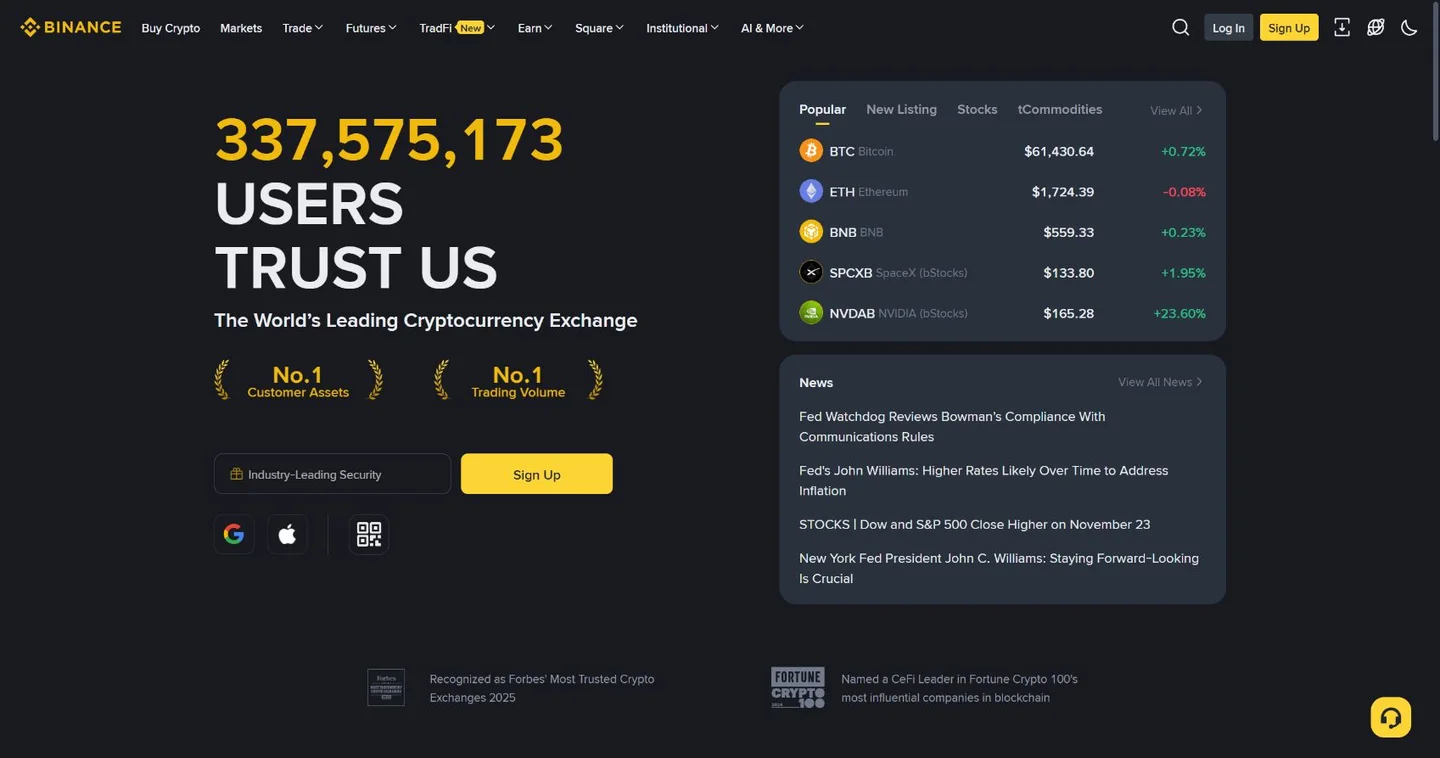
Binance’s low spot commission remains relevant, but the first decision in November 2026 is whether the specific asset and withdrawal network you need is operating after the October security incident. The official incident notice estimated an impact of about $6.3 billion, described precautionary withdrawal suspensions and promised coverage from SAFU and company resources. Subsequent announcements document replenishment and a phased reopening. A review that stops at the 2019 hack misses the most consequential recent event. October incident statement, November network update.
For an eligible international customer, ordinary spot commission starts at 0.10% maker and taker, or 0.075% with eligible BNB fee payment. That is only the execution commission. Country access, a funding conversion, the usable withdrawal route and the cost of moving assets out determine whether the headline advantage survives. This article covers Binance international; Binance.US and Binance TR have their own reviews and conditions.
1. Binance at a glance
| Question | Documented answer | Reader consequence |
|---|---|---|
| Trading product | International Binance order-book spot | Do not use these rates as a Binance.US tariff |
| Ordinary entry commission | 0.10% maker / 0.10% taker | Pair promotions and categories can differ |
| Eligible BNB fee payment | 25% discount; ordinary rate 0.075% / 0.075% | Requires the correct setting and fee-payment asset |
| Recent security event | October 2026 incident; operator estimate about $6.3bn | Read dated recovery and network announcements before funding |
| Reserve verification | Merkle-tree / zk-SNARK inclusion mechanism | Check snapshot, token coverage and limitations |
| US product | Separate Binance.US | Global market visibility does not create US access |
| EU/EEA | Country, entity and renewed verification need checking | Existing-account notices do not establish every new application |
| Research basis | Official company, DOJ, SEC and clemency records | No personal deposit, support or withdrawal test |
Sources: spot schedule, reserve page, regional-product explanation, EEA re-verification.
2. Ownership, founders and the current group
Binance’s official company page says Changpeng Zhao launched the business in July 2017 and identifies Yi He as co-founder and co-CEO. Its leadership and ecosystem descriptions should be read as the current published company account, rather than a shareholder register or independent governance audit. Company overview.
The page describes an ecosystem that includes the exchange, Research, Academy, Charity and Square. These have different jobs. Academy is educational material; Square includes contributions from users and media. A Square post about a new listing, licence or fee is not automatically an operator announcement, even though it appears on a Binance domain.
Binance.US has a separate operating-company context. The US site describes BAM Trading Services and its independence from the international exchange, while acknowledging common ownership. That distinction matters to contracts, permitted states and account operations. It does not erase the group-related history discussed in the enforcement section. Binance.US company explanation.
3. October 2026 incident and the recovery record
The 30 October update says the initial investigation suggested a compromised DevOps laptop gave an attacker access to a service container and enabled unauthorised withdrawal transactions. It said no evidence of wallet private-key leakage had been found at that stage. These were preliminary operator findings, not a completed independent technical post-mortem. Incident notice.
Binance estimated total impact at about $6.3 billion and reported approximately $3 billion frozen on-chain. A freeze, a recovered asset and a customer’s usable withdrawal balance are different milestones. The company pledged to absorb losses through SAFU and its own funds; the pledge is not itself an independently audited completion of every reimbursement or replenishment.
| Dated notice | What it establishes | What it does not establish |
|---|---|---|
| 30 Oct 2026 | Operator estimate, initial cause, loss-coverage commitment and withdrawal pause | Final technical attribution or complete recovery |
| 1 Nov 2026 | Phased withdrawal restart and an initial network/asset list | Every asset and network reopening simultaneously |
| 2 Nov 2026 | Completed proof for a 31 Oct snapshot covering ten named tokens; company reported about 95% coverage of impact | A blanket current status for all remaining tokens |
| 6 Nov 2026 | Additional assets scheduled to reopen | Universal account and network eligibility |
| 14 Nov 2026 | Further network reopenings announced | That any later account-specific transfer must succeed |
The 1 November update and 2 November proof update must not be flattened into one statement that all losses were already recovered on the first day. The later 6 November and 14 November notices extend the operational picture. Check the actual asset/network status before sending funds; this review has not completed a withdrawal test.
The security consequence is practical. An inexpensive order-book fill does not compensate for an unusable exit route. Someone buying an asset specifically to transfer it elsewhere should resolve the withdrawal question before choosing the trading venue.
4. Other major breaches, court cases and founder proceedings
| Date | Event | Scope | Documented result |
|---|---|---|---|
| 7 May 2019 | Security breach; 7,000 BTC withdrawn | International exchange hot-wallet incident | Operator reported API-key/2FA compromise and said SAFU would cover losses |
| Nov 2023 | Corporate guilty plea and Zhao BSA plea | US criminal and sanctions-related resolution | DOJ reported about $4.3bn penalties and compliance commitments |
| Apr 2024 | Zhao sentence | Individual criminal case | DOJ clemency register lists four months and a$50m fine |
| 2025 | Presidential clemency for Zhao | Individual case | DOJ register lists a pardon; this is distinct from corporate obligations |
| 29 May 2025 | SEC civil case against Binance/BAM entities and Zhao | Separate securities-enforcement action | Dismissal with prejudice; do not describe the old allegations as an outstanding case |
| Oct–Nov 2026 | New security incident and phased recovery | International exchange operations | Dated notices above; current account/network status remains specific |
The 2019 hack
The original Binance notice describes attackers obtaining API keys, 2FA codes and potentially other information, followed by a 7,000 BTC withdrawal. It described phishing, malicious software and other methods, and stated that SAFU would cover the event. The same URL now contains an October 2026 update: its 2019 transaction must not be mistaken for the loss amount of the later incident. Original notice with dated update.
Criminal resolution and the founder’s later status
In November 2023, DOJ announced corporate guilty pleas concerning Bank Secrecy Act, money-transmission and sanctions offences, together with Zhao’s BSA-related plea. This was admitted conduct in a criminal resolution, not merely a rumour or a complaint filed by a private customer. DOJ resolution, Zhao case page.
The subsequent individual history needs its outcome. DOJ’s clemency register lists Zhao’s sentence and a 2025 pardon. That changes the account of the individual case; it should not be used to imply that a personal pardon automatically rewrote every obligation of every Binance company. Official clemency register.
The SEC’s May 2025 dismissal concerns a separate civil action naming international and BAM entities. A dismissal is the procedural outcome to report, while the criminal resolution remains its own event. Keeping the cases separate produces a more accurate history than either calling the whole group exonerated or describing every old allegation as still awaiting trial. SEC dismissal record.
5. Trading products and what they actually change
| Tool or service | Useful task | Important boundary |
|---|---|---|
| Order-book spot | Exchange an eligible asset against a quoted market | Commission, spread and visible quantity are separate costs |
| Market and limit orders | Choose immediate matching or a price boundary | A marketable limit can still be taker; a resting limit can remain unfilled |
| OCO / OTOCO | Link conditional order instructions | A trigger does not guarantee complete execution at the desired price |
| BNB fee payment | Reduce an eligible ordinary spot commission | A discount depends on settings and balance; owning BNB introduces its own exposure |
| Margin, futures and options categories | Separate leveraged or contractual exposure | Do not price borrowing, funding or liquidation from the spot table |
| Research and Academy | Learn concepts and review published analysis | Educational material is not an executable offer |
| Square | Read community and media contributions | A user post is not official country, licence or fee evidence |
The official order guide and fee categories are the relevant product references. A long menu is useful only when the chosen regional account can use the instrument and the customer understands what it settles into. A derivative, an exchange-held coin and a self-custody wallet balance should not be treated as the same asset arrangement.
6. The pair and the asset used to pay fees
Binance’s spot-fee explanation says ordinary trading fees are charged in the asset received. Buy ETH with USDC and the ordinary fee is deducted in ETH; sell ETH into USDC and the fee is charged in USDC. An enabled BNB fee-payment arrangement changes the fee-payment asset and can reduce the rate.
Suppose an eligible regular user buys 2 ETH, with an illustrative execution price of 3,000 USDC each. At 0.10%, a fee taken from the received asset is 0.002 ETH, leaving 1.998 ETH. The fee’s quote-value equivalent at that hypothetical price is 6 USDC. No claim is made that 3,000 USDC is a current price.
With a valid 25% BNB-payment discount, 0.10% becomes 0.075%. A 6,000 USDC notional then produces a 4.50 USDC-equivalent commission, charged through the BNB arrangement. The BNB quantity depends on the conversion used at execution; this review does not invent one. Maintaining BNB also introduces a token balance whose price can change, so the discount is not a return on holding that token.
The account’s actual setting, balance and pair eligibility must support the discount. A maker/taker row showing a promotion on one pair does not reduce all pairs. The live schedule distinguishes ordinary trading, USDC pricing and other programmes.
7. Regular pricing and VIP qualification
The regular tier covers the published volume band below $1 million. The first VIP spot row requires the documented combination of at least $1 million in 30-day volume and at least 5 BNB, and lists 0.09% maker / 0.10% taker before the BNB-payment discount. Other qualification programmes exist, so a prospective customer should examine the route actually assigned to the account. Tier table.
| Ordinary regular-user spot fill | Rate | Commission on 1,500 USDC notional |
|---|---|---|
| Maker or taker, standard | 0.10% | 1.50 USDC equivalent |
| Eligible BNB fee payment | 0.075% | 1.125 USDC equivalent |
These calculations deliberately stop at the trading commission. They do not include the acquisition cost of the funding asset, spread, an extra conversion or the exit transfer. The amount of an asset received after fees and the total cash cost of acquiring it are different quantities.
Maker status depends on execution. A limit order that immediately matches resting liquidity can pay taker fees, while a resting order carries the possibility of no fill. On a pair where regular maker and taker rates are identical, the reason to use a limit price is control over execution price, not an assumed fee reduction.
8. Global documentation is not a country-permission map
Binance’s general terms describe the contractual service and relevant operator arrangements. Those terms need to be read with the regional documents presented to the customer. An English-language site or a globally visible price page does not establish that a particular legal entity can accept a new account in Germany, France or another EEA country.
For the EEA, the verified support evidence includes a re-verification process rather than a blanket approval of new-country onboarding. Binance says affected existing EEA users must complete renewed identity checks after notification, with withdrawal-only restrictions if they miss the deadline. That is an operational condition on an existing account, not proof that every new EEA applicant is eligible. EEA re-verification notice.
The scope of this review therefore stops short of a country-by-country EEA access recommendation. Before funding, confirm the contracting entity and the actual country-specific account offer. Stablecoin, margin, derivatives and payment features may each need a further check. Do not substitute an international account for a US account because its order screen is visible.
9. KYC can recur after the account opens
The EEA verification article says Binance requires identity verification and may require it again as compliance standards change. Its examples include previously missing proof of address or enhanced-due-diligence answers, an earlier verification provider and identity details that no longer meet the updated process.
An affected user receives a notification before the new process becomes available. The practical job is to verify the request through the signed-in account, prepare the requested current documents and complete the stated deadline. An unsolicited message that asks for documents should not be trusted merely because it carries the brand name.
Expired documents, a changed legal name or a changed nationality can require information to be updated. A successful earlier verification does not promise permanent access to every product, and an allowed withdrawal mode is not the same as restored trading access. This is especially relevant if the account is used as a temporary stop between two other platforms.
10. Funding and withdrawal determine whether the fee advantage survives
A global spot percentage does not give one universal bank-deposit or card-purchase cost. The relevant fiat offer depends on the account, currency and jurisdiction. If a bank or payment partner quotes a conversion or processing charge, include it before comparing the 0.10% spot row with another exchange.
For a crypto-funded route, write down the sending platform’s withdrawal charge, the network used, Binance’s current deposit instructions, the intended spot pair and the eventual exit. Using USDT to fund a USDT pair is not equivalent to receiving USD in a bank account. A later USDT-to-fiat conversion and cash withdrawal can erase a small commission saving.
Before any outgoing transfer, check the exact chain, required memo or tag, destination support and the fee quoted for that transfer. This review does not supply a fixed BTC, ETH or BNB withdrawal price because network-specific conditions and the confirmation quote can change. A transfer is not priced by the maker/taker schedule.
11. Spot order tools: what changes after a trigger
Binance’s spot guide documents market and limit orders alongside conditional tools including OCO and OTOCO. These make it possible to define linked entry or exit conditions, rather than monitor a position continuously. The useful question is what order gets placed after the trigger, not just whether the interface has a stop button. Official order-type guide.
A triggered limit order can remain unfilled if the market moves beyond its limit. The same guide discusses partial execution and remaining quantity. For someone trading a less liquid pair, that is an operational difference worth understanding before relying on an automated exit. Feature access still belongs to the relevant account and regional product; the guide itself warns that educational material does not replace the applicable terms.
12. A funding and withdrawal decision table
For the international product, this review does not establish one universal EUR or USD bank tariff. Country and provider conditions change the available path. The table is a checklist for selecting a route, rather than a claim that every method is available to every applicant. The official fee and transaction documentation and regional terms control the actual offer.
| Path to consider | Cost components to identify | Operational check |
|---|---|---|
| Cash-funded purchase | Bank/card provider fee, conversion or quoted purchase spread | Currency, residence, provider and any hold |
| Transfer crypto in, trade, transfer out | Sender network fee, trading commission, withdrawal quote | Asset and network match at both ends |
| Use a different quote asset first | First conversion, second trade and exit cost | A cheaper pair can add a whole extra transaction |
| Remain in the exchange account | Trading cost and ongoing counterparty exposure | A displayed balance is not an independently tested withdrawal |
| Transfer after the October incident | Current withdrawal quote and supported network | Use the latest operational notice and account confirmation |
Record the funding asset and fee-payment asset separately. Receiving USDC after a sale, paying trading fees in BNB and withdrawing through a particular blockchain are three accounting entries. Mixing them can make a route look cheaper simply because one cost disappears from the quote-currency subtotal.
13. Reserve verification, SAFU and custody
Binance’s reserve page describes a Merkle-tree and zk-SNARK verification mechanism. It is intended to let a customer check inclusion of an in-scope balance without revealing other users’ balances. Its usefulness depends on the snapshot, covered assets and the verification procedure actually followed. Atlas did not run a private-account inclusion test. Reserve methodology.
The incident updates make the date particularly consequential. The November 2 proof covered ten named tokens in an October 31 snapshot; it was not a declaration that every token’s liquidity and every network’s withdrawal service were identical. A reserve proof and a completed withdrawal answer different questions. Dated recovery proof.
SAFU is an operator-controlled protection resource. The company also pledged its own funds for the October event. These statements should not be presented as statutory deposit insurance or a promise that a future event will have the same response. The review distinguishes the coverage commitment, reported replenishment and confirmed operational notices.
14. Regulation: a permission belongs to a service
The current company overview describes Binance Exchange as regulated by the ADGM Financial Services Regulatory Authority. This is a meaningful statement about the published regulatory context, but it does not establish an EU MiCA passport or US nationwide onboarding. The contracting documents and permission relevant to the customer’s service remain essential. Company regulatory description.
For an EU applicant, identify the offered legal entity and whether the desired product can be opened in the country today. A registered local business, an approved spot service and permission to trade derivatives are different checks. For a US resident, read the separate Binance.US review rather than trying to make the international tariff fit a US account.
15. Mobile operation and API risk
Binance’s official notices link its iOS/Android trading app. The account signed into that app is the relevant product; the same brand in an app-store search is not enough to identify the legal operator. No app-store rating, speed score or account-recovery result has been assigned in this review.
The 2019 breach is a reason to treat API permissions as an account-control decision. A portfolio tool’s need to read balances is different from permission to place orders or move funds. Protect API credentials and recovery channels, inspect the permissions requested by third-party software and revoke access when it is no longer needed. These are practical controls, not a claim that any setting prevents all attacks. Incident context.
16. Fees at three trade sizes
The following calculations use the ordinary 0.10% rate on a single executed spot notional, assuming no promotion or different pair category. They isolate commission and do not include price impact, funding or a withdrawal. The order’s own size is not proof of the account’s qualifying 30-day volume. Rate source.
| Executed notional | Maker commission | Taker commission |
|---|---|---|
| 100 USD | 0.10 USD | 0.10 USD |
| 1000 USD | 1.00 USD | 1.00 USD |
| 10000 USD | 10.00 USD | 10.00 USD |
With eligible BNB fee payment, the corresponding commissions are $0.075, $0.75 and $7.50 at $100, $1,000 and $10,000. At $1,000, the saving is $0.25 per ordinary fill. That gives the discount a sensible scale: it is a genuine tariff difference, but not a substitute for comparing an entire cash-to-crypto-to-wallet route.
17. Liquidity and execution quality
An exchange-wide volume ranking does not tell a customer how much BTC, ETH or a smaller token can be traded at the best price. Inspect the exact pair, bid/ask spread, depth and intended amount. A different quote currency or a promotion can change both the commission and the relevant order book.
Atlas’s liquidity lab remains educational while public-display and derived-data rights are unresolved. Its synthetic books are not measurements of Binance. No conclusion here claims Binance is always the deepest venue or that a particular-sized order will execute at a guaranteed price.
18. Advantages, limitations and suitable users
| Reason to shortlist | Reason to reconsider |
|---|---|
| Ordinary 0.10% spot commission, with a documented conditional discount | The October 2026 incident makes current withdrawals and recovery material |
| Linked conditional spot orders | Complexity and partial-fill risk remain |
| Published reserve-verification and recovery documentation | Coverage is scoped and dated, not comprehensive insurance |
| A wide range of product categories | US/EU permission cannot be inferred from the global menu |
Binance is most relevant to an eligible international trader who can use the desired pair directly and has resolved the exit route. It is a weaker choice when country eligibility is unclear, the customer needs a US account, or an intended withdrawal is still subject to operational restrictions. A beginner should compare the final cash outlay and custody arrangement before treating a small spot commission as the deciding feature.
19. Alternatives worth comparing
| Alternative | Why compare it | Boundary |
|---|---|---|
| Kraken | EUR bank routes, Pro tools and periodic reserve verification | Checked entry Pro rate 0.40%/0.80%; state and asset conditions differ |
| Bitstamp | Direct fiat trading and a separate institutional business | Connected European accounts have different pricing and order access |
| Binance.US | A distinct US spot account | Supported state and service scope must be checked |
See Kraken, Bitstamp and Binance.US. The Kraken tariff, Bitstamp schedule and Binance.US schedule concern different products. Compare matched country, pair, tier and funding method before deciding which is cheaper.
20. Frequently asked questions
Does the 2019 7,000 BTC loss describe the 2026 incident?
No. The older notice retains the May 2019 event and now has a separate October 2026 update. The later incident has its own estimate and recovery announcements. Combining the two dates produces an inaccurate security history.
Did a presidential pardon dismiss every Binance case?
The DOJ register concerns Zhao’s individual clemency. Corporate criminal obligations and the separately dismissed SEC civil action require their own records. An individual outcome should not be treated as a group-wide legal conclusion.
Does zero-knowledge verification mean every withdrawal is available?
No. A proof concerns an in-scope snapshot. The operational asset/network status is a separate check, particularly during a phased reopening.
21. Final verdict
The international spot tariff remains straightforward enough to model, and the conditional BNB reduction is measurable. The larger decision in this review is operational: identify an eligible account, a usable pair and a working withdrawal route after the October incident. The updated legal and security history belongs beside the fee calculation, not hidden behind a global brand ranking.
Research checked on 23 November 2026. This is a review of official documentation; no account opening, trade, support-response or withdrawal test is claimed.
Sources and check dates
- Binance incident 2026 ·
- Binance withdrawals nov14 ·
- Binance spot schedule ·
- Binance por current ·
- Binance us about ·
- Binance kyc ·
- Binance about current ·
- Binance recovery 4 ·
- Binance por recovery 2026 ·
- Binance withdrawals nov06 ·
- Binance breach 2019 ·
- Binance doj resolution ·
- Binance zhao case ·
- Zhao clemency record ·
- Binance sec dismissal ·
- Binance order types ·
- Binance fees ·
- Binance terms ·
- Kraken fees ·
- Bitstamp fees ·
- Binance us fees ·
Operator, regulatory and court records support the relevant findings; third-party market data is identified in the text. Effective dates and unresolved checks remain beside the claim.