
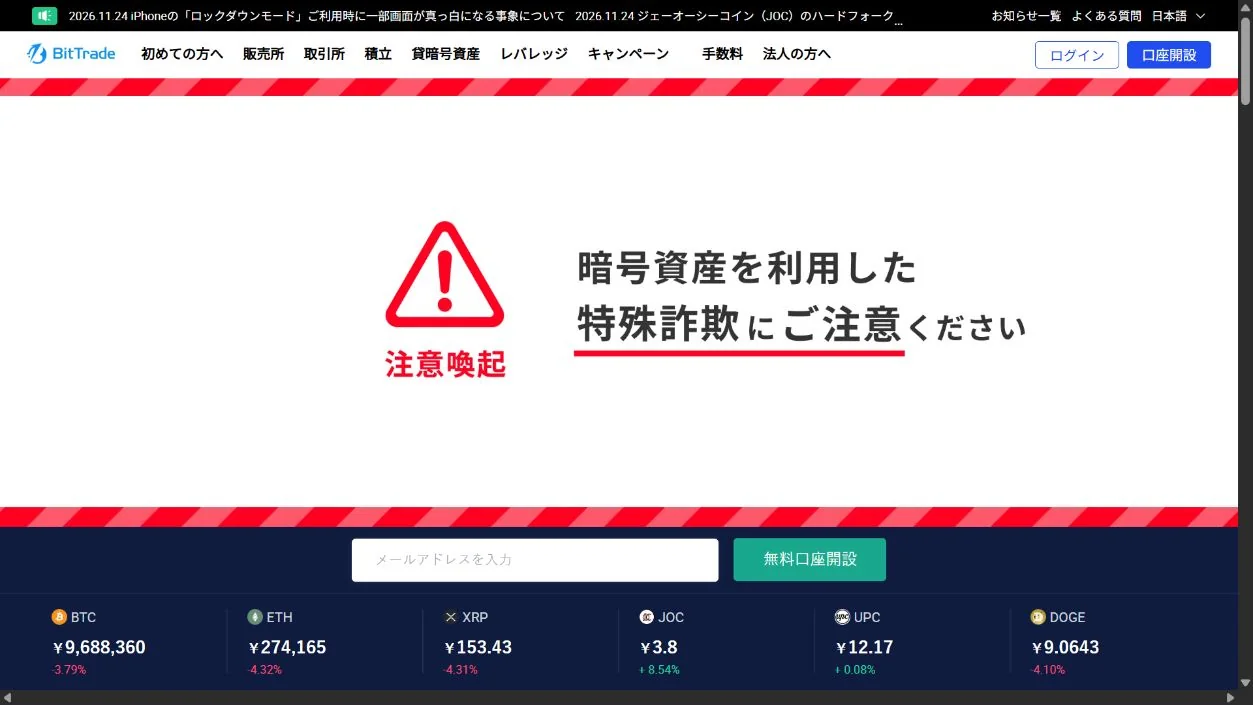
BitTrade through the lens of a Japanese yen account
BitTrade is a Japanese exchange, and that fact determines the usefulness of almost everything else in this review. Its published order-book tariff is straightforward: 0% maker and 0.10% taker on the displayed JPY pairs. But a low trading fee does not turn the service into a globally available dollar or euro account.
For an eligible Japan resident, the meaningful comparison is between BitTrade’s quoted-price marketplace, its order book and the complete route back to yen or an external wallet. For a US or EU resident looking for an account at home, residency is the first obstacle. We keep those conclusions separate rather than market a domestic Japanese product as an international exchange.
1. The quick assessment
| Area | Verified position | Why it matters |
|---|---|---|
| Operator | BitTrade Inc., established September 2016 | A Japanese company, not a generic global Huobi account |
| Crypto registration | Kanto Local Finance Bureau No. 00007 | Check the named entity and service scope |
| Financial instruments registration | Kanto No. 3295 | Separate from the spot-exchange registration |
| Personal eligibility | Japan residents | An EN review does not imply international onboarding |
| Displayed JPY order-book fees | 0% maker / 0.10% taker | Marketplace spread is a different cost |
| JPY withdrawal | ¥330 including tax | Significant on a small cash-out |
| Crypto exits | Coin-specific published charges | Compare the network and minimum too |
Sources: company profile, onboarding guide, live fee table.
2. Background, shareholders and the Huobi Japan name
BitTrade’s current company profile dates the business to September 2016. It lists SINOHOPE SG PTE. LTD., Bitfire Group Holdings Limited, Tokai Tokyo Financial Holdings and FPG among its major shareholders. The page does not supply a complete percentage ownership breakdown, so we do not manufacture one. Corporate profile
The company explains that the service adopted the Huobi branding in 2019, returned to the BitTrade service name in February 2023, and changed its corporate name from Huobi Japan to BitTrade Inc. on 21 April 2023. The announcement was published on 29 May. Publication date and effective corporate-change date are different. Official rebranding notice
This history is especially important when searching for scandals. A security incident at another Huobi-branded or HTX business cannot automatically be assigned to this Japanese entity. Establish the operator, affected wallet and date before treating a headline as part of BitTrade’s own history.
3. Japanese registration: what was actually checked
The FSA’s licensed-provider list and BitTrade’s corporate disclosure identify the Japanese crypto-asset exchange registration. The FSA record gives the registration date as 29 September 2017. BitTrade also discloses its separate Type I financial instruments business number. FSA list, company disclosure
| Evidence | Appropriate interpretation |
|---|---|
| Named FSA crypto registration | The identified Japanese provider is registered for the relevant business |
| Separate financial instruments number | Check the derivative product’s own agreement and eligibility |
| A coin appearing on the platform | Not a government guarantee of that coin’s value |
| A Japanese registration | Not proof of US state permissions or EU passporting |
The distinction is practical. A reader should compare products within the permissions and account terms that actually govern them. Registration does not remove price, custody, technology or operational risk.
4. US residents and EU residents
The personal onboarding guide states that the service is for people resident in Japan. We found no separately verified BitTrade US exchange or EU retail product for this review. Eligibility guide
| Reader’s situation | Atlas treatment |
|---|---|
| Resident in Japan | Check full personal eligibility and current KYC acceptance |
| Resident in a US state | Japanese personal product unavailable on the residence criterion |
| Resident in an EU country | Same residence barrier; no EU product assumed |
| Foreign national living in Japan | Check accepted identity and residence documents; nationality alone is not the residence test |
| Existing customer moving overseas | Ask the provider about account handling before moving funds |
We do not suggest bypassing a residence restriction or using someone else’s Japanese address. A foreign-language website, a foreign shareholder and a global brand history do not change who can open the domestic account.
5. KYC and account preparation
The current beginner guide describes three verification approaches: My Number-based verification, smartphone identity verification and a postal method. Which path is available depends on the applicant and documents. Account-opening guide
Prepare a consistent legal name, current Japan address, identity documents and bank details before funding. A mismatch between the identity record and bank beneficiary can create a problem even where the trading account itself opens successfully. Do not treat a stated application time as a promise that compliance review, postal delivery or a first withdrawal will finish in the same time.
| Checkpoint | Useful question |
|---|---|
| Identity method | Does this method accept my actual document and nationality? |
| Residence | Is my current address eligible and up to date? |
| Tax information | Have I disclosed all information requested by the current application? |
| Bank account | Is it in the accepted account holder’s name? |
| Relocation | What happens if my residency changes after opening? |
This review did not submit an application or upload documents. It therefore does not claim a tested approval time or a tested foreign-resident onboarding outcome.
6. Marketplace versus order-book exchange
BitTrade presents a quoted-price marketplace and an order-book exchange as separate ways to transact. Its fee page lists the marketplace trading commission as free, but the buy/sell price difference remains a customer cost. Service explanation, fee disclosure
| Trading route | Price formation | Cost to compare |
|---|---|---|
| Marketplace purchase | Provider’s displayed purchase quote | Actual yen paid per coin received |
| Marketplace sale | Provider’s displayed sale quote | Actual yen received per coin sold |
| Resting order-book limit | Your price, subject to another user matching | Maker fee, probability of execution and waiting time |
| Immediate order-book execution | Available opposing orders | Taker fee, spread and depth |
A zero separate commission can still produce a more expensive purchase than a 0.10% order-book fee. Conversely, a resting order may never fill. The fair comparison uses the same asset, amount and timestamp, with an executable quote on each route.
7. Current spot fee table
We opened the public fee page in a browser and waited for its JavaScript table to populate. On 24 November 2026, the following displayed JPY pairs all showed 0.0000% maker and 0.1000% taker. These are published tariffs, not fees observed on a personal trade. Browser-verified schedule
| Pair examples | Maker | Taker |
|---|---|---|
| BTC/JPY | 0% | 0.10% |
| ETH/JPY | 0% | 0.10% |
| XRP/JPY | 0% | 0.10% |
| LTC/JPY and BCH/JPY | 0% | 0.10% |
| ADA/JPY, DOT/JPY and XLM/JPY | 0% | 0.10% |
| JOC/JPY, ASTR/JPY, DEP/JPY | 0% | 0.10% |
This table deliberately does not infer the existence or tariff of an unobserved BNB/JPY order book merely because BNB has a withdrawal fee elsewhere on the page. Asset support, trading-route support and order-book support are three different fields.
8. Yen deposits and cash withdrawal
The public schedule lists account opening and maintenance as free. It describes ordinary quick deposits as free apart from the specified Pay-easy exception, while bank and other deposit routes can leave the customer responsible for external banking or service charges. JPY withdrawal is ¥330 including tax. Fee page, populated withdrawal row
| Component | Published exchange-side position | Remaining question |
|---|---|---|
| Account opening and maintenance | Free | Other product fees remain separate |
| Bank transfer deposit | Customer bears applicable bank charge | Your bank’s actual tariff |
| Quick deposit | Free subject to stated route exception | Eligibility, minimum and availability |
| JPY withdrawal | ¥330 | Current limits and processing schedule |
Do not use an old bank beneficiary from a rebranding announcement as a current payment instruction. Always obtain the deposit details inside the verified account. A successful past transfer does not establish that the same details remain valid today.
9. Worked cost examples in yen
Assume an immediate order-book purchase at the displayed 0.10% taker rate, with no slippage. The following is arithmetic based on the tariff, not a market-price forecast.
| Purchase notional | Trading fee equivalent | ¥330 cash withdrawal as share of that amount |
|---|---|---|
| ¥10,000 | ¥10 | 3.30% |
| ¥100,000 | ¥100 | 0.33% |
| ¥1,000,000 | ¥1,000 | 0.033% |
The last column illustrates a fixed cash-out cost; it is not automatically charged when crypto is bought and retained. If a person later sells at an unchanged notional and cashes out, two taker trades plus ¥330 would be ¥350 on ¥10,000 or ¥530 on ¥100,000, before banking costs and spread. Actual sale value and execution can differ.
This is why transaction size changes the practical ranking. A small withdrawal is dominated by the fixed charge, while the same fixed amount becomes less important on a larger transfer.
10. Crypto deposits and external-wallet exits
The live schedule displayed the following coin-denominated withdrawal charges. They must be paired with the correct supported network and the current account confirmation. Withdrawal tariff
| Asset | Displayed withdrawal fee |
|---|---|
| BTC | 0.0005 BTC |
| ETH | 0.005 ETH |
| BNB | 0.0003 BNB |
| XRP | 0.1 XRP |
| SOL | 0.01 SOL |
| LTC | 0.001 LTC |
| BCH | 0.0001 BCH |
UPC, ZPG, ZPGAG and ZPGPT displayed withdrawal unavailability markers. A listed balance should not be assumed transferable. For an external destination, check the deposit minimum there as well: receiving less than that minimum can create a separate recovery problem.
We do not translate these charges into dollars using an invented live price. Compare them in their native units, or multiply by a dated price appropriate to the decision.
11. Minimums, confirmations and transfer information
BitTrade publishes a separate amount-and-limit page. In the reviewed material, BTC deposits required a 0.0001 BTC minimum, ETH 0.001 ETH and BNB 0.01 BNB; confirmation requirements also differed by asset. These are distinct from withdrawal fees and may change. Amount table
The transaction instructions describe sender and recipient information for withdrawals and Travel Rule handling. Transaction instructions
| Before sending | Why it matters |
|---|---|
| Match the asset and chain | A ticker is insufficient to identify a network |
| Check minimum credited amount | A technically valid transfer may still be below the threshold |
| Supply any destination tag | Some receiving accounts cannot identify the beneficiary without it |
| Confirm the receiving provider is supported | Travel Rule compatibility can matter |
| Retain the transaction hash | Separates a broadcast transfer from an internal pending request |
No transfer was made for this review, and no recovery service was tested.
12. Leverage and lending are separate decisions
BitTrade’s leverage fee disclosure includes a 0.03% daily position charge, calculated at the stated daily valuation point. It should not be confused with a spot taker commission or assumed to be an hourly rate. Leverage fees
For scale, a ¥1,000,000 position at an unchanged applicable valuation would incur ¥300 for one daily charge or ¥9,000 for 30 such charges. That illustration excludes price movement, spread, liquidation effects and changes to the position. A leveraged position can incur charges on exposure larger than the cash deposited.
The provider also advertises crypto lending. Service catalogue Examine its own agreement, redemption terms and counterparty treatment. Ordinary custody, a lending claim and collateral behind a leveraged position should not be treated as the same legal or economic exposure.
13. Custody and security disclosures
BitTrade describes offline cold-wallet arrangements and multiple-person approval, with multisignature methods where supported. Its security page also describes the use of hot wallets. The service page’s broad cold-storage statement should therefore be read with the more detailed operational description, rather than expanded into a claim that no connected wallet exists. Security explanation, service page
The transaction instructions discuss segregation and trust arrangements for customer money and crypto custody requirements. These are documentary disclosures, not a reserve audit conducted by Atlas. Transaction instructions
| Control or disclosure | Relevant limit |
|---|---|
| Offline signing | Does not eliminate all internal process risk |
| Multiple approvals | Does not establish every approval was correctly applied |
| Registration and segregation rules | Do not guarantee a token’s price |
| Company statement of no hacking | Is not a comprehensive independent incident investigation |
14. Hacks, operational incidents and controversies
Two recent notices help distinguish an incident at BitTrade from an incident elsewhere.
| Date | Official account | Classification |
|---|---|---|
| 25 September 2026 | Company said it checked asset management after reports of an overseas exchange theft and found its assets appropriately managed | BitTrade response to another venue’s incident, not an admission of its own theft |
| 29 October 2026 | Restoration notice concerned incorrect price display in iOS version 3.19.01; company attributed it to internal display code and said assets and personal information were unaffected | Documented application issue; the company’s stated findings remain attributed |
Sources: September asset-management notice, October iOS notice.
We did not establish a major BitTrade customer-wallet theft or a founder criminal conviction from the evidence reviewed. That is a limited research finding. It does not justify a timeless clean-history guarantee. In particular, incidents affecting a different Huobi or HTX entity require their own evidence before being included here.
15. App, website and liquidity considerations
BitTrade provides app and web access, and advertises a WebSocket API. Service catalogue The iOS incident above is a concrete reason to compare a surprising displayed price with an independent view before placing an order. It is not evidence that every current app version remains defective.
Our review did not measure order latency, app reliability or live depth. The exchange’s inclusion in this expansion follows a dated third-party liquidity screening. It does not establish a given BTC/JPY or ETH/JPY execution price. An accurate comparison needs contemporaneous books in the same quote currency, with fees and FX kept separate.
16. Alternatives for different readers
A Japan resident can compare BitTrade with Bitbank, Coincheck and bitFlyer. Focus on the same activity: immediate yen purchase, resting order, cash withdrawal or external transfer. Comparing one venue’s marketplace price with another’s maker commission alone is misleading.
A US or EU resident should instead start with a provider whose local service and account eligibility can be verified. BitTrade’s low displayed maker fee does not compensate for being outside the personal account’s residence scope.
17. Reader questions
Is BitTrade the same as a global Huobi or HTX account?
The Japanese operator has a documented Huobi Japan naming history. That does not make the products, permissions or incident histories interchangeable.
Is buying on BitTrade free?
Displayed order-book maker commission is zero on the observed pairs. Taker commission is 0.10%, and the quoted-price marketplace has a spread. Transfers and other products have separate costs.
Can I withdraw BNB?
The live fee table displayed a BNB withdrawal charge. Confirm that the network and withdrawal service are currently available for the account and destination before sending funds.
What is the main reason to shortlist it?
For an eligible Japan resident, a clear JPY order-book tariff and documented domestic provider are useful starting points. Complete the comparison with the actual quote, withdrawal route and service requirements.
Prepared from the dated sources listed below. This is a documentary review; no account opening, trade, support-response or withdrawal test is claimed.
Sources and check dates
- Bittrade Company ·
- Bittrade Beginners ·
- BitTrade live trading and withdrawal fees ·
- Bittrade Rebrand ·
- Japan Fsa ·
- Bittrade Service ·
- Bittrade Fees ·
- Bittrade Amount ·
- Bittrade Instructions ·
- Bittrade Security ·
- Bittrade 62592946198809 ·
- Bittrade 63697991107353 ·
Operator, regulatory and court records support the relevant findings; third-party market data is identified in the text. Effective dates and unresolved checks remain beside the claim.