
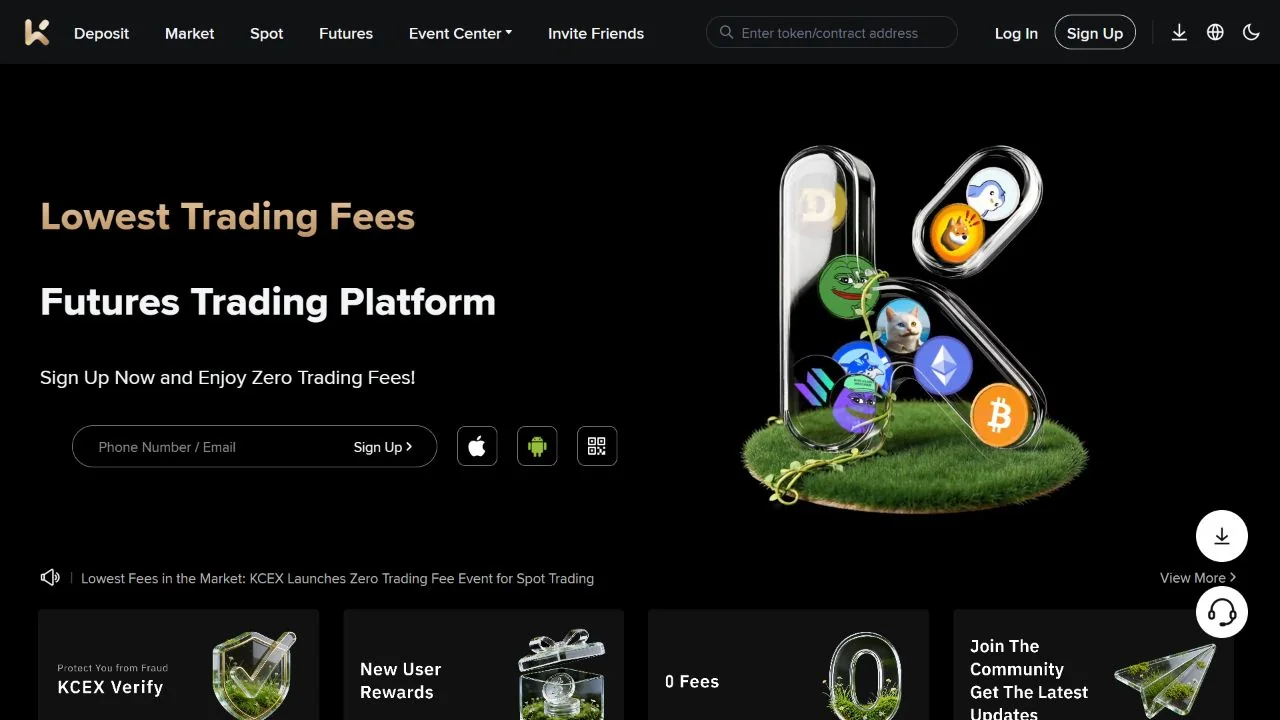
KCEX’s main attraction is easy to state: its published spot schedule charges 0% maker and taker commission, and its futures guide lists 0% maker / 0.01% taker. The harder question is how much money arrives at the destination after execution, network charges and any additional exchange used for fiat conversion.
This inspection follows that complete route, then examines who can use the service, what the identity documents say and what happened during its historical maintenance shutdown. Sources were checked on 24 November 2026. Low commission is a useful comparison point; it does not establish US eligibility, EU authorisation or guaranteed execution.
1. An exchange for a particular job
| Intended use | Editorial assessment |
|---|---|
| Eligible user trading already-owned crypto | The published commission merits comparison with actual execution |
| US resident opening a domestic account | Excluded under the reviewed agreement |
| EU reader seeking a documented MiCA counterparty | Authorised local entity and service scope not established here |
| User needing a verified bank-to-coin-to-bank route | Banking availability and full provider charges not verified |
| Leveraged trader | Low transaction fees leave funding, liquidation and operational risk |
| Small balance withdrawn frequently | Network charges and minimums may dominate commission savings |
The review’s organising question is whether a zero-commission venue improves a completed transaction. That requires more information than the fee banner.
2. Background, operator disclosure and ownership
The About KCEX page says the centralised platform was established in 2021 and offers spot, futures and other derivatives. It describes an experienced team but does not identify a founder or controlling shareholder in the reviewed text. We do not fill that gap with names copied from unsourced review sites.
The page also claims regulatory licences in countries including the United States and Canada. The User Agreement dated 23 November 2026 is more relevant to account access. It expressly excludes US and Canadian users in its restricted-country provisions.
| Disclosure | What a reader still needs |
|---|---|
| Brand and 2021 establishment statement | Exact contracting company for the account |
| General licence claim | Named entity, regulator, permission and service scope |
| Product menu | Personal eligibility for each service |
| Named founder absent from reviewed material | Verified corporate record before attributing ownership or allegations |
These gaps matter when evaluating complaints and potential legal recourse. A website brand is not a substitute for the defendant or regulated entity in a legal document.
3. United States: no state-by-state opening assumed
The agreement’s AML and trade-monitoring section names the United States and Canada among jurisdictions from which transactions or registrations are rejected. The list is expressly non-exhaustive and can change. Other named restrictions include mainland China, Hong Kong, Singapore and several sanctioned or otherwise excluded jurisdictions.
The US restriction applies at country level in this reviewed service. Atlas does not invent a New York-only exclusion or infer that a different US state is permitted. No separately verified KCEX.US account product is established here.
KCEX says concealment or false statements about location, nationality or residence can lead to account closure and position liquidation. A language code such as en-US in the help-centre URL is a localisation choice; it is not evidence of US retail eligibility.
4. EU/EEA access and the authorisation gap
The reviewed agreement does not establish a named MiCA-authorised KCEX entity, its registered services or a member-state onboarding matrix. A European country missing from the restricted list should therefore be treated as unverified, not automatically available.
This distinction also applies between spot and derivatives. An identified authorisation for one activity would not by itself establish permission for perpetual futures, custody, payments and every promotional product. Obtain the actual contracting entity and current country-specific service confirmation before transferring assets.
This review does not conclude that the absence of a verified record proves worldwide illegality. It records the narrower finding: the evidence collected does not support a blanket EU availability or authorisation claim.
5. Trading fees, including the promotional boundary
The official commission guide gives the following rates:
| Market | Maker | Taker | Qualification |
|---|---|---|---|
| Spot | 0% | 0% | Publicly published schedule; pair campaigns can differ |
| Futures | 0% | 0.01% | Check the specific pair’s displayed rate |
The spot FAQ describes zero fees as an event. That wording matters: it supports the rate currently promoted, not a promise that zero commission can never be changed.
There is also an arithmetic inconsistency in the official futures guide. Its example introduces 1 BTC at 60,000 USDT, but then uses 40,000 in the worked calculation and produces a 4 USDT taker fee. At 60,000 USDT and 0.01%, the correct illustrative fee is 6 USDT. We use the stated formula and consistent numbers, rather than copying the inconsistent example.
6. How zero commission can still lose a price comparison
Consider two hypothetical 10,000 USDT purchases of the same coin at the same time. Venue A has zero commission but an average fill 0.25% worse than a common reference price. Venue B charges 0.10% and fills 0.05% worse.
| Hypothetical route | Execution difference | Commission | Combined difference |
|---|---|---|---|
| A | 25 USDT | 0 | 25 USDT |
| B | 5 USDT | 10 USDT | 15 USDT |
Venue B is 10 USDT better in this illustration before withdrawals. This is not a measured KCEX order-book result. It demonstrates why the relevant comparison is average execution plus charges, with the same side, size, time and reference currency.
An aggregate liquidity score or daily turnover cannot supply those missing fills. An ETH/USDT book can also differ substantially from a small-token book on the same venue. Do not transfer a Bitcoin execution assumption to every listing.
7. Spot order controls
The spot FAQ documents limit, market and take-profit/stop-loss orders, including one-way and two-way modes. It also describes a slippage-tolerance setting for market orders and distinguishes locked assets from available balances.
A limit order controls its permissible execution price but may remain unfilled. A stop condition is not a guaranteed realised price. A partially filled order can leave both a position and an unfilled balance, so inspect executions rather than treating the original order amount as completed.
Slippage tolerance can constrain a trade under the platform’s rules; it does not create missing counterparties. Read what happens to the unexecuted remainder. This review has not submitted orders or tested the interface’s behaviour during stress.
8. Futures: low commission, separate funding
The futures FAQ distinguishes index price, mark price and execution price. It says mark price is used for liquidation and unrealised profit and loss. Funding is a periodic transfer between position holders, separate from exchange trading commission.
For an unchanged 30,000 USDT notional, a taker entry at 0.01% costs 3 USDT. An equal-notional taker exit costs another 3. A maker entry and taker exit cost 3 combined, before funding and execution effects. These examples assume the published pair rate applies.
Leverage changes the margin supporting the notional, not the multiplication used to calculate commission. On 1,000 USDT margin supporting a hypothetical 30,000 USDT position, a 6 USDT round trip is 0.6% of that starting margin. Price losses and liquidation can be much larger.
9. KYC and daily limits
The identity-verification guide, dated 2 November 2024, states a 30 BTC daily withdrawal limit for basic verification. It describes country selection, identification details and uploading an identity document through the app.
That is a dated published tier description, not an independently tested current allowance for every account. The agreement allows KCEX to adjust transaction and withdrawal limits and request additional identification. It also describes identity, beneficial-owner and suspicious-transaction monitoring.
| Common assumption | Better reading |
|---|---|
| Registration succeeded, so withdrawals are unconditional | Additional account or transaction checks may follow |
| A published limit is a processing-time guarantee | A ceiling does not promise immediate settlement |
| No document requested yet means documents can never be required | The agreement provides for identity checks |
| A higher KYC tier overrides country restrictions | Eligibility remains separate |
10. Privacy and account security
The Privacy Policy dated 17 July 2026 describes collection of registration information and technical information including IP address, browser, language and device characteristics. Its stated uses include verification, security and compliance. This is not an anonymity guarantee.
The Google Authenticator guide describes dynamic codes used for login, withdrawals and security-setting changes. Keep the recovery secret somewhere separate from the phone and never give it to someone claiming to be support.
Account two-factor authentication does not independently verify exchange solvency, reserves or cold-wallet practices. This inspection did not establish a dated independent custody audit or comprehensive liabilities report. An absent report here is an evidence gap, not proof that the platform holds no assets.
11. Deposits and external-wallet funding
The public fee-page indexed snapshot lists crypto deposit and withdrawal routes. For a deposit, establish the exact coin, chain, minimum and memo requirements before sending. A token’s name does not make all networks interchangeable.
This review did not verify a complete direct USD ACH or EUR SEPA banking route, its provider or its current total tariff. Do not assume a “buy crypto” link means that bank withdrawals are available in the reverse direction.
If you buy crypto elsewhere first, add that venue’s conversion fee and withdrawal cost. The KCEX trade may be free while the completed bank-to-bank route costs more than trading directly at a venue with a small commission.
12. Withdrawal charges: read below the banner
The indexed public fee page displays a “Zero Withdrawal Fee” heading, but its network rows list non-zero charges. The live text extractor did not populate those rows, so these are dated indexed observations rather than a successfully executed withdrawal quote.
| USDT network, indexed snapshot | Listed minimum | Listed withdrawal charge |
|---|---|---|
| Tron / TRC20 | 5 USDT | 1 USDT |
| Ethereum / ERC20 | 5 USDT | 0.23 USDT |
| BNB Smart Chain | 5 USDT | 0.01 USDT |
| Arbitrum One | 5 USDT | 0.10 USDT |
The appropriate conclusion is that a network charge can remain payable; the heading does not establish a zero total. Confirm the final asset, network, minimum, debit and amount received in your account workflow.
At a hypothetical 1 USDT charge, moving 20 USDT costs 5% and moving 2,000 costs 0.05%. Fewer withdrawals can reduce repeated fixed costs, but leaving a larger exchange balance increases custody exposure. That is a trade-off, not a universal recommendation to consolidate funds.
13. January 2024 shutdown and manual withdrawal process
The official 8 January 2024 maintenance announcement is more consequential than a routine short outage. It described critical issues, suspended spot activity, cancelled pending orders and scheduled futures-order placement and cancellation to stop at 14:00 UTC. Existing futures positions were to be settled at the last price.
Normal withdrawals were described as available until 14 January, after which the website would be under maintenance. The notice instructed users needing withdrawals to submit asset, chain, address, account, KYC and transaction-history information, plus a photograph holding identification and a handwritten note. It stated processing within seven working days.
This establishes the announced historical process, not that every request was processed within that time or that the same instructions apply today. The notice did not provide a definite restoration time. Do not describe it as proof of a theft, or erase its settlement and access implications by calling it only an upgrade.
14. Later maintenance and market-data reliability
A 21 August 2026 official notice described a spot-system interruption affecting order placement, cancellation, market orders, chart updates, API access and order-book data. It said deposits, withdrawals and futures were unaffected within that announced scope.
The material was readable through indexed primary text, while the live localised page exposed navigation. The notice alone does not establish the outage’s final duration or an unresolved outage today.
For a trader, a chart that remains visible is insufficient proof that the underlying book or cancellation path is operating normally. Keep an external market reference and understand how to inspect open orders after service resumes. This review does not claim to have measured KCEX uptime.
15. Hacks, scandals and regulator record
The South Korean FSC’s October 2026 material includes KCEX among unregistered operators subject to domestic website blocking. That is a jurisdiction-specific regulatory event. It should not be described as a global insolvency finding or a founder’s criminal conviction.
The collected primary sources did not establish a major KCEX wallet theft, a verified founder conviction or a final comprehensive compensation account for the 2024 maintenance event. We do not manufacture a dramatic scandal to fill the section, and we do not present the absence of a verified finding as a clean bill of health.
Customer complaints can point to questions about freezes or execution. Without transaction records, a company response and any relevant decision, they remain allegations. The maintenance notices and regulator material provide firmer facts for this review than an unexplained user-star average.
16. Alternatives and a practical decision
Compare KCEX with another venue using the same coin, chain and exit destination. For an EEA reader, Bitvavo offers a different local-entity and euro-banking comparison. US readers should examine a separately reviewed domestic product such as Coinbase or Kraken, with state and service checks.
For international derivatives, compare the Phemex and WEEX operational and regulatory record as carefully as their commissions. A fee advantage is most useful when the account is eligible, the order fills acceptably and the exit route works at a known total cost.
17. FAQ
Is KCEX spot trading free? Its current published guides show zero maker and taker commission and describe a zero-fee event. That does not remove spread, slippage or external-transfer charges.
Is every withdrawal free? No such conclusion follows from the page heading. The indexed network table lists non-zero charges; obtain the final account quote.
Can US residents register? The reviewed User Agreement excludes the United States. No separate US service was verified.
Is KCEX authorised across the EU? A named MiCA-authorised entity and permitted service scope were not established by this research.
Did KCEX shut down in 2024? It announced an extended maintenance process with cancelled orders, futures settlement and later manual withdrawal requests. That historical notice is not a claim that the present site is closed.
Has Atlas traded there? No. This is a documentary inspection with explicitly illustrative cost calculations.
Prepared from the dated sources listed below. This is a documentary review; no account opening, trade, support-response or withdrawal test is claimed.
Sources and check dates
- About KCEX ·
- User Agreement ·
- User Agreement ·
- KCEX Futures Trading Fees Explained: Maker and Taker Rates and Fee Calculations ·
- KCEX Spot Trading FAQ: Fees, Order Types, Trading Rules and Common Questions ·
- KCEX Futures Trading FAQ: Common Questions About Perpetual Futures, Funding Rates, Liquidation Prices, and Trading Fees ·
- How to Complete Identity Verification (KYC)? ·
- Privacy Policy ·
- How To Set Up Google Authenticator? | KCEX ·
- KCEX Trading Fees | 0-Fee Spot and the Industry's Lowest Futures Rates ·
- KCEX System Maintenance Announcement (2024/01/08) ·
- Notice on KCEX Spot Trading System Maintenance | KCEX ·
- 카드뉴스 - 홍보자료 - 알림마당 - 금융위원회 ·
Operator, regulatory and court records support the relevant findings; third-party market data is identified in the text. Effective dates and unresolved checks remain beside the claim.