
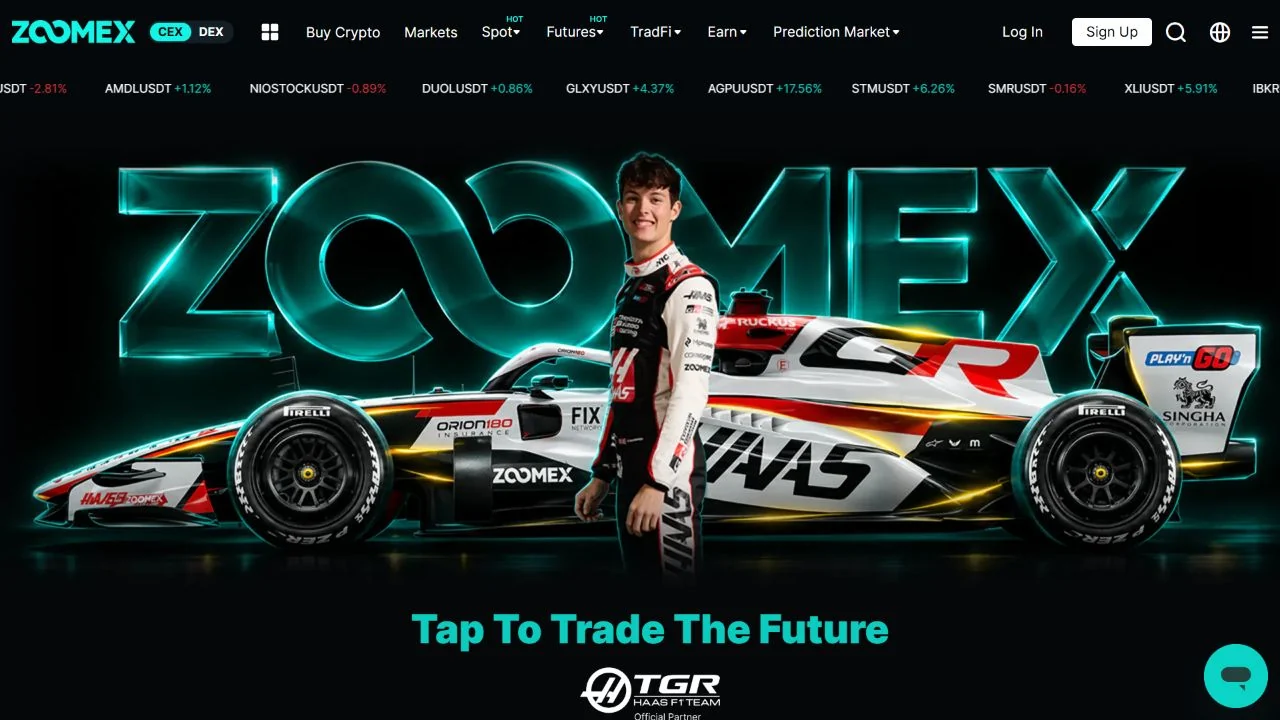
Zoomex: start with geography, then separate the contracts
Zoomex’s own service-restriction page makes the first decision straightforward for many readers: it excludes both the United States and the European Union. Conditional no-standard-KYC access does not override that geography. The platform’s marketing about international registrations must be read alongside the actual access rule.
For an eligible customer elsewhere, the useful comparison separates spot, standard perpetuals and Innovation Zone contracts. The latter have a higher published commission. Its security evidence also deserves more precision than “audited”: a Hacken web assessment identifies a testnet scope, specific findings and a mix of resolved and accepted issues.
1. Main findings
| Subject | Verified public position |
|---|---|
| History | Company describes a 2021 founding |
| Spot guide | 0.10% maker / 0.10% taker |
| Standard perpetuals | 0.02% maker / 0.06% taker |
| Innovation Zone | 0.04% maker / 0.11% taker |
| US / EU | Explicitly excluded in service page |
| KYC tier guide | Lv. 0: 100 BTC-equivalent/day; Lv. 1: 200, with checks and geographic restrictions |
| External transfer | Network-specific confirmation required |
| Internal transfer | Guide describes no handling fee |
Sources: company material, November fee explanation, service exclusions, identity FAQ, withdrawal guide.
2. Company identity and ownership evidence
The company describes Zoomex as a derivatives-focused platform founded in 2021. We did not verify a complete current beneficial-ownership register or founder shareholdings. A Simple Earn agreement identifies Zoomex Technology Limited for that product, but that is not sufficient to assign the same legal provider to every global service without reading the applicable agreement. Company description, Earn agreement
Before a substantial deposit, identify the precise company contracting for the intended account and product. A generic brand name and a list of registrations are not a complete answer to that question.
3. United States: no eligible global route established
The service-restricted-country page expressly includes the United States. We did not verify a separate domestic Zoomex US exchange or a state-specific exception. Service restriction
Atlas records the global product as unavailable in the US. The presence of US-related registration claims in marketing does not override that exclusion. A compliance registration, an exchange permission, a clearing permission and a live retail account are different things and need matching evidence.
4. European Union and other restrictions
The same page explicitly excludes the European Union, alongside named locations including Singapore, Hong Kong, mainland China, Quebec and Seychelles. It also says false location representations can lead to account termination and liquidation of open positions. Country restrictions
| Location | Treatment in this review |
|---|---|
| EU member state | Excluded global service |
| United States | Excluded global service |
| Quebec | Named Canadian provincial exclusion; not rewritten as all Canada |
| Iceland, Liechtenstein, Norway | Not silently equated with EU membership; local access still requires verification |
| Other country | Check the current account and product conditions |
We do not suggest using a VPN or false address. A no-standard-KYC tier does not make an excluded country eligible.
5. Registration claims and product permission
Zoomex’s company material lists MSB, NFA and AUSTRAC-related statuses. We did not independently reconstruct the current entity, registration number and permitted service behind every claim. They remain attributed company disclosures. Company transparency material
The practical rule is to match each claim to a legal entity and product, then check whether the company actually accepts the customer’s country. In this case, the explicit US/EU service exclusion remains decisive for the global account. An AML registration should not be advertised as personal deposit insurance or a universal derivatives licence.
6. Spot trading commission
The official 10 November 2026 fee explanation gives standard spot commission of 0.10% maker and 0.10% taker. VIP rates and promotions can differ. Trading-fee explanation
| Assumed executed value | One standard spot fill | Two equal-value fills |
|---|---|---|
| 1,000 USDT | 1 USDT | 2 USDT |
| 10,000 USDT | 10 USDT | 20 USDT |
| 100,000 USDT | 100 USDT | 200 USDT |
These are arithmetic examples, not live orders. Spread, market impact and withdrawals remain separate. A zero-fee event should be identified by pair and dates rather than used as the ordinary tariff for every visitor.
7. Standard perpetuals and Innovation Zone
The same explanation distinguishes standard USDT-margined and inverse perpetuals from the Innovation Zone. Product fee categories
| Product | Maker | Taker |
|---|---|---|
| Standard USDT perpetual | 0.02% | 0.06% |
| Standard inverse perpetual | 0.02% | 0.06% |
| Perpetual Innovation Zone | 0.04% | 0.11% |
A 100,000 USDT notional in a standard linear perpetual implies 20 USDT maker or 60 USDT taker commission. At the Innovation Zone references, those amounts become 40 and 110 USDT. The comparison assumes the same linear notional base; inverse-contract calculations require their own contract-value formula.
Do not apply the spot rate to a perpetual, or the standard perpetual tariff to an Innovation Zone contract. Those are materially different calculations.
8. Funding, leverage and the total position cost
Commission is charged on execution; funding is a separate holding-period transfer, and liquidation conditions are a separate risk. The fee guide explicitly distinguishes the categories. Fee categories
| Cost or exposure | What to capture |
|---|---|
| Entry commission | Executed notional and maker/taker role |
| Exit commission | Actual closing notional, which may differ |
| Funding | Contract rate, sign and timestamps |
| Spread/impact | Available depth at execution |
| Liquidation | Margin model and reference price |
At unchanged notional, two standard taker fills on 100,000 USDT cost 120 USDT before funding. A small collateral deposit can therefore incur significant commission on larger leveraged exposure. We did not test a position or project a trading return.
9. KYC: conditional access and BTC-equivalent limits
The identity FAQ describes Lv. 0 access without standard identity verification, but allows verification requests for compliance, security and risk review. It gives daily ceilings of 100 BTC equivalent at Lv. 0 and 200 BTC equivalent at Lv. 1, using BTC index-price equivalents across tokens. KYC FAQ
| Activity | Guide’s treatment |
|---|---|
| Basic registration/trading | Standard KYC not automatically required at Lv. 0 |
| Withdrawal within tier | Still subject to security and compliance controls |
| Above tier ceiling | Higher verification required |
| Fiat processor | Provider can have its own KYC |
| Restricted geography | Not made eligible by KYC status |
These are published ceilings, not promises of immediate withdrawal or anonymous access under every circumstance. We did not test a no-document transfer.
10. Identity evidence and review timing
The guide describes government-issued identity documents and clear, unedited images. It also describes possible multi-business-day review. That is provider guidance, not an observed approval time for an Atlas account. Verification procedure
Keep the account name, residence and funding history consistent. If a review is requested, use the official workflow and retain the request. A high public withdrawal ceiling does not remove the need to explain an unusual transfer. Never send a seed phrase or authentication code to someone offering to bypass verification.
11. Deposits and the Funding Account workflow
Zoomex’s withdrawal guide says assets in the Trading Account should first be moved to the Funding Account for withdrawal. It separates on-chain transfers from internal transfers. Withdrawal procedure
| Step | What to check |
|---|---|
| Deposit | Asset, chain, minimum and destination tag where needed |
| Trading balance | Amount available after fees and positions |
| Funding Account | Correct internal location before withdrawal |
| External withdrawal | Current network, address, fee and minimum |
| Internal transfer | Correct recipient UID/email/phone, where eligible |
An internal movement within the platform is not a blockchain withdrawal. It also does not remove exposure to the same provider simply because another account receives the balance.
12. Withdrawal costs and contract-address compatibility
The guide describes internal transfers as having no handling fee. On-chain timing depends on blockchain processing, and the current asset/network confirmation determines the actual exit. We did not verify a universal fixed BTC or ETH withdrawal charge. Transfer guide
It contains a specific warning about matching the USDT contract address on Optimism with the receiving wallet’s supported contract. That is more precise than simply matching a ticker. If the contracts differ, the guide says not to proceed.
A free internal transfer should never be presented as proof that all on-chain withdrawals are free. Nor should an old fee for one chain be applied to a different representation of the asset.
13. Fiat purchases, card and earning services
Third-party purchase providers can impose their own identity and eligibility requirements. We did not verify a complete current USD/EUR bank round trip with both charges. KYC provider distinction
The card and Simple Earn offerings also require their own product analysis. The Earn agreement identifies a separate product relationship and says yields are not guaranteed, with redemption and service restrictions described in its terms. Earn agreement
Do not use a card provider’s supported-country list to override the exchange’s EU exclusion, or assume an earning balance has the same redemption conditions as ordinary spot custody. No yield promise or reward valuation appears in this review.
14. Hacken evidence: scope and unresolved acceptance
Hacken’s web-assessment page is dated 30 October 2025 and identifies testnet.zoomex.com as scope. It reports six findings: three resolved and three accepted, comprising one medium, two low and three observations. Hacken assessment
| Finding example | Provider-page status |
|---|---|
| Unvalidated image URL in VIP endpoint | Fixed, medium |
| Password-change verification issue | Fixed, low |
| JWT-signing algorithm issue | Accepted, low |
| Vulnerable JavaScript dependencies | Accepted, observation |
An accepted issue is not the same as a resolved issue. A testnet web assessment is also not a complete production custody audit, reserve attestation or financial audit. Atlas did not reproduce the findings, retest fixes or inspect private infrastructure. This is a scoped account of public evidence.
15. Reserves and marketing claims
The company promotes a proof-of-reserves framework and security/transparency resources. We did not independently reconcile a current asset/liability snapshot or establish personal fund insurance. Company material
| Evidence layer | Question still to answer |
|---|---|
| Public wallet assets | Who controls them and are they encumbered? |
| Liability dataset | Are all relevant customer balances included? |
| Customer inclusion | Can an individual verify their own balance? |
| Security assessment | Which system and version were tested? |
| Registration claim | Which entity and service does it concern? |
A monthly report discussing another exchange’s hack is not evidence of a Zoomex theft or of Zoomex’s immunity from the same class of risk. We do not import unrelated incident numbers into its own history.
16. Hacks, founder cases and correctly matched allegations
We did not establish a major Zoomex customer-wallet theft or a founder criminal conviction from the reviewed primary material. This is a limited research finding, not a lifetime clean-history assurance.
Searches can surface similarly spelled brands and unrelated company directors. Domain and legal-entity matching must precede attribution. A user complaint needs the actual transfer, account state and provider response before it becomes a confirmed incident; a legal accusation needs a matched regulator or court record.
The Hacken findings above are documented security issues, but they are not proof that a theft occurred. Their scope and disposition are more informative than a generic “passed an audit” badge.
17. Interface, demo trading and liquidity
Zoomex markets trading tools, copy workflows and demonstration access. We did not benchmark the app, measure support speed or test live execution. Demonstration fills would not establish the liquidity available for a funded account in any event.
The exchange entered this expansion through a dated venue-level screen. A meaningful comparison still needs the exact spot or perpetual instrument, timestamp, side, amount and fee tier. Standard and Innovation Zone contracts should not be mixed, and funding should be added only where applicable. Atlas’s current synthetic examples are not Zoomex market measurements.
For US/EU readers, a locally supported provider is the starting point. Compare the relevant Kraken, Coinbase or Bitstamp product under its own eligibility and terms.
18. Frequently asked questions
Can US or EU residents use the global account?
The service page expressly excludes both the US and EU. Conditional Lv. 0 access does not override it.
Are all perpetuals charged 0.02% / 0.06%?
The November guide lists a separate Innovation Zone reference of 0.04% / 0.11%. Confirm the actual contract and account tariff.
Does no standard KYC mean no checks?
No. Compliance, security, tier and third-party-provider requirements can still trigger identity checks.
Did Hacken certify complete financial safety?
No. The cited page concerns a scoped testnet web assessment with resolved and accepted findings. It is not a full financial or custody assurance.
Prepared from the dated sources listed below. This is a documentary review; no account opening, trade, support-response or withdrawal test is claimed.
Sources and check dates
- Zoomex Company ·
- Zoomex Fees ·
- Zoomex Country ·
- Zoomex Kyc ·
- Zoomex Withdraw ·
- Zoomex Earn ·
- Zoomex Pentest ·
Operator, regulatory and court records support the relevant findings; third-party market data is identified in the text. Effective dates and unresolved checks remain beside the claim.