
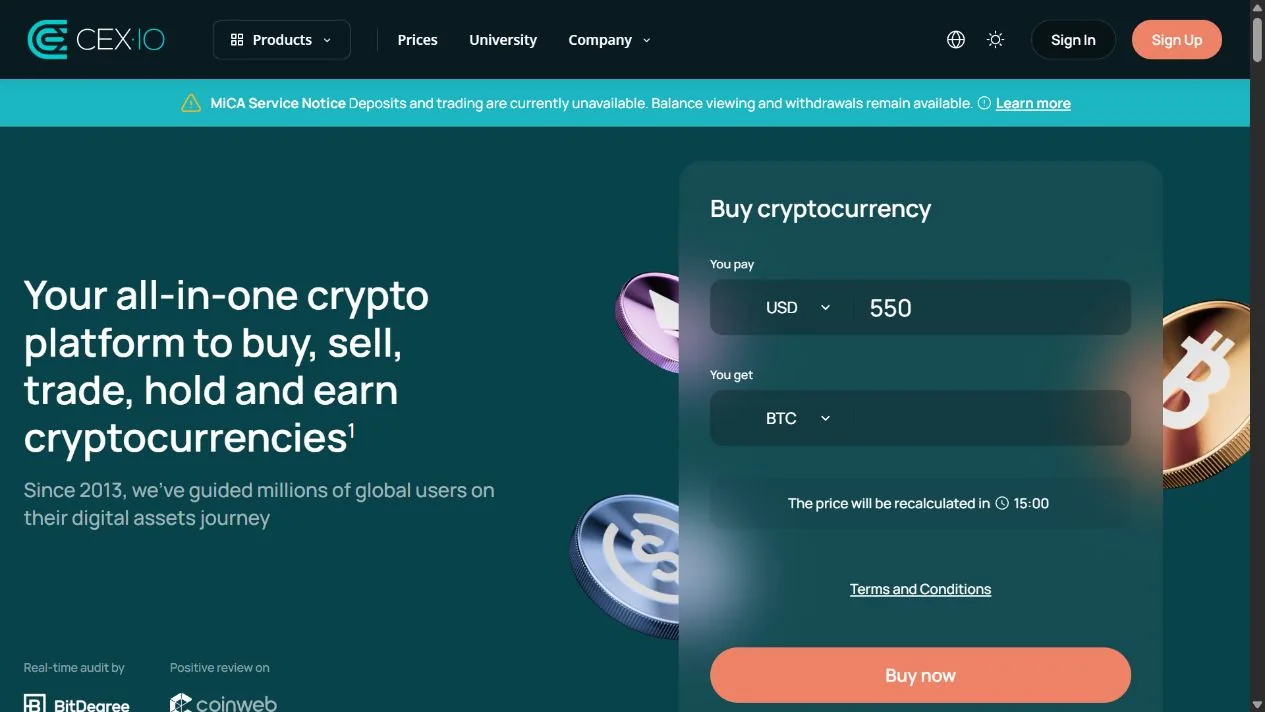
For CEX.IO, where you live and which service you mean come before the fee comparison. A US spot account, the European withdrawal-only position, an Instant Buy quote and an internal Pay transfer are different cases. Treating them as one universally available exchange produces the wrong answer.
The most consequential finding at our 24 November 2026 check is in the European terms: CEX.IO is not onboarding new EU/EEA users during the described MiCA restriction period; existing accounts are limited to withdrawal and account-management purposes. A SEPA fee table remaining online does not override that restriction.
1. Start with the service you can actually use
| Situation | What the inspected evidence says | Implication |
|---|---|---|
| New EU/EEA applicant | No new onboarding under the European terms | Do not deposit on the assumption that trading is open |
| Existing EU/EEA account | Withdrawal-only and account management | Focus on supported exit routes and records |
| Eligible US customer | Separate CEX.IO Corp. relationship | Check the state, asset and product |
| New York resident | US terms give New York as a restricted location | A generic US landing page is insufficient |
| Hawaii resident | Published notice says services were discontinued | No reopening was established in this research |
| Other international customer | Separate entity terms and restricted-country list | Neither US nor EU conditions should be inherited |
These distinctions are drawn from the current entity-specific terms and Hawaii notice. Restrictions can change. The article is a dated account of the inspected documents, not an account-opening decision made on behalf of the exchange.
2. From mining exchange to several products
CEX.IO dates its launch to 2013 and identifies Oleksandr “Alex” Lutskevych as its founder in its company history. Its origins include the GHash.IO mining pool and trading of mining-related exposure. Today’s card purchase, wallet and spot products should not be confused with those historical mining services.
The company describes a progression from a centralised exchange to a broader group of trading and payment tools. Age is useful context, but it cannot establish today’s solvency or the terms applicable to a new account. The current complete beneficial ownership structure was not independently reconstructed for this review.
3. Which company is your counterparty?
The legal-document index separates documents for the United States, EEA, United Kingdom, other jurisdictions and fiat payment services. The terms likewise say residency and account type determine the applicable contract.
| Published entity | Role described in current materials |
|---|---|
| CEX.IO Corp. | US relationship; NMLS 1804170 |
| CEX.IO Europe, S.L. | Spanish entity, NIF B72550395; European terms |
| CEX.IO Markets UK Ltd | Separate UK entity and terms |
| CEX OVRS LLC | Certain other eligible jurisdictions |
| Axira Solutions Inc. | Fiat payment services under applicable terms |
An incorporated business, a money-services registration, a state money-transmitter licence and a MiCA authorisation are different records. Their existence should not be translated into an unrestricted permission to offer every crypto product worldwide.
4. Europe: a pending application is not a granted licence
The public disclosures describe CEX.IO Europe S.L.’s MiCA application to Spain’s CNMV as under review. The European terms, marked 1 July 2026, state that new EU/EEA onboarding is suspended and existing accounts remain accessible for withdrawal-only and account management.
That changes the review’s recommendation for a European looking for a new trading venue. A historical list of euro payment methods or a product article showing an order book does not establish present trading permission. Nor does an application prove that passporting across the EEA has been granted.
For an existing account, the useful questions are the balances that can be withdrawn, the supported bank or blockchain destination, any requested compliance documents and the transaction history needed for records. No date for a reopening is inferred here.
5. US access needs the state and the product
The US licence page lists money-transmitter records and links to NMLS 1804170. The US terms identify CEX.IO Corp. and name New York as an example of a restricted location. They do not make the website an all-state offering.
| US check | What it resolves | What it does not resolve |
|---|---|---|
| Applicable US terms | Contract and basic eligibility | Approval of a particular applicant |
| State licence / disclosure | Relevant legal record and complaint channel | Every asset or service being enabled |
| Current account country and state | Residence scope | Bank or card acceptance |
| Asset and pair list | Published US product coverage | Current execution depth |
The Hawaii notice says the service sunset took effect 21 June 2023 and directs customers with unwithdrawn balances to support. A later-dated help page repeating that history is not evidence of a new closure date or of reopening.
6. Product names: Instant Buy is not Spot Trading
The Exchange Plus rebranding notice describes the change to CEX.IO Spot Trading and links to trade.cex.io. It distinguishes the newer platform from the legacy exchange. An old review’s screenshot or fee table can therefore refer to a different interface.
| Workflow | Main price question |
|---|---|
| Instant Buy / Sell / Convert | What is the complete quoted amount paid and received? |
| Spot Trading | What fee applies to the specific account, pair and execution? |
| Fiat deposit followed by trading | What does funding add before the trade? |
| Crypto withdrawal | Which network, minimum and withdrawal charge apply? |
| CEX.IO Pay | Are both users eligible for that internal service? |
The right comparison is the end result for the same initial debit and destination. A quote service and an order book cannot be evaluated solely by attaching the same headline commission to both.
7. Trading fees: separate current and future schedules
The profile guide directs users to the account’s fee schedule and says fees can depend on 30-day volume and day of the week. The current account-specific trading tariff was not obtained in this documentary review. Atlas therefore leaves it unverified in the calculator rather than importing a competitor’s rate or a legacy tariff.
A particularly misleading older source is the reduced-pair offer. Its help-page date is in 2026, but the offer body specifies 9 October–31 December 2023. The listed 0.10% promotional fee is not treated as an active universal rate.
There is a newer, explicit announced replacement schedule effective 21 December 2026:
| Rolling 30-day volume, upper end of band | Announced fee from 21 December |
|---|---|
| $10,000 | 0.40% |
| $50,000 | 0.25% |
| $100,000 | 0.23% |
| $500,000 | 0.19% |
| $1,000,000 | 0.17% |
| $2,500,000 | 0.15% |
| $5,000,000 | 0.13% |
| $10,000,000 | 0.11% |
| $20,000,000 | 0.10% |
The announcement gives one fee column; it does not justify inventing a separate maker rebate. These future rates are not the current tariff on the review date. Exact upper boundaries are included: $50,000 is in the 0.25% band, while $50,000.01 enters the 0.23% band.
8. Open orders across the fee change
The same announcement says execution date controls the charge. Open orders remain active, but any portion executed on or after 21 December uses the new schedule. Placing an order earlier does not lock its old fee indefinitely.
For a purely illustrative $1,000 execution at the announced 0.40% rate, commission would be $4. Two equal-notional executions would cost $8 before spread or other charges. This is arithmetic for the announced schedule, not a claim about a transaction available today.
A staged order that straddles a fee change can require more than one fee calculation. Preserve the individual fills and timestamps rather than relying on the original order-entry time.
9. Funding and cash-out charges
The public funding table rendered the following selected rows during our check. These are published route charges, subject to country, account and provider availability. In particular, the European service restriction takes precedence over the presence of a SEPA row.
| Method | Published deposit charge | Published withdrawal charge |
|---|---|---|
| ACH | $0 | $5 |
| SEPA | €0 | €2.99 |
| Faster Payments | £0 | £2.99 |
| Open Banking | €1.99 | No withdrawal option shown |
| PayPal | 3.99% + $5 | 3.99% + $5 |
| VISA / Mastercard | 0.49%–4.99% + service charge | 0.49%–4.99% + service charge |
| Apple Pay / Google Pay | 0.49%–4.99% + service charge | Unavailable in the displayed table |
For marked methods, new customers within three months of identity verification face a published $1,000 daily and $3,000 monthly cap. That cap can matter more than a large maximum displayed in the main row. Provider-specific charges and the final transaction confirmation still need review.
10. A funding comparison before trading
These examples use the observed tariff and assume no additional provider, bank or FX charge. They are cost illustrations, not tested transfers.
| Hypothetical operation | Explicit route charge |
|---|---|
| Fund $1,000 by ACH | $0 |
| Withdraw $1,000 by ACH | $5 |
| PayPal operation on a $1,000 fee basis | $44.90 |
| Withdraw €100 by SEPA | €2.99, equal to 2.99% of €100 |
| Withdraw €1,000 by SEPA | €2.99, equal to 0.299% of €1,000 |
The PayPal calculation is $1,000 × 3.99% + $5. The final debit or credited amount depends on whether the fee is added or deducted. It does not include an Instant Buy quote or a later trading commission.
Fixed exit charges are proportionally larger on small balances. A card route with a percentage range plus an unspecified service charge cannot honestly be represented by one complete total until the account supplies a quote.
11. KYC: information needed at onboarding and later
The identity-verification guide covers identity details, a supported government document, residence, tax information where required and face/liveness checks. It directs applicants to confirm that their country is supported before proceeding. Other verification levels and payment methods can impose additional requirements.
| Stage | Why it matters |
|---|---|
| Residence and personal information | Determines the applicable entity and eligibility |
| Document and liveness | Establishes identity under the verification process |
| Tax information | May be requested for relevant jurisdictions |
| Payment-method verification | Does not follow automatically from document approval |
| Ongoing transaction review | Additional evidence can be requested later |
The guide’s onboarding workflow is not a guarantee of approval within a fixed time. We did not submit identity records, open an account or test the handling of a source-of-funds request.
12. Assets: US lists cannot be copied into Europe
The US asset and pair page includes BTC, ETH and BNB among its listed assets, with pairs such as BTC/USD, ETH/USD and BNB/USD in the inspected version. That is a product-coverage statement for eligible US accounts, not universal state permission.
For the EEA, the USDT/DAI notice describes 2025 trading and transfer suspensions and conversion of remaining balances to USDC. Its later page date does not change the event dates in the body. A USDT pair visible in the US list must not be offered as evidence that it remains available to a European account.
Listing counts are deliberately not frozen into a permanent boast here. Listings, delistings, networks and regional coverage change independently.
13. Deposits and withdrawals on a blockchain
The ticker is only one part of a crypto transfer. The sending and receiving network, memo or tag, minimum and available withdrawal state must match. Confirm the live network instructions rather than reproducing a deposit address from an article.
A withdrawal commission is distinct from an order-book commission and from the sender’s blockchain expense. An exchange can also support trading an asset while temporarily limiting transfers. Those conditions are particularly relevant for an account already in withdrawal-only mode.
We did not establish a reliable current, network-specific BTC or ETH withdrawal charge through the inspected public rendering. The missing amount remains unknown; it is not entered as zero or borrowed from another exchange.
14. Liquidity and order protection
The rebranding materials describe advanced order types, subaccounts and a Max Slippage feature. That is a description of the product, not an independent test of execution quality. No latency number, depth figure or realised-slippage result is invented here.
For an order-book comparison, use identical pairs, quote currency, side, timestamps and size. A BTC/USD order should not be compared directly with BTC/USDT without accounting for the quote asset and conversion. Then add the fee applicable to the actual account.
An execution-protection setting may prevent an unfavourable fill by leaving an order unfilled. That trade-off matters if the user needs immediate execution. This review does not verify the current setting’s detailed behaviour in a live account.
15. CEX.IO Pay is an internal transfer service
The Pay availability guide says the service is unavailable to UK and EEA users and restricted in some US states. It also limits US users to sending and receiving with users in supported US states.
Its generally supported list includes Texas, Florida and Washington, while the unavailable/restricted list includes California, New York and Hawaii, among others. These are Pay-specific lists. They should not be copied into a universal spot-trading or bank-funding state matrix.
An internal transfer described as fee-free does not make a subsequent blockchain withdrawal fee-free. Nor does it establish that the recipient is eligible to receive or withdraw the same asset.
16. Security, custody and insurance language
The current US disclosures warn that crypto balances are not FDIC or SIPC insured. They include state-specific complaint channels and warnings about irreversible transactions, fraud and the limits of a surety bond. A licence is not a promise that an authority will reimburse a customer after a hack.
For personal security, protect the associated email, enable the available strong authentication and minimise API permissions. The profile/API guide distinguishes read access from trading permissions and describes account activity records. A portfolio reader does not need trading rights.
No complete current independent reserves report, custody-insurance contract or penetration-test result was verified for this article. We therefore do not assign a numerical safety score or turn a marketing security statement into an assurance opinion.
17. The GHash.IO concentration controversy
One important historical controversy concerns the Bitcoin network rather than a theft from CEX.IO customers. In its 9 January 2014 statement, GHash.IO said its share exceeded 40% of hashing power and acknowledged the threat of reaching 51%. It proposed temporarily stopping new independent mining participation and allowing mining through other pools, while denying an intention to attack Bitcoin.
The current company history says GHash.IO was later retired after approaching 51%. This was a centralisation concern with potential implications for consensus security. It is not evidence that a 51% attack occurred or that customers suffered a specified wallet loss.
Keeping that distinction makes the history useful: a mining-pool concentration episode, an account takeover and an exchange-wallet compromise are different events requiring different evidence.
18. Hacks, founder allegations and court cases
The primary records collected for this review did not establish a specific major CEX.IO exchange-wallet theft, a founder conviction or a final court order proving the kinds of claims sometimes circulated in unsourced reviews. That is a limit of this research, not a certificate of an incident-free history.
The documented service exits and European restrictions remain material even without a hack: they affect whether funds can be traded or moved. A customer complaint about a delayed transfer also cannot, on its own, establish insolvency or a criminal fraud.
We would update this section with a dated regulator notice, court record, company incident report or a properly attributed response, keeping the allegation, finding and outcome separate.
19. App, support and account records
The official verification and product guides describe web and mobile workflows. Atlas has not installed the app, rated its usability from a funded account or measured support response times. No five-star support claim is inferred from a help-centre article.
For a service restriction or failed withdrawal, provide the official support channel with the relevant asset, network, timestamp and transaction identifier. Keep the contract version, notices, bank confirmations and individual trade fills. They are more useful for resolving a discrepancy than a screenshot of a generic balance alone.
The US terms also address dormant accounts and unclaimed-property handling under applicable law. Do not assume that abandoning an old account indefinitely preserves every administrative option without consequence; check notices and maintain current contact details.
20. Alternatives and final assessment
For a new European trading account, the present withdrawal-only position makes an actively onboarding, appropriately authorised alternative the relevant comparison. Start with the applicable European products reviewed at Kraken, Bitstamp and Bitvavo, then confirm the chosen country and route.
For a US user, compare the supported domestic products and state eligibility at Coinbase, Kraken and Gemini. CEX.IO’s published ACH route can be worth examining where the account is eligible, but current trading charges and the complete exit cost still need a quote.
CEX.IO is best understood as several regional and product relationships under one brand. The useful comparison begins with that relationship and ends with the amount received after the complete route. Its long history does not remove the need to read the current restriction notice or the fee change scheduled for December.
21. Frequently asked questions
Can a new EU resident open and trade today?
The inspected European terms say new EU/EEA onboarding is suspended during the restriction period. Existing accounts are limited to withdrawal and account management.
Is the 0.40% fee already current?
No. The inspected announcement makes it effective from 21 December 2026 at the lowest volume band. An execution before that date uses the current account tariff, which this review does not invent.
Does a US money-transmitter licence mean all states are supported?
No. State, asset and service restrictions remain separate. New York is named as restricted in the US terms, and the Hawaii sunset notice remains relevant.
Can I use a Pay state list to decide whether spot trading is available?
No. Pay is a separate internal-transfer product with its own restrictions.
Was the GHash.IO controversy an exchange hack?
No such conclusion follows from the cited statement. It concerned mining concentration and the risk of approaching 51% of Bitcoin hashing power.
Prepared from the dated sources listed below. This is a documentary review; no account opening, trade, support-response or withdrawal test is claimed.
Sources and check dates
- CEX.IO current entity-specific terms (public HTML) ·
- Communication to Hawaii customers ·
- We are CEX.IO ·
- Legal & Privacy ·
- US licenses and registrations ·
- Exchange Plus is rebranding to CEX.IO Spot Trading ·
- Profile page overview (+API trading guide) ·
- Trade certain pairs with lower fees ·
- Upcoming changes to the CEX.IO Spot Trading fee schedule ·
- CEX.IO funding schedule — public rendered table checked 24 November 2026 ·
- Account Verification Guide for App: Identity Verification ·
- Supported currencies and trading pairs for U.S. customers ·
- MiCA Compliance: Changes to USDT and DAI holdings for EEA Users ·
- CEX.IO Pay availability: Where you can send crypto instantly & free ·
- Bitcoin mining pool GHash.IO is preventing accumulation of 51% of all hashing power ·
Operator, regulatory and court records support the relevant findings; third-party market data is identified in the text. Effective dates and unresolved checks remain beside the claim.