
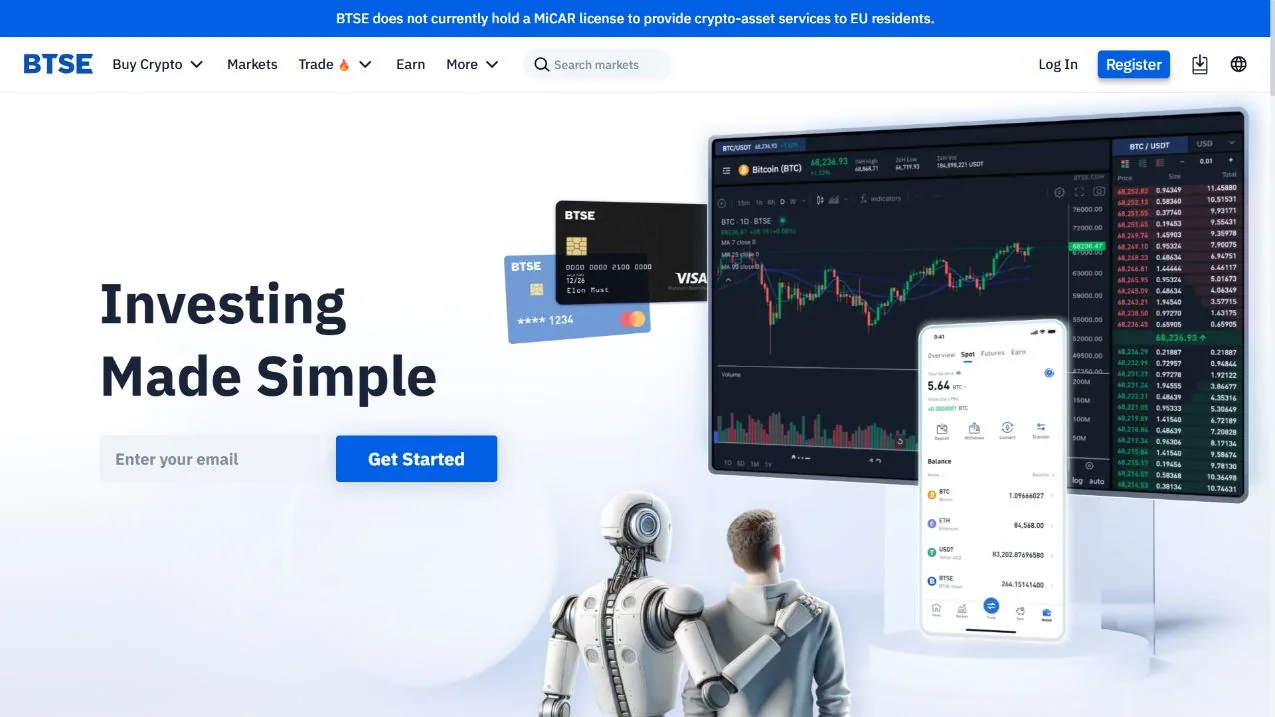
BTSE offers a broader funding comparison than a purely crypto-to-crypto exchange: its support pages itemise bank and card deposit charges, alongside spot and derivatives tiers. For an eligible user, that makes it possible to examine the route from cash to a trade rather than commission alone.
The first decision remains geographical. BTSE excludes US users, has ended UK service, and says it does not currently hold MiCA/CASP authorisation. Its explanation of limited EU access under reverse solicitation is a company position with conditions, not a blanket European service permission. This assessment checks the documentary record on 24 November 2026.
1. Who this comparison serves
| Reader or task | Assessment |
|---|---|
| Eligible international customer comparing funding routes | Published deposit charges provide useful starting inputs |
| US citizen, national or resident | Excluded under the reviewed global terms |
| UK customer | Company says services ended 21 February 2025 |
| EU customer seeking a MiCA-authorised provider | BTSE expressly says it has no current CASP authorisation |
| Active derivatives trader | Compare the correct futures tier, funding and notional exposure |
| User evaluating an audit claim | Distinguish a dated reserve engagement from a complete security or financial audit |
BTSE should be compared by account, product and completed route. Atlas has not opened or funded an account, placed trades or measured support and withdrawal performance.
2. History, founders and the dated fundraising record
BTSE’s March2021 fundraising announcement dates the business to 2018 and identifies Jonathan Leong as co-founder and then-CEO. It reports a $22 million funding round and $400 million valuation at that time.
These are historical company statements, not a current valuation, audited balance sheet or proof of the present controlling shareholder. The executive title should retain its date rather than being copied into 2026 as if leadership could not have changed.
The product evolved around spot, derivatives and trading infrastructure. A financing round can explain the company’s development, but investment by a family office does not guarantee customer balances or establish every regulator’s authorisation.
3. Seychelles application rejection and Costa Rica migration
The Seychelles FSA statement dated17September2025 says BTSE Holding Limited’s VASP application was rejected as of 24 July 2025 and the company was instructed to cease operations or migrate services out of the jurisdiction.
The same statement says BTSE Holding informed the authority of its acquisition by BTSE GLOBAL LIMITED SOCIEDAD DE RESPONSABILIDAD LIMITADA, incorporated in Costa Rica, and migration of existing users effective 2 July 2025.
| Date in the authority’s statement | Event described |
|---|---|
| 31 December 2024 | Application submission |
| 2 July 2025 | Company-reported effective user migration |
| 24 July 2025 | Application rejection |
| 17 September 2025 | Publication of authority’s statement |
Those dates are reproduced as stated; we do not invent an alternative sequence or infer a Costa Rican crypto licence from incorporation. Match the provider named in your current agreement with any claimed permission. A historical Seychelles address does not establish a current Seychelles VASP licence.
4. US and UK access
The global terms exclude citizens, nationals or residents of the US, Canada, Taiwan, Russia, the UK and other listed jurisdictions. The country-support notice gives further restricted and prohibited categories.
There is no separately verified BTSE.US personal product in this assessment, and Atlas does not create a permissive US state list from general registration publicity. The terms’ nationality wording can matter in addition to current residence.
The support page specifically says UK service was discontinued effective 21 February 2025. A current English website or a published FPS deposit fee does not reverse that restriction. Payment-method documentation and personal account availability are separate facts.
5. EU: no CASP authorisation, conditional company explanation
BTSE’s dedicated MiCAR FAQ states that it does not hold a current MiCAR/CASP authorisation and does not market or solicit crypto-asset services to EU residents. It says users independently approaching it may access certain services under the reverse-solicitation provisions of Article 61, with a written onboarding confirmation.
That is BTSE’s description of its access framework. This review does not independently determine that the exception applies to any reader or that a checkbox validates every product. It is not a substitute for a named authorised local provider and does not establish universal EU access.
Atlas leaves the EU profile unverified or conditional in its descriptive treatment, rather than calling BTSE MiCA-licensed. An EEA comparison should also distinguish EU member states from non-EU EEA states and confirm the particular country; one category should not silently supply another’s permission.
6. Spot fee tiers
The current spot-fee guide lists the following public rates:
| Tier | Published 30-day volume | Maker | Taker |
|---|---|---|---|
| General user | — | 0.2000% | 0.2000% |
| VIP 1 | $100,000 | 0.1500% | 0.1500% |
| VIP 2 | $250,000 | 0.1000% | 0.1000% |
| VIP 3 | $1,000,000 | 0.0800% | 0.0900% |
| VIP 5 | $10,000,000 | 0.0500% | 0.0700% |
| VIP 10 | $2,000,000,000 | 0% | 0.0250% |
The guide says fees are taken from the currency received: buying BTC with USDT reduces received BTC; selling BTC reduces received USDT. An advertised top-tier maker rate is not the baseline for a new small account.
Confirm the assigned tier and pair. Token-staking benefits and other programmes can provide alternative conditions; they should be evaluated with their own capital exposure and current rules rather than added to a discount mechanically.
7. Spot cost examples
At 0.2%, a 1,500 USDT fill costs 3 USDT in equivalent terms; a 15,000 USDT fill costs 30. AtVIP 3, a 15,000 USDT maker fill costs 12 and a taker fill 13.50.
| Illustrative 15,000 USDT unchanged-notional round trip | Commission |
|---|---|
| General user, maker then taker | 60 USDT |
| VIP 3, maker then taker | 25.50 USDT |
| VIP 3, taker on both legs | 27 USDT |
These isolate commission and assume the published tier applies. Real exit notional changes with price. Add deposit costs, spread, execution impact and withdrawal before comparing the final route.
The difference between a card charge and a bank charge can exceed the spot commission saving. That is why a funding-method comparison may be more useful for an occasional buyer than the exchange’s lowest possible VIP rate.
8. Futures: a separate schedule
The futures-fee guide publishes 0.0200% maker /0.0550% taker for a general user. Its highest tiers include maker rebates; these are not ordinary new-account rates.
| Futures tier | Maker | Taker |
|---|---|---|
| General user | 0.0200% | 0.0550% |
| VIP 1 | 0.0100% | 0.0500% |
| VIP 3 | 0.0050% | 0.0450% |
| VIP 9 | −0.0025% | 0.0250% |
| VIP 10 | −0.0050% | 0.0200% |
The guide separates trading fees from funding and calculates them on notional, deducting charges from margin. A 40,000 USDT maker entry and equal-notional taker exit at the general tier cost 8+22=30 USDT before funding and execution.
A rebate is not a profit guarantee. The order must qualify as maker and fill, while adverse selection, price movement and market exposure can exceed the rebate.
9. Fiat deposit charges
BTSE’s deposit-fee support page provides a useful method-level table:
| Method | Published exchange-side deposit charge |
|---|---|
| SEPA | Free |
| SIC | Free |
| FPS | 0.1% |
| SWIFT | From USD 10 or equivalent |
| Debit/credit card, Google Pay, Apple Pay | 3.3% |
These are fee disclosures, not evidence that every customer can use every rail. The final deposit page controls the account quote, and the sending bank can charge separately. “From” is a floor or starting quote, not a universal flat cost.
For illustration,3.3% on 1,000 units is 33, while 0.1% is 1. Those are charges on the specified payment notional; whether a charge is added on top or deducted from credited funds changes the amount available to trade. Retain the actual confirmation rather than assuming both workflows credit the same amount.
10. Fiat withdrawal and timing
The withdrawal-fee page does not provide one universal numeric tariff. It directs users to the selected currency and method’s current quote and notes that the receiving bank may charge.
Published timing guidance describes SEPA and FPS as 1–3 business days and SWIFT as 1–5, with out-of-hours, weekend and holiday requests potentially processed on the next business day. These are support estimates, not an Atlas-tested completion promise.
| Complete-route input | Treatment |
|---|---|
| Published deposit-method charge | Starting input, subject to account availability |
| Cash-out charge | Obtain current method/currency quote |
| Intermediary or receiving-bank fee | Separate from exchange commission |
| Currency conversion | Record both rate and net credited amount |
| Eligibility | Must be resolved before a usable cost total |
A model with a known free deposit but an unknown cash-out charge is still incomplete. Atlas does not fill the missing leg with zero.
11. KYC: the grace period has expired
The 16October2025 announcement requires new customers to complete KYC for crypto depositing and trading. It gave existing users until 30 June 2026 to comply; after that, unverified users were described as withdrawal-only.
The verification guide distinguishes the current levels:
| Feature | Level 1 /Primary | Level 2 /Advanced |
|---|---|---|
| Government-issued ID | Required | Required |
| Proof of address | Not listed at this level | Required |
| Crypto deposits and trading | Available subject to eligibility | Available subject to eligibility |
| Published crypto withdrawal ceiling | Up to 1,000,000 USDT | Up to 3,000,000 USDT |
| Cards and bank transfers | Not available | Available subject to eligibility |
The old grace period is history, not an extension into November 2026. These are published service levels and ceilings, not unconditional daily settlement guarantees or permission in an excluded jurisdiction.
12. Identity documents, privacy and ongoing review
The guide describes supported original ID and facial verification, with proof of residence for advanced service. Account information and the document must match. Further information can be required when an account or transfer needs review.
Keep identity uploads within official account workflows. Separate authenticator recovery information from the phone, and maintain external copies of payment references and transaction records. KYC approval should not be confused with an independent check that the platform is solvent or authorised for every offered product.
This review has not submitted documents, verified approval time or tested how an individual account appeal is handled.
13. Crypto exits and the withdrawal whitelist
BTSE’s whitelist guide describes limiting withdrawals to approved addresses and requiring2FA before the feature can be enabled. New addresses added after activation have a 24-hour wait before whitelisting and use.
That can be a useful account control, but it also affects an urgent legitimate transfer. Prepare the intended address and confirm its asset/network before relying on an immediate exit. An address book entry is not proof that the receiving platform supports the coin on that chain.
Current crypto network charges and minimums were not verified as one universal tariff here. Obtain the quote and net receipt for the actual coin, chain and account. A transfer within an exchange system also does not provide the same custody outcome as an external wallet withdrawal.
14. What Hacken actually reviewed
The security provider’s BTSE engagement page identifies a one-time proof-of-reserves engagement, Mar 2026, dated 9 April 2026. BTSE’s 19November explanation describes the reserve scope and says it did not examine platform security, personal-data protection or internal controls.
| Evidence | What it supports | What it does not establish |
|---|---|---|
| Provider-hosted dated engagement | A specified reserve-review engagement | A live continuous solvency certificate |
| Company explanation of assets/liabilities | Claimed in-scope backing conclusion | Every off-chain corporate obligation |
| Explicit exclusions | Boundaries of the engagement | Web, app and custody security retested |
| One-time scope | Point-in-time evidence | Future withdrawal availability |
The full underlying PDF was not obtained in this review; the visible report control resolved to an icon in the text tool. We therefore identify the engagement and attribute the described conclusion to the available company explanation, rather than claiming an independent recalculation or an audited current reserve percentage.
15. Custody and the meaning of a balance
A trading balance is a claim within the provider’s custody and contractual framework. A reserve engagement, a company incorporation and an account-security control each address a different part of that relationship.
For a long-term holder, the relevant comparison may be how much needs to stay on the exchange at all. For an active trader, it is how much collateral and settlement balance the strategy needs. Those decisions cannot be answered simply by pointing to a large reserve ratio or by assuming self-custody removes all operational risk.
Read the particular earn, lending or collateral terms before treating every balance as ordinary spot custody. Lock-ups, rehypothecation rights or liquidation exposure, where present in a product’s terms, require their own assessment.
16. Hacks, legal cases and founder controversies
The strongest verified regulatory event collected here is the Seychelles application rejection and reported migration. It is an administrative record concerning the named company, not a founder conviction or proof of customer theft.
The primary material gathered did not establish a major completed BTSE wallet theft or a founder criminal conviction. That limited finding should not be rewritten as an incident-free guarantee. Customer complaints and allegations require their own records, company response and any relevant decision.
The dated fundraising statement also should not be used to infer current ownership or recourse. If a new case identifies another BTSE-branded entity, match that legal person and product before importing its outcome into the global exchange review.
17. Alternatives and FAQ
US readers can compare state-scoped products in Kraken, Coinbase and Binance.US. EU readers seeking an identified authorised local account can examine Bitvavo or Bitstamp, with country and product conditions. International derivatives comparisons can include Phemex and Bitunix on the same notional and exit assumptions.
Is BTSE MiCA-licensed? Its dedicated FAQ says no current CASP authorisation. Its conditional reverse-solicitation explanation is not a blanket EU licence.
Can Americans use the reviewed service? The global terms exclude US citizens, nationals and residents. No separate US product was established.
What are base fees? Published spot 0.2%/0.2%; futures 0.02%/0.055%, before any applicable tier or programme.
Are bank deposits free? SEPA and SIC are listed as free at the exchange side, while other methods have charges. Eligibility and external-bank costs remain separate.
Can old customers still postpone KYC? The announced grace period ended 30 June 2026. The notice describes unverified existing accounts as withdrawal-only after that date.
Does the Hacken engagement audit the entire platform? No. The reviewed engagement is a dated proof-of-reserves exercise with an explicitly narrower scope.
Prepared from the dated sources listed below. This is a documentary review; no account opening, trade, support-response or withdrawal test is claimed.
Sources and check dates
- BTSE’s Series A Fundraising Round Achieves a $400M Valuation — BTSE Blog ·
- PUBLIC STATEMENT – BTSE Holding Limited T/A BTSE ·
- Terms and Conditions for Crypto Exchange Users ·
- BTSE Restricted Jurisdictions | Prohibited Users : BTSE Support ·
- Is BTSE licensed under MiCAR? : BTSE Support ·
- Spot Trading Fees : BTSE Support ·
- Futures Trading Fees : BTSE Support ·
- Fiat Deposit Fees Explained (Costs & Charges) : BTSE Support ·
- Fiat Withdrawal Fees Explained : BTSE Support ·
- How Long Do Fiat Withdrawals Take? : BTSE Support ·
- New KYC Steps Required for BTSE Users ·
- BTSE KYC Verification Guide | How to Complete Identity Verification : BTSE Support ·
- Withdrawal Whitelist: What It Is and How to Use It : BTSE Support ·
- Btse audit by Hacken ·
- BTSE’s Independent Audits: What Hacken Verified and What It Means for You ·
Operator, regulatory and court records support the relevant findings; third-party market data is identified in the text. Effective dates and unresolved checks remain beside the claim.