
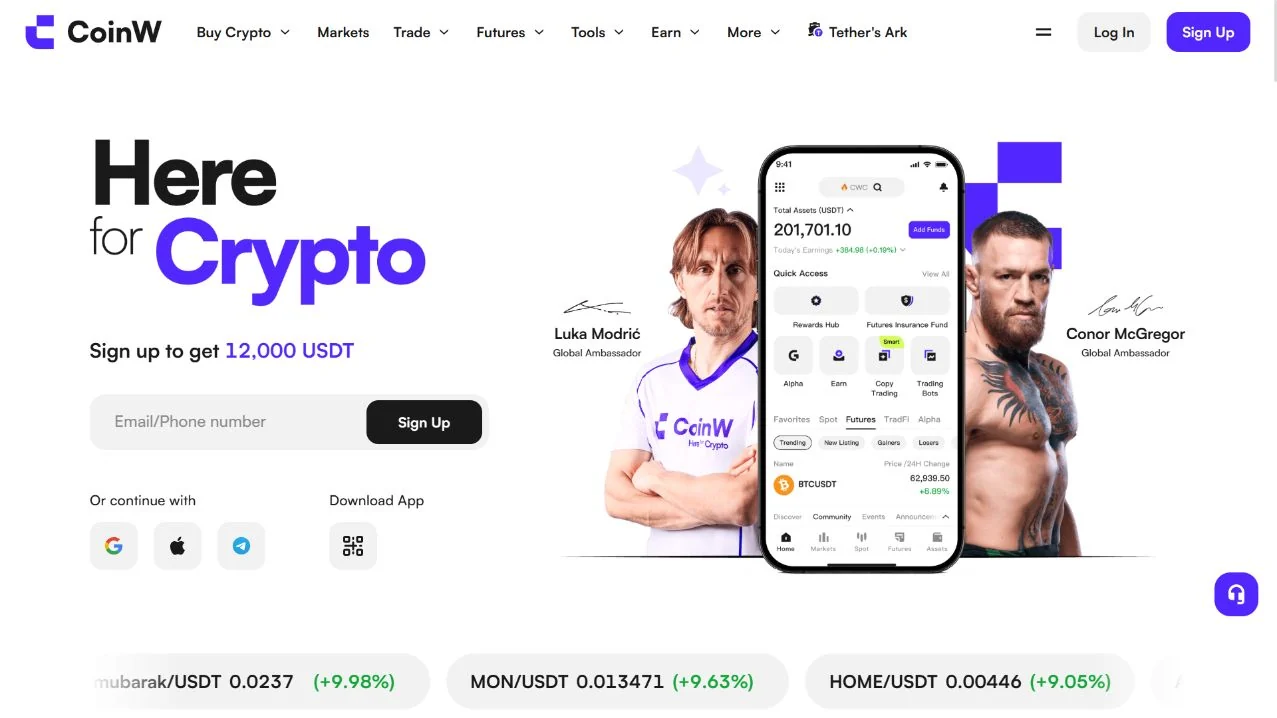
CoinW’s global product range should not distract US readers from a decisive account change: the exchange announced the termination of US-connected accounts in May 2026, with normal login ending after its June deadline. A current review must explain that exit process rather than present an old registration tutorial as an available US service.
For eligible international users, the more useful questions are the applicable spot VIP tier, derivatives costs, custody disclosures and the history behind security headlines. This report checks primary sources on 24 November 2026, including the company’s response to suspicious transactions in 2023 and a separate Taiwan prosecutor record.
1. Editorial verdict and intended reader
| Requirement | Assessment |
|---|---|
| New US personal account | Reviewed global service unavailable |
| Residual balance in a terminated US-connected account | Follow the dedicated official exit process, not a new deposit workflow |
| Eligible international spot trader | Compare 0.1% base commission and applicable spot VIP tier |
| EU reader seeking an authorised local entity | Named MiCA product and member-state scope not verified here |
| Copy-trading or bot user | Add strategy-specific rules and leveraged exposure |
| Reader checking a “CoinW hack” headline | Separate suspicious transactions, company response and confirmed loss evidence |
CoinW is a relevant trading comparison, but its brand, country access, legal counterparty and each product need to be assessed separately. This documentary report does not claim account-opening, trade, support-response or withdrawal testing.
2. Background and founder identification
CoinW’s eighth-anniversary announcement dated 29 October 2025 supports the company’s 2017 origin narrative and refers to its founder as Gary. It also publishes large user and turnover figures; those remain company claims rather than an Atlas measurement of active funded users or executable volume.
Some third-party databases identify a different fuller founder name. This research did not establish the documentary link between those names, current shareholding or a complete controlling-ownership chain. We therefore use the identity stated by the company with that attribution, rather than silently treating every online founder biography as verified.
An executive interview or anniversary letter can help understand the business. It does not replace the legal entity in an account agreement or make the founder personally responsible for every customer claim.
3. Which company is the counterparty?
The Legal Statement identifies COINW, a private company incorporated in the Union of Comoros, with an address in Anjouan. Its displayed update date is 1 June 2026, even though an older date appears in the URL path.
Use the document’s displayed version and actual account agreement when identifying the provider. A URL containing 2025 is not proof that its body is unchanged since 2025.
This company identification does not, by itself, establish a permission for US money transmission, EU crypto-asset services or every derivatives product. The country restrictions and any claimed authorisation need to match the same named entity and service.
4. US termination: the dates and residual-asset route
The 8 May 2026 notice says the United States is a restricted jurisdiction and that CoinW would terminate accounts identified as US-connected. It required recent acceptable non-US address evidence where a user disputed that classification.
The notice says that after 00:00:00 on 30 June 2026, affected users would no longer be able to log in normally. It describes a residual-asset process: contact official support with the account, receive approval for a four-hour unfreezing window, and complete withdrawal before the account is frozen again.
| Situation | Relevant action in the notice |
|---|---|
| Classified as US-connected | Address evidence or account termination process |
| Deadline already passed | Dedicated support-led residual-asset procedure |
| Temporary unfreeze approved | Complete the exit within the notified window |
| New US registration | No supported route established by this notice |
These are published instructions, not a guarantee that Atlas has verified an individual request or approval time. Confirm the official support channel and never pay an unsolicited “unlock fee” to an impersonator.
5. Other country restrictions and the EU question
The Legal Statement also excludes the UK, Canada, Japan, mainland China, Hong Kong, Singapore, the UAE and numerous other jurisdictions. A shortened marketing list should not be used to erase those exclusions.
The reviewed material did not establish a named MiCA-authorised CoinW product and exact member-state service scope for EU/EEA residents. A European country absent from the global exclusion list remains unverified in this review.
| Check | Why it is separate |
|---|---|
| Account residence eligibility | Determines whether the personal account can be maintained |
| Legal entity and permission | Identifies the authorised provider and activities |
| Spot versus perpetual futures | Different product and regulatory scopes |
| Fiat provider | Its banking and payment permissions may differ |
| Promotional eligibility | A campaign can be narrower than account access |
No separate CoinW.US account or blanket EU version is established here. Atlas does not import global pricing into a hypothetical regional product.
6. Spot fees and the usable VIP comparison
The current public Fees page lists 0.1% maker and 0.1% taker as the spot baseline. The new spot-fee-system announcement, published August 2025 and subsequently updated, gives a more detailed tier structure.
| Spot tier | 30-day average assets | 30-day spot volume | Maker | Taker |
|---|---|---|---|---|
| Regular | 0 | 0 | 0.100% | 0.100% |
| VIP1 | $10,000 | $100,000 | 0.090% | 0.095% |
| VIP3 | $50,000 | $850,000 | 0.070% | 0.075% |
| VIP5 | $300,000 | $3,500,000 | 0.050% | 0.060% |
| VIP7 | $1,200,000 | $15,000,000 | 0.030% | 0.050% |
The announcement says the higher qualifying criterion determines the tier and that tiers update daily. The table is the published programme, not a verified personal account assignment. Confirm the live rate, relevant balance calculation and pair before trading.
7. What the discount saves—and what it does not
At the 0.1% baseline, a 2,000 USDT fill costs 2 USDT. A 20,000 USDT fill costs 20. At VIP3, an unchanged 20,000 USDT maker fill costs 14 and a taker fill costs 15.
| Illustrative 20,000 USDT route | Commission only |
|---|---|
| Regular maker entry + taker exit | 40 USDT |
| VIP3 maker entry + taker exit | 29 USDT |
| VIP3 two taker fills | 30 USDT |
These examples hold the notional unchanged to isolate commission. They omit price movement, spread, slippage, funding the account and withdrawal. A tier saving of 11 USDT is not necessarily useful if achieving it requires leaving substantially more assets in custody than the user otherwise needs.
Measure the tier’s value against expected legitimate trading activity and custody exposure. Unnecessary volume can introduce market and execution costs while chasing a small future discount.
8. Zero-fee campaigns are scoped and dated
The January 2026 WET/USDT campaign applied zero maker/taker fees to a designated pair during 5–12 January 2026, with explicit exclusions including grid trading for that pair. It was not a general permanent zero-fee tariff.
For any campaign, check the pair, start and end time, order channel, account type and whether rewards are fee coupons or withdrawable assets. A title saying “2025 edition” can coexist with a 2026 event body; read the actual stated period rather than relying on the heading.
The important comparison is the rate applicable to the intended trade today. Old reward notices are useful history, not a current quotation.
9. Futures, funding and strategy accounts
The public fee hub lists 0.02% maker and 0.06% taker for futures. Its notice says futures VIP upgrades are currently unsupported; the spot VIP table should not automatically be applied to derivatives.
At an unchanged 25,000 USDT notional, maker entry costs 5 USDT and taker exit 15: 20 USDT combined before funding and execution. Two taker fills cost 30. Fees follow notional exposure, not merely the initial margin.
Copy trading, bots and strategy accounts add implementation choices: margin moved into a strategy, supported order size, stop conditions, profit-sharing or other product-specific charges where applicable. Read those terms rather than assuming “copy” or “automated” means lower risk. Funding, liquidation and adverse price moves can dominate a small commission difference.
10. KYC: read the service and the document date
The August 2025 operation guide describes Basic then Advanced verification, identification images and a liveness check. Its table lists 10 BTC and 100 BTC withdrawal limits for the respective levels.
A separate individual-KYC FAQ updated May 2026 says certain services require at least C2 verification. The older operation guide also contains wording that verification is not required simply to trade. Those are different service scopes and document versions, not an unconditional no-KYC withdrawal promise.
| Question | What to confirm |
|---|---|
| Can the account trade? | Current jurisdiction and product permissions |
| Can it withdraw? | Current level, limit and any transaction review |
| Is more information needed? | Account-specific request and reason |
| Does advanced KYC override a country exclusion? | No |
Limits are ceilings, not guarantees of immediate processing. Additional checks can apply where security or compliance concerns arise.
11. Funding and withdrawing crypto
The withdrawal guide distinguishes blockchain withdrawal from an internal transfer to another CoinW account. It tells users to move the asset into the Funding account where required, choose the coin and mainnet, enter the destination and complete the displayed checks.
An internal transfer keeps the recipient within the exchange’s custody environment. An external withdrawal adds chain, address, minimum and network-fee requirements. The receiving service may impose its own crediting and compliance checks.
| Withdrawal detail | Required comparison |
|---|---|
| Coin and network | Both sides must support the same route |
| Fee denomination | Coin units versus quote-currency estimate |
| Amount debited | Include the charge if added on top |
| Net received | Relevant amount for the next trade or wallet |
| Wallet availability | A listed asset can have a temporarily closed network |
This research did not establish a current universal BTC, ETH or USDT withdrawal price. Atlas leaves an unverified charge unresolved rather than labelling it free.
12. Fiat on-ramps and complete-route pricing
A direct card purchase, third-party conversion and P2P payment can produce different costs and counterparty relationships. Obtain the provider name, gross payment, net coin, conversion spread, service charge and account eligibility.
This review did not verify a complete own-name USD ACH or EUR SEPA round trip and current total tariff. A purchase button does not establish cash-out in the reverse direction, and a payment partner’s availability does not override CoinW’s country restrictions.
For a crypto-funded user, include the withdrawal cost at the originating platform. For a bank-funded user, compare the entire bank-to-coin-to-bank outcome. These are different routes and should not share a fabricated total.
13. October 2023 suspicious transactions: alert and response
CoinW’s 2 October 2023 statement acknowledges that security company Cyvers had flagged suspicious transactions. CoinW responded by saying it had not experienced a security breach causing massive customer losses and describing periodic cold-wallet address changes. It disclosed new Bitcoin and Ethereum cold-wallet addresses and said it submitted them to market-data platforms.
Third-party coverage often labels the event a roughly $13 million hack. The captured company response does not independently settle that loss claim or supply a forensic reconciliation. This review therefore distinguishes the suspicious-transaction alert from a confirmed final theft amount and attributes the company’s explanation.
| Evidence | What remains unresolved here |
|---|---|
| Company acknowledges external alert | Whether all flagged transactions were unauthorised |
| New wallet addresses disclosed | Full source and destination ownership reconciliation |
| Company says no massive user-asset loss | Independent quantified loss and compensation outcome |
The statement’s later update date should not move the underlying event into 2025. It remains a 2023 incident and response. The limited record does not justify either a definitive no-hack certificate or an unattributed confirmed-loss headline.
14. Taiwan prosecutor record
A Shilin District Prosecutors Office release from August 2025 describes eight people involved in CoinW’s Taiwan operations, including regional management, marketing, business development and technical roles. The indexed official text alleges virtual-asset services were provided without the required local AML registration or compliance status.
The release also discusses separate franchise-store activity. This review does not merge every allegation involving those stores into the global exchange’s own revenue or customer-loss figure. The available excerpt is a prosecutor’s account, not a final criminal judgment; a current final court outcome was not verified here.
Full PDF retrieval was unsuccessful, so the article’s treatment is limited to the inspected indexed primary passage. It does not invent a sentence, conviction, complete charge-by-charge outcome or founder identity from the partial names used by the prosecutor.
15. South Korea and the CoinW6 identity trap
The South Korean FSC’s October 2026 material includes CoinW among unregistered operators subject to domestic website blocking. That is a country-specific regulatory record, not proof of a worldwide shutdown.
A different US case involves CoinW6. The SEC’s 17 September 2024 release describes a fake investment platform using CoinW6.com and other named domains. The cited release does not name coinw.com among those defendant domains.
Do not substitute a similar name for corporate identification. This review does not establish that the CoinW6 defendant and the reviewed CoinW exchange are the same entity. The SEC allegations cannot simply be assigned to CoinW’s founder or current operator.
16. Reserves and the narrow meaning of the ratio
The 25October 2026 reserve update reports a company total reserve ratio of 111.79%. The PoR page describes its total ratio in terms of platform USDT reserves divided by user USDT balances, alongside Merkle inclusion verification.
Read the denomination and scope. A figure labelled “total” should not automatically be described as an independently audited backing percentage for every coin, corporate liability and product. The public capture did not populate the latest snapshot time and numeric fields consistently.
This review has not independently reconciled liabilities, tested wallet ownership or verified an accountant’s opinion over the entire business. A reserve snapshot and regulatory authorisation also answer different questions. Neither guarantees future liquidity or uninterrupted withdrawals.
17. Apps, impersonation and practical security
The February 2026 impersonation warning describes fraudulent websites and apps copying CoinW’s branding, including social-media approaches that move to Telegram and pressure victims to transfer crypto. The company says representatives do not try to persuade customers to deposit more money or make particular trades.
Use official app links and verified support details, enable suitable authentication and keep recovery information outside the device. Treat a conversation initiated on LinkedIn, Telegram or another social channel as separate from the official account interface until verified.
This warning is evidence of impersonation risk, not proof that every complaint concerns a fake site. A genuine account dispute still needs its own records and response. Atlas did not test the app, response times or recovery process.
18. Alternatives and FAQ
US readers should compare the separate state-scoped products in Coinbase, Kraken and Binance.US. EEA readers can examine a documented local product such as Bitvavo or Bitstamp. Eligible international traders can compare Bitunix or Phemex using the same product and exit assumptions.
Is CoinW open to US residents? The reviewed global service excludes the US and announced the termination process in 2026. No separate US version was verified.
What happens to a residual US balance? The May notice describes official support approval and a four-hour withdrawal window. Confirm the current account instructions directly.
What are baseline fees? The public hub lists spot 0.1% / 0.1% and futures 0.02% / 0.06%. Spot VIP and pair promotions have their own conditions.
Was the 2023 event definitively a $13 million theft? The company acknowledged suspicious-transaction reporting and gave its response. A final independent loss reconciliation was not established here.
Was the Taiwan case a founder conviction? The primary excerpt describes allegations about local operational roles. A final conviction and founder attribution were not verified.
Is CoinW6 the same platform? The cited SEC release concerns different named domains. This review establishes no corporate identity between them and coinw.com.
Prepared from the dated sources listed below. This is a documentary review; no account opening, trade, support-response or withdrawal test is claimed.
Sources and check dates
- | Central de Ajuda e Suporte | CoinW ·
- Legal Statement | Справочный центр | CoinW ·
- Announcement Center ·
- Fees ·
- | Centrum pomocy i wsparcie | CoinW ·
- | Help Center & Support | CoinW ·
- FAQ ·
- | Central de Ajuda e Suporte | CoinW ·
- How to Withdraw Cryptocurrency | Help Center | CoinW ·
- | مركز المساعدة والدعم | CoinW ·
- ○銘等 8 人,基於未通過洗錢防制登記而提供虛擬資產服務之犯意 ·
- 카드뉴스 - 홍보자료 - 알림마당 - 금융위원회 ·
- SEC.gov | CoinW6 ·
- Announcement Center ·
- Proof of Reserves ·
- FAQ ·
Operator, regulatory and court records support the relevant findings; third-party market data is identified in the text. Effective dates and unresolved checks remain beside the claim.